 IndustryInsights

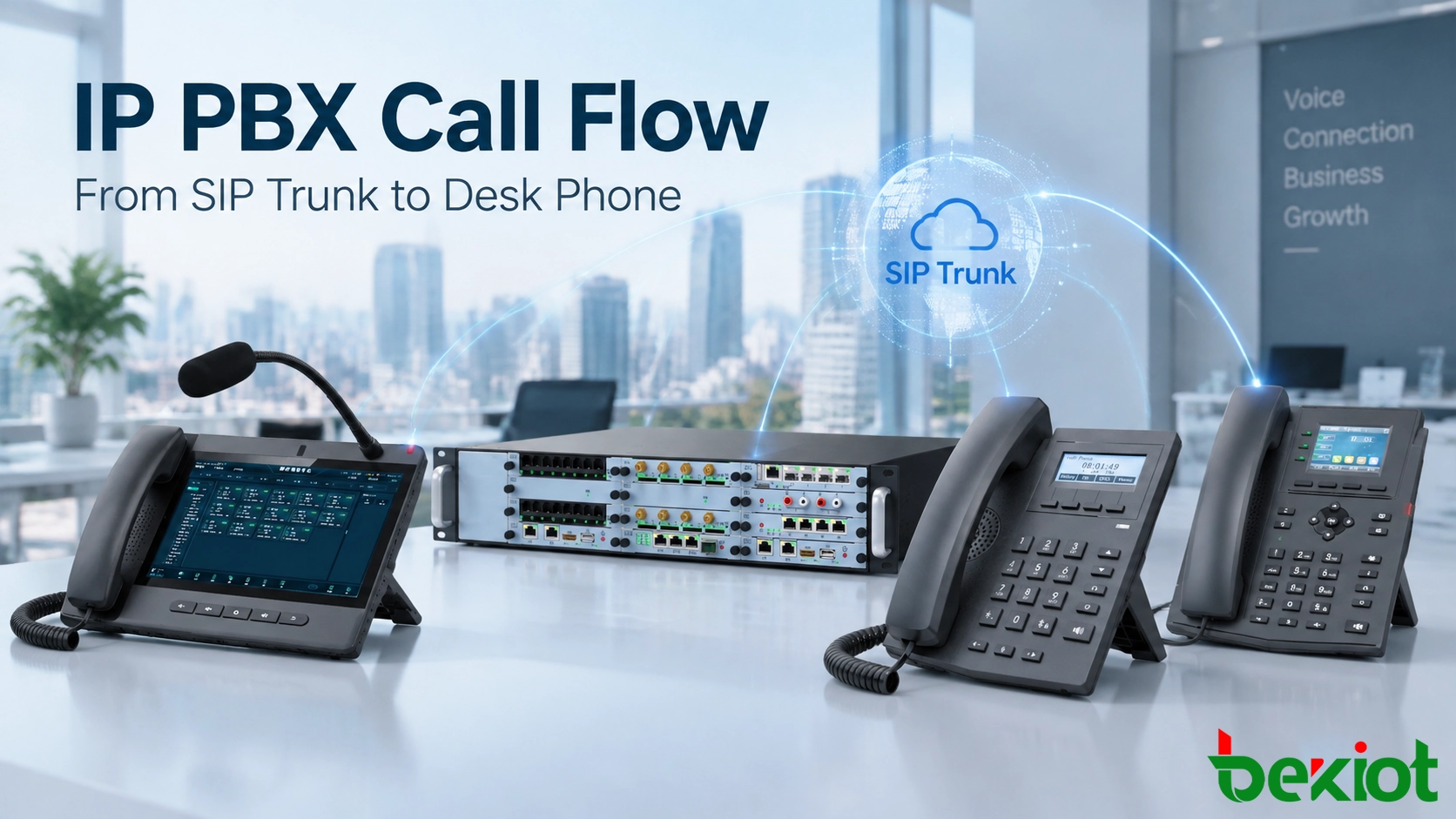
An IP PBX is the central control system in an enterprise VoIP environment. It manages user extensions, external telephone connections, call routing rules and voice communication sessions through IP networks.
Unlike traditional telephone systems that rely on dedicated circuit switching, an IP PBX uses SIP-based communication to establish calls between external networks and internal endpoints.
Understanding the complete call flow from SIP Trunk to desk phone helps administrators and engineers understand how a VoIP call is created, routed and maintained.
A typical enterprise call path includes:
SIP Trunk → IP PBX → Extension → Desk Phone → RTP Media
Each component performs a specific function during the communication process. The SIP Trunk provides external connectivity, the IP PBX controls the call logic, and the desk phone provides the user interface for voice communication.
In a business VoIP system, the IP PBX works as the central communication controller. All incoming and outgoing calls are processed according to configured routing rules.
When a call arrives, the IP PBX does not simply forward the request. It analyzes the destination number, checks user settings and determines the correct communication path.
The basic call handling process includes:
Receiving SIP signaling from the carrier or endpoint;
Checking authentication and routing rules;
Locating the destination extension;
Establishing the SIP session;
Creating the RTP media connection.
SIP Trunk: Provides the connection between the enterprise IP PBX and the telephone service provider.
IP PBX Server: Controls call routing, extensions and communication sessions.
SIP Extension: Represents registered users and communication devices.
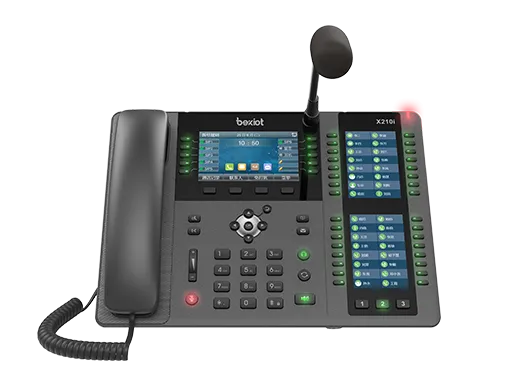
Desk Phone: Receives calls and provides voice communication for users.
RTP Stream: Transmits the actual voice packets after call establishment.
An incoming call starts when an external user dials a company telephone number provided through a SIP Trunk.
The call flow typically follows these steps:
The caller dials the company number.
The SIP provider receives the call request.
The provider sends SIP signaling to the enterprise IP PBX.
The IP PBX analyzes the incoming number.
The routing rules determine the destination.
The selected desk phone receives the call.
For example, when a customer calls a company's main number, the IP PBX may route the call to an IVR menu, a department group or a specific extension.
Routing rules determine how the IP PBX handles different types of calls.
Common routing methods include:
Direct extension routing;
Auto attendant (IVR);
Ring groups;
Call queues;
Time-based routing.
These rules allow businesses to control how calls are distributed without changing physical telephone wiring.
A typical enterprise incoming call may follow this path:
Company Number → SIP Trunk → IP PBX → IVR → Department Extension → Desk Phone
The IP PBX manages each step and ensures that the caller reaches the correct destination.

A VoIP call consists of two separate communication processes: SIP signaling and RTP media transmission.
SIP signaling is responsible for controlling the call session, including call setup, ringing, answering and termination. RTP is responsible for carrying the actual voice data after the call is established.
Separating signaling and media allows IP PBX systems to manage calls more efficiently and provides greater flexibility compared with traditional telephone systems.
A typical SIP call follows a standard message exchange process:
INVITE → 100 Trying → 180 Ringing → 200 OK → ACK → RTP Media → BYE
Each step has a specific purpose.
INVITE: The caller sends a request to establish a communication session.
100 Trying: The receiving system confirms that the request is being processed.
180 Ringing: The destination phone starts ringing.
200 OK: The called party accepts the call.
ACK: The caller confirms the session establishment.
RTP: Voice packets begin transmission.
BYE: Either side terminates the call session.
Understanding this signaling process helps engineers troubleshoot common VoIP issues, such as failed calls, registration problems and one-way audio.
After the SIP session is established, voice communication is carried through RTP streams.
The RTP path may be:
Desk Phone → Network → IP PBX → Network → Remote Endpoint
or, depending on system configuration:
Desk Phone → Remote Endpoint
In many IP PBX deployments, signaling is controlled by the IP PBX while media traffic may flow directly between endpoints.
Voice quality depends on several network factors:
Bandwidth availability;
Network latency;
Packet loss rate;
Codec configuration.
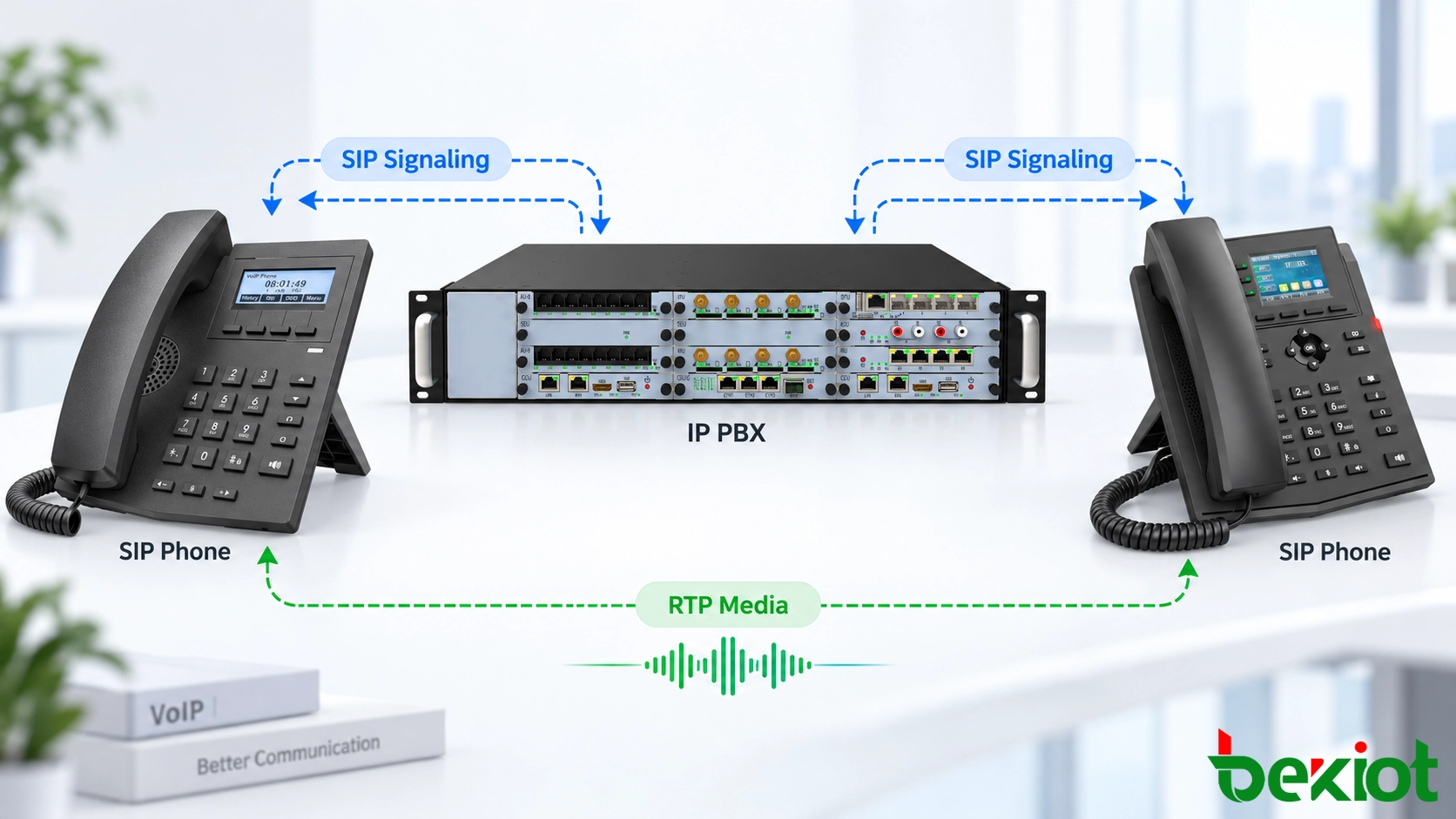
Before a desk phone can receive calls, it must register as a SIP extension on the IP PBX.
The registration process allows the IP PBX to identify the device and know where to deliver incoming calls.
A typical registration process includes:
The IP phone sends a REGISTER request to the IP PBX.
The IP PBX verifies user credentials.
The extension status is stored in the system.
The phone becomes available for communication.
After successful registration, the IP PBX associates the extension number with the device network information.
When a call arrives, the IP PBX can immediately identify the destination phone and send the SIP call request.
Internal extension calls are one of the most common IP PBX scenarios.
For example:
Extension 1001 calls Extension 1002
The process is:
Extension 1001 sends a SIP INVITE request.
The IP PBX checks the extension database.
The IP PBX locates Extension 1002.
Extension 1002 receives the call request.
Both phones establish RTP media.
Because internal calls stay within the enterprise network, they usually provide lower cost and faster connection compared with external calls.
Outgoing calls follow the opposite direction of incoming calls. The IP phone first sends the request to the IP PBX, which then determines how the call should leave the enterprise network.
The typical process is:
Desk Phone → IP PBX → SIP Trunk → Carrier Network → External Number
The IP PBX performs several actions before sending the call externally.
Checks user dialing permission;
Applies outbound routing rules;
Selects the correct SIP Trunk;
Sends the call request to the carrier.
Businesses can configure different outbound rules according to department or user requirements.
Examples include:
Different departments using different SIP Trunks;
International calls requiring special permission;
Emergency numbers using priority routes.
Flexible routing is one of the major advantages of IP PBX systems compared with traditional telephone systems.
Although an IP PBX is based on software and IP networks, successful deployment requires careful planning of network conditions, security policies and communication requirements.
A well-designed IP PBX system should not only handle current call requirements but also provide enough flexibility for future expansion.
Voice communication has higher requirements for network stability compared with ordinary data services.
During deployment, administrators should consider:
Available bandwidth;
Network latency;
Packet loss;
Jitter control;
Quality of Service (QoS) configuration.
Poor network conditions may cause problems such as delayed audio, interrupted calls or one-way voice communication.
For enterprise environments, separating voice traffic from regular data traffic can improve communication reliability.
SIP Trunk configuration determines how an IP PBX communicates with external telephone networks.
Common configuration parameters include:
SIP server address;
Authentication information;
Telephone number mapping;
Codec selection;
Call routing rules.
Correct SIP Trunk configuration ensures that incoming and outgoing calls can be processed correctly.
Because IP PBX systems communicate through IP networks, security should be considered during system deployment.
Common protection methods include:
Strong user authentication;
Firewall protection;
Access control policies;
Regular system updates.
Proper security configuration helps prevent unauthorized access and protects enterprise communication services.
One of the main advantages of IP PBX systems is scalability. Unlike traditional telephone systems that depend heavily on dedicated hardware capacity, IP-based communication platforms can expand through software configuration and network deployment.
Businesses can gradually add:
Additional SIP extensions;
New SIP Trunk providers;
More IP desk phones;
Remote users and softphones;
Additional communication applications.
A modern IP PBX platform can support multiple types of endpoints according to different business requirements.
Common endpoints include:
SIP desk phones;
Softphone applications;
Conference phones;
Analog phones through gateways;
Mobile SIP clients.
This flexibility allows organizations to build communication systems suitable for different working environments.
IP PBX systems can also integrate with other business applications to improve communication efficiency.
Typical integrations include:
CRM systems;
Call recording platforms;
Customer service systems;
Unified communication applications.
Through integration, telephone communication becomes part of broader business processes rather than an independent service.
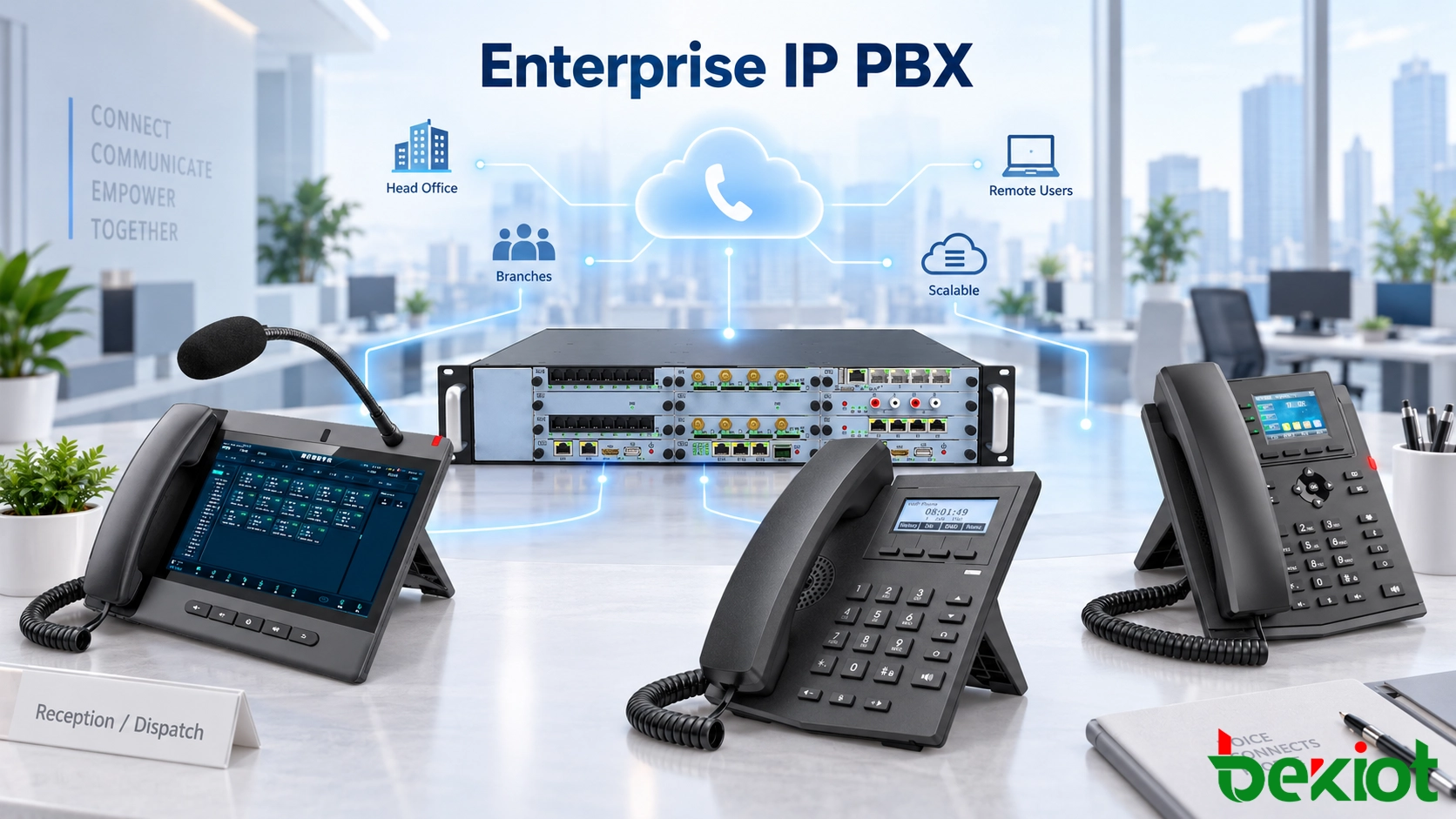
The complete IP PBX call flow from SIP Trunk to desk phone involves multiple stages, including SIP registration, call routing, signaling exchange and RTP media transmission.
The IP PBX works as the central communication controller, connecting external telephone services with internal extensions and managing how calls are delivered throughout the organization.
By understanding the relationship between SIP Trunk, IP PBX, SIP extensions and desk phones, businesses can better design VoIP systems, improve troubleshooting efficiency and build more reliable communication environments.
DSLIU provides IP PBX and VoIP communication solutions, supporting SIP Trunk connectivity, IP phone deployment, communication gateways and flexible enterprise telephone system configurations to help organizations build scalable and reliable IP communication platforms.
底部简介