 IndustryInsights

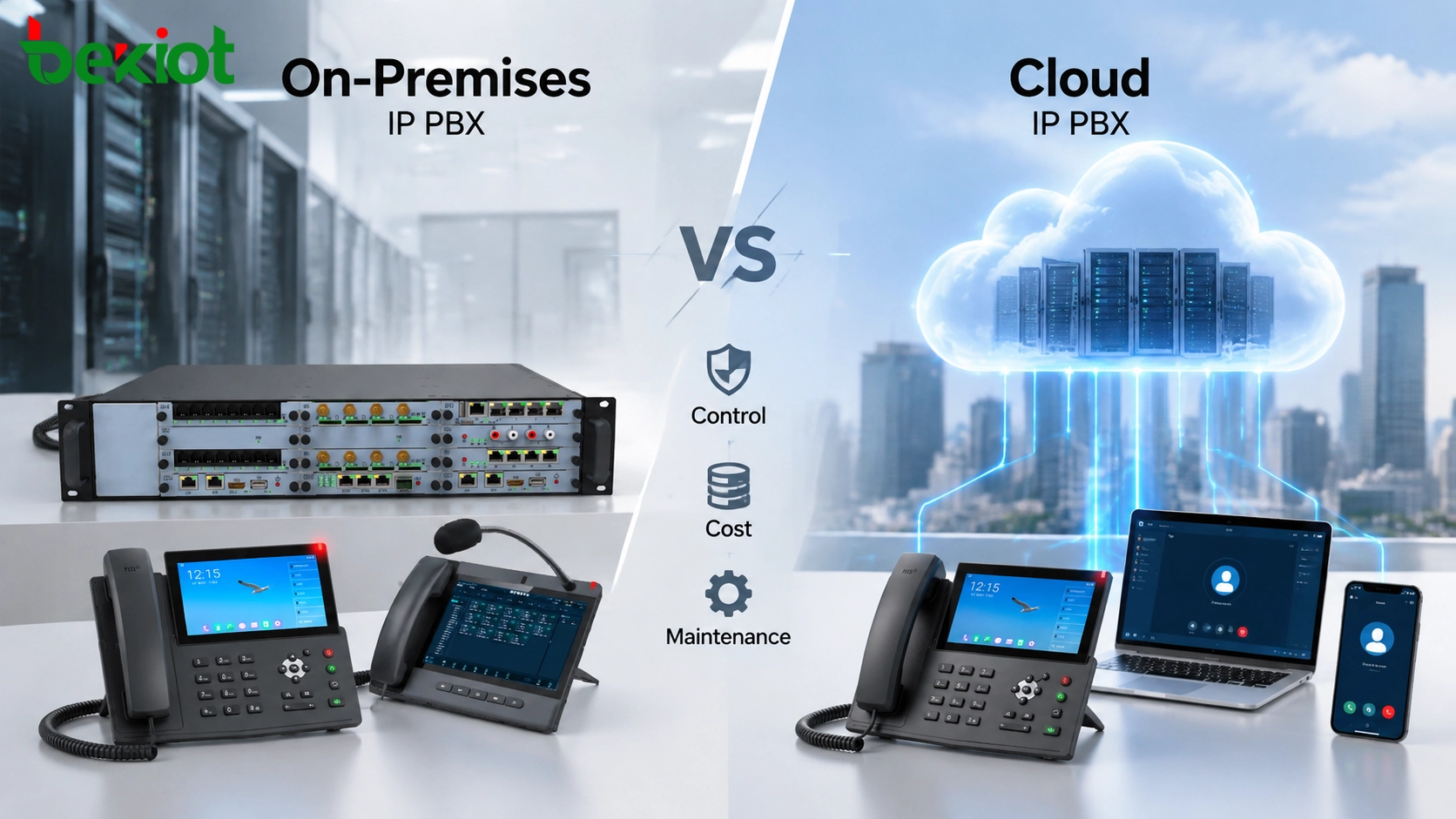
For modern enterprises and industrial organizations, selecting the right IP PBX deployment model is a strategic decision that affects communication reliability, operational efficiency and long-term cost structure.
On-Premises and Cloud IP PBX represent two different approaches to enterprise communication architecture. They differ in infrastructure ownership, system control, cost structure and maintenance responsibility.
The best deployment model depends on an organization's operational environment, technical resources, security requirements and future communication plans.
| Category | On-Premises IP PBX | Cloud IP PBX |
| Infrastructure | Company-owned and managed | Hosted by service provider |
| System Control | High customization and direct management | Service-based management |
| Initial Investment | Higher upfront cost | Lower initial investment |
| Maintenance | Managed internally | Managed by provider |
| Scalability | Requires infrastructure planning | Flexible service expansion |
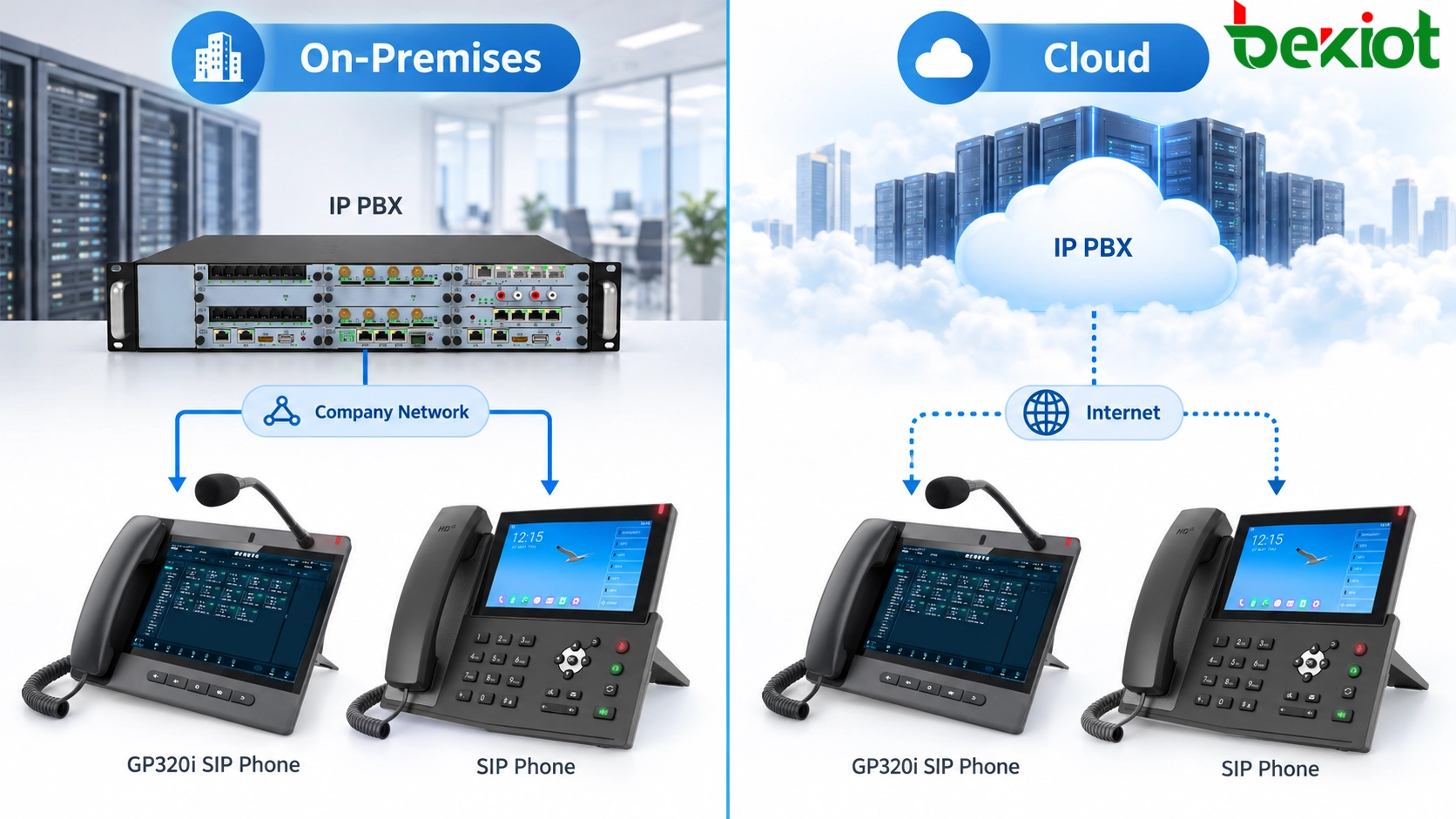
The most fundamental difference between On-Premises and Cloud IP PBX is who controls the communication infrastructure and system operation.
An On-Premises IP PBX is deployed within the organization's own server environment or private network. The organization manages the hardware, software configuration and communication policies.
This deployment model provides control over:
Call routing rules;
Extension management;
SIP Trunk configuration;
User permissions;
System integration.
For industries such as petrochemical, mining, transportation and energy, communication systems often need to support more than standard office calling. They may require integration with industrial communication devices, dispatch platforms, alarm systems or specialized field communication equipment.
An On-Premises architecture provides greater flexibility for organizations that need customized communication workflows and deeper integration with existing operational systems.
Cloud IP PBX moves the core communication infrastructure to the provider's data center. Users access communication services through IP phones, softphones or web-based management platforms.
Organizations usually manage:
Users;
Extensions;
Basic call settings;
Communication features.
The provider manages the underlying infrastructure, including server resources, platform availability and software maintenance.
This approach reduces internal IT workload and allows organizations to deploy communication services without building their own PBX infrastructure.
Customization capability is another important consideration.
On-Premises IP PBX generally allows deeper customization of:
Call flows;
Routing logic;
Third-party integrations;
Private network deployment.
Cloud IP PBX platforms usually provide standardized communication functions. Additional customization may require specific integrations or provider support depending on business requirements.
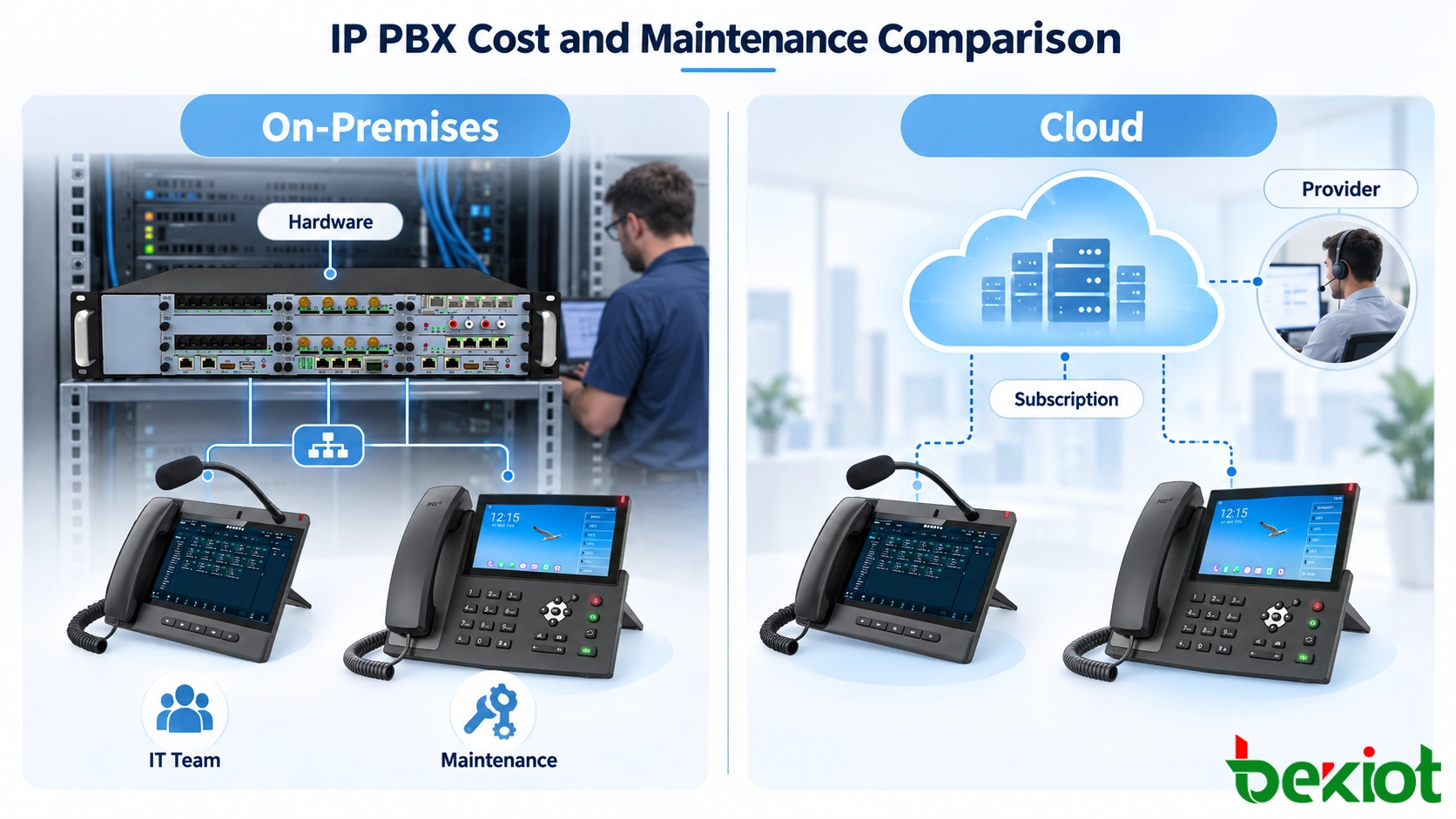
Cost is one of the most important factors when selecting an IP PBX deployment model. However, the difference between On-Premises and Cloud IP PBX is not only about initial investment, but also about the total cost of ownership (TCO) throughout the system lifecycle.
Organizations should evaluate hardware investment, software costs, maintenance requirements and future expansion costs before selecting a deployment model.
An On-Premises IP PBX requires a higher initial investment because the organization builds and owns the communication infrastructure.
Typical costs include:
Server hardware;
Software licenses;
IP phone terminals;
Network equipment;
System installation and configuration.
For organizations with a large and stable user base, On-Premises IP PBX can provide better long-term cost efficiency because there are no ongoing per-user subscription fees.
Large industrial facilities, multi-site enterprises and organizations with hundreds of extensions may benefit from the lower long-term operating cost of a self-managed communication platform.
Cloud IP PBX usually follows an operational expenditure (OpEx) model. Instead of purchasing and maintaining core PBX infrastructure, organizations pay for communication services based on usage.
Common cost factors include:
Monthly or annual user subscriptions;
Additional feature packages;
Cloud service plans;
SIP Trunk services.
This model reduces upfront investment and allows businesses to scale communication services according to actual requirements.
For small and medium-sized organizations, Cloud IP PBX can provide a faster deployment path without requiring dedicated PBX infrastructure.
A complete cost analysis should consider the entire lifecycle of the communication system.
On-Premises IP PBX costs may include:
Hardware replacement;
Software upgrades;
Internal IT resources;
Maintenance contracts.
Cloud IP PBX costs are usually related to:
Continuous subscription fees;
Additional users;
Service upgrades;
Connectivity requirements.
The most economical solution depends on the organization's size, expected service lifetime and communication requirements.
Maintenance responsibility directly affects system reliability, troubleshooting efficiency and operational management.
With an On-Premises IP PBX, organizations maintain direct responsibility for system operation and technical management.
Maintenance activities usually include:
System monitoring;
Hardware maintenance;
Software updates;
Backup and recovery;
Fault troubleshooting.
The advantage is that organizations can decide maintenance schedules, upgrade timing and troubleshooting procedures according to their operational requirements.
For industries where communication availability directly affects production or safety, local control can provide faster response when technical issues occur.
Cloud IP PBX transfers most infrastructure maintenance responsibilities to the service provider.
The provider typically manages:
Server infrastructure;
Platform availability;
Software updates;
Data center operation.
This reduces the workload of internal IT teams and allows organizations to focus on user management and daily communication operations.
However, cloud deployment also means that system availability depends on provider service quality, network connectivity and external maintenance processes.
Security and scalability are important factors when organizations select an IP PBX deployment model. A communication system must not only support current business requirements but also adapt to future growth.
On-Premises IP PBX provides organizations with direct control over communication infrastructure and data management.
Administrators can define:
Network access policies;
Firewall rules;
User authentication methods;
Data storage strategies.
This approach is often preferred by organizations that require greater control over communication data, internal networks or specific compliance requirements.
Cloud IP PBX providers typically manage security at the platform and infrastructure level.
Common security measures include:
User authentication;
Encrypted communication;
Infrastructure protection;
Continuous platform monitoring.
For organizations without dedicated security teams, provider-managed security can reduce the complexity of maintaining communication infrastructure.
Scalability determines how easily a communication system can support new users, locations and business requirements.
On-Premises IP PBX can expand through:
Additional server resources;
New IP phones;
Additional SIP Trunks;
Software and system upgrades.
However, expansion usually requires advance planning for hardware capacity, network resources and system configuration.
Cloud IP PBX expands mainly through service configuration:
Adding new users;
Creating additional extensions;
Supporting remote employees;
Activating new communication features.
This flexibility makes Cloud IP PBX suitable for organizations with changing user numbers or distributed teams.
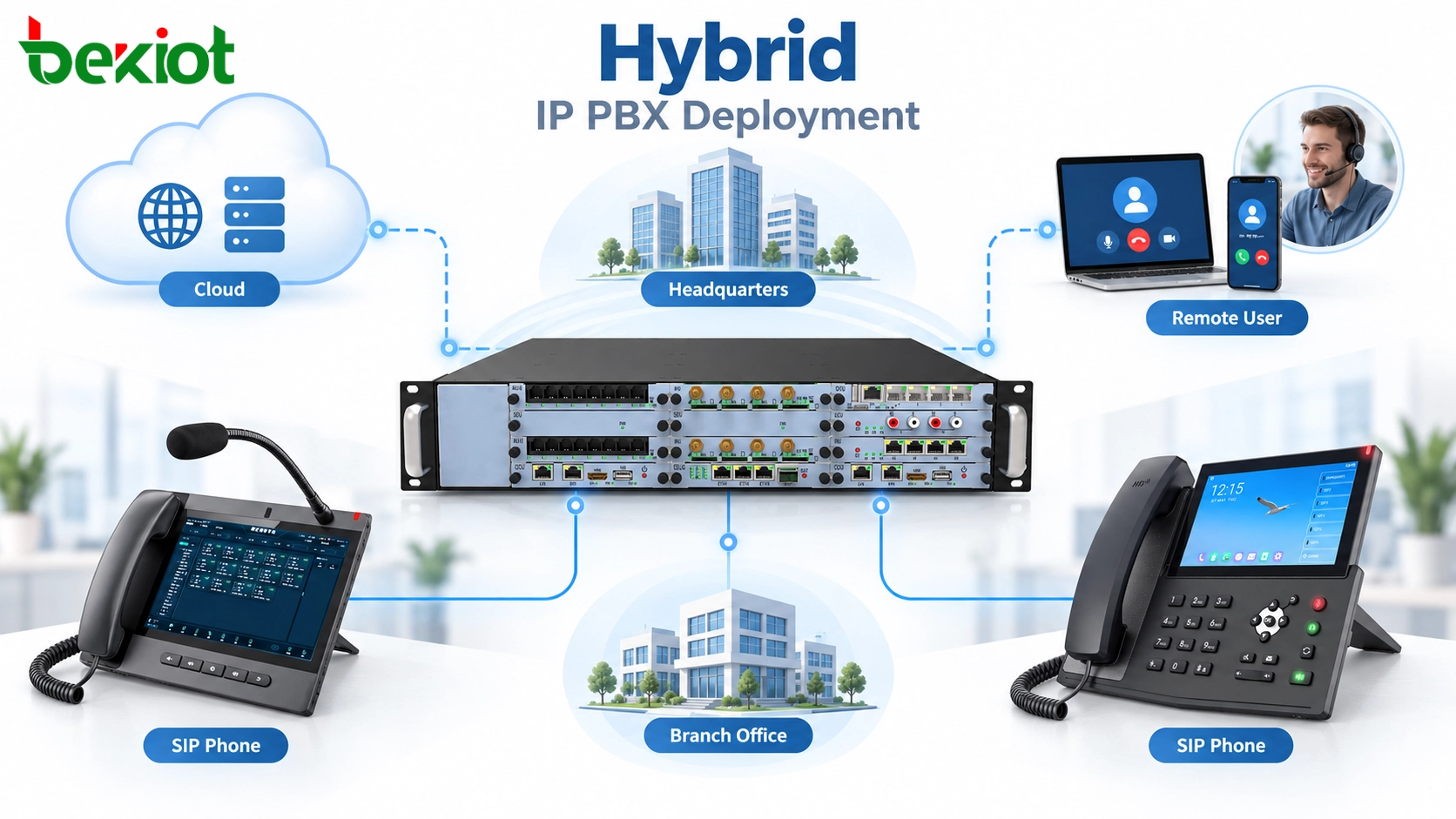
Many organizations do not choose a fully On-Premises or fully Cloud approach. Instead, a Hybrid IP PBX deployment combines local infrastructure with cloud-based services.
Hybrid deployment allows businesses to maintain control over critical communication resources while using cloud capabilities for flexibility and expansion.
A hybrid model is often suitable when organizations need:
Local control over important communication systems;
Cloud access for remote users;
Connectivity between multiple locations;
Gradual migration from traditional systems.
For example, an enterprise may keep its main IP PBX infrastructure at headquarters while allowing branch offices and remote users to access communication services through cloud-based features.
For industrial organizations, hybrid deployment can provide a balance between reliability and flexibility.
Mission-critical communication systems can remain locally controlled, while cloud services can support:
Remote administration;
Multi-site communication;
Distributed users;
Business expansion.
This approach helps organizations maintain operational control while improving communication flexibility.
There is no single IP PBX deployment model that fits every organization. The right choice depends on business size, operational requirements, technical capability and future communication strategy.
You require full control over communication infrastructure;
You need customized call routing and system integration;
You manage critical communication environments;
You have internal IT resources for system maintenance;
You prefer long-term infrastructure ownership.
You need rapid deployment;
You want to reduce infrastructure management;
You have limited internal IT resources;
You need flexible user expansion;
You prefer subscription-based operating costs.
You need both local control and cloud flexibility;
You operate multiple locations;
You are migrating gradually from existing systems;
You need different deployment models for different business units.
Choosing between On-Premises, Cloud or Hybrid IP PBX should not be based only on initial cost. A successful deployment strategy should consider communication requirements, operational environment, technical resources and long-term business development.
Organizations should evaluate several key factors before selecting a deployment model:
Required level of system control;
Available IT and technical resources;
Security and compliance requirements;
Number of users and locations;
Future communication expansion plans.
For standard business environments, Cloud IP PBX may provide a simple and efficient communication deployment approach. For organizations requiring deeper customization, private infrastructure control or complex integrations, On-Premises IP PBX may provide greater flexibility.
For enterprises with multiple locations, existing communication infrastructure or mixed operational requirements, Hybrid IP PBX can provide a balanced approach by combining local control with cloud-based flexibility.
Different industries may have different communication priorities.
For industrial environments such as energy, transportation, manufacturing and infrastructure facilities, communication systems often need to consider:
Operational reliability;
Network availability;
System integration requirements;
Long-term maintenance capability.
In these scenarios, the deployment model should be selected according to operational requirements rather than a single cost factor.
For example, a large industrial facility may prefer an On-Premises IP PBX for critical communication control, while using cloud-based services for remote offices or administrative users.
The choice between On-Premises and Cloud IP PBX ultimately depends on how an organization balances control, cost and maintenance responsibility.
On-Premises IP PBX provides stronger infrastructure ownership, customization capability and direct system management, making it suitable for organizations with specific technical requirements and complex communication environments.
Cloud IP PBX provides simplified deployment, reduced infrastructure responsibility and flexible service expansion, making it suitable for businesses that prefer managed communication services.
Hybrid IP PBX combines the advantages of both approaches by allowing organizations to maintain control over critical communication systems while using cloud capabilities for expansion and flexibility.
DSLIU provides IP PBX and VoIP communication solutions, supporting On-Premises deployment, Cloud communication architectures, Hybrid IP PBX models, SIP Trunk integration and enterprise IP phone systems.
By evaluating control requirements, total cost of ownership and maintenance capabilities, organizations can select the IP PBX deployment strategy that best supports reliable communication and future business growth.
底部简介