ROIP Gateway Networking for Cross-Regional Walkie-Talkie Communication
ROIP gateway networking connects walkie-talkie systems across distant sites through IP networks, supporting multi-channel mapping, low-latency PTT communication, and practical cross-regional radio interconnection.
Becke Telcom
Walkie-talkies remain one of the most direct communication tools for field teams. Security patrols, industrial workers, logistics staff, transportation operators, emergency teams, construction crews, and maintenance personnel rely on push-to-talk communication because it is fast, simple, and familiar. Users do not need to dial a number, wait for connection, or operate a complex terminal. They press PTT, speak, and the group hears the message immediately.
The limitation is coverage. Traditional radio communication works well within a local area, especially when radios, base stations, or repeaters are properly deployed. But when two working sites are separated by tens or hundreds of kilometers, ordinary walkie-talkies cannot communicate directly. Building a chain of radio repeaters between distant sites may be expensive, difficult to maintain, and unnecessary if both sites already have network access.
A practical solution is ROIP gateway networking. ROIP, or Radio over IP, converts radio audio and control signals into IP-based voice transmission. By connecting local walkie-talkie systems to ROIP gateways, distant sites can communicate through a LAN, VPN, private network, or internet connection while field users continue using their existing radios.
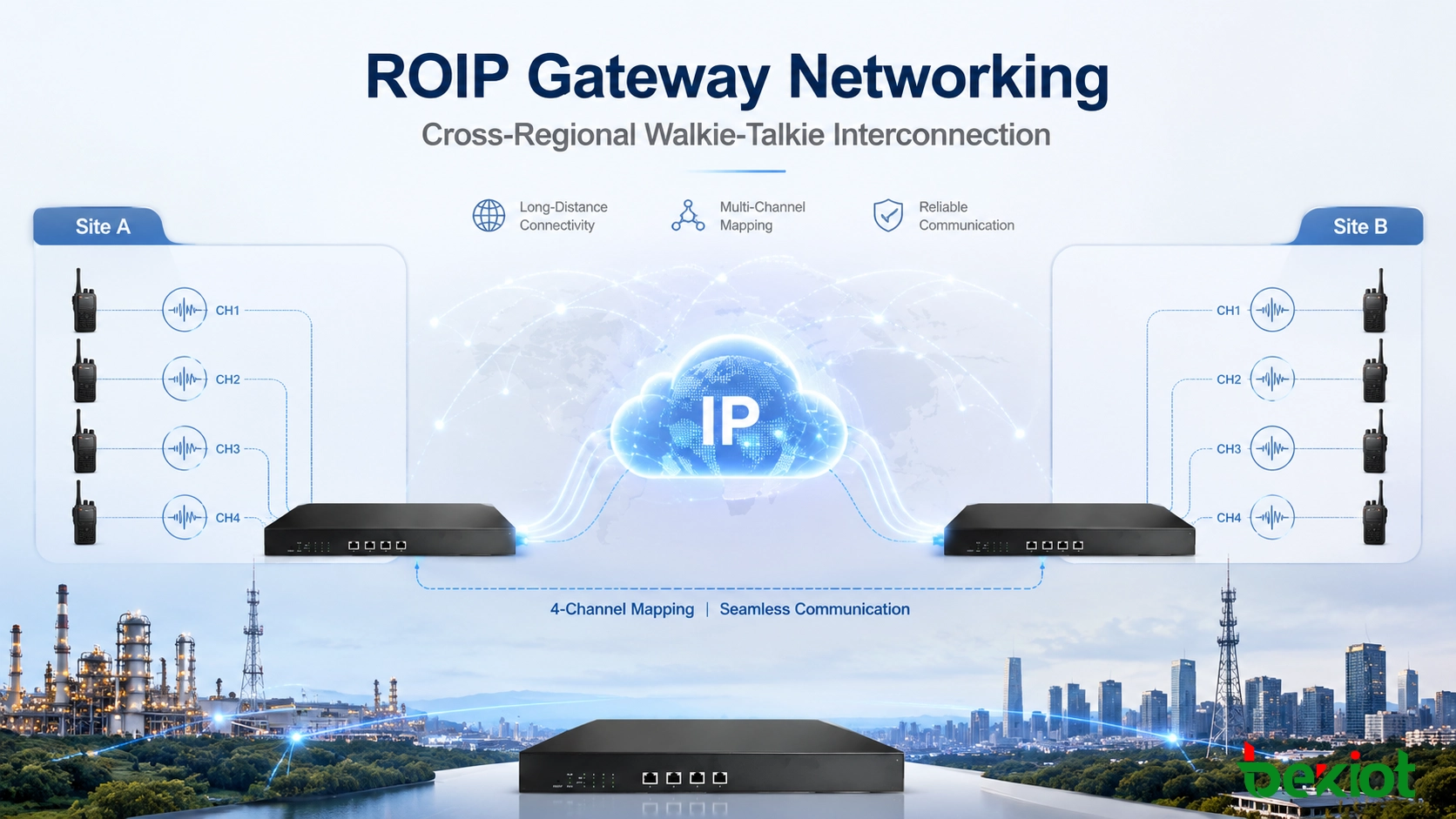
ROIP gateways connect local walkie-talkie systems across distant sites through an IP network.
Why Cross-Regional Walkie-Talkie Networking Is Needed
Many organizations operate across more than one physical location. A company may have two industrial parks, two logistics bases, two tunnel sections, two security zones, or several remote facilities. Each site may already use its own walkie-talkie channels, vehicle-mounted radios, base radios, or local repeaters for daily work.
The problem appears when those separate sites need real-time radio communication with each other. For example, Site A and Site B may be 100 kilometers apart. Each location has four radio channels for different working groups. The customer wants Channel 1 at Site A to communicate with Channel 1 at Site B, Channel 2 with Channel 2, Channel 3 with Channel 3, and Channel 4 with Channel 4.
Solving this only with radio coverage may require high-power repeaters, tower resources, antenna planning, intermediate relay points, frequency coordination, power supply, and field maintenance. For a fixed two-site interconnection project, that approach may be more complex than necessary. When both locations already have stable IP connectivity, a ROIP gateway can extend the existing radio channels in a much simpler way.
ROIP gateway networking does not replace the walkie-talkie user experience. It extends existing radio channels over an IP network while keeping the same PTT operation for field users.
How a ROIP Gateway Works
A ROIP gateway acts as a bridge between radio equipment and an IP network. On the radio side, it connects to walkie-talkie terminals, vehicle-mounted radios, base radios, or repeater interfaces through customized cables. On the network side, it converts radio audio into packet-based voice data and sends it to another ROIP gateway at the remote site.
When a user speaks on a radio channel at Site A, the local radio terminal receives the signal. The ROIP gateway captures the audio and radio status, converts the voice into IP data, and transmits it to the gateway at Site B. The remote gateway then outputs the audio to the corresponding radio terminal, which broadcasts the voice into the matched walkie-talkie channel at Site B.
The same process works in the opposite direction. Users at Site B can speak through their local walkie-talkies, and the voice is sent back to Site A through the ROIP gateway link. From the field user’s point of view, the operation feels like normal walkie-talkie communication. The IP network works in the background.
Typical Deployment: Two Sites with Four Radio Channels
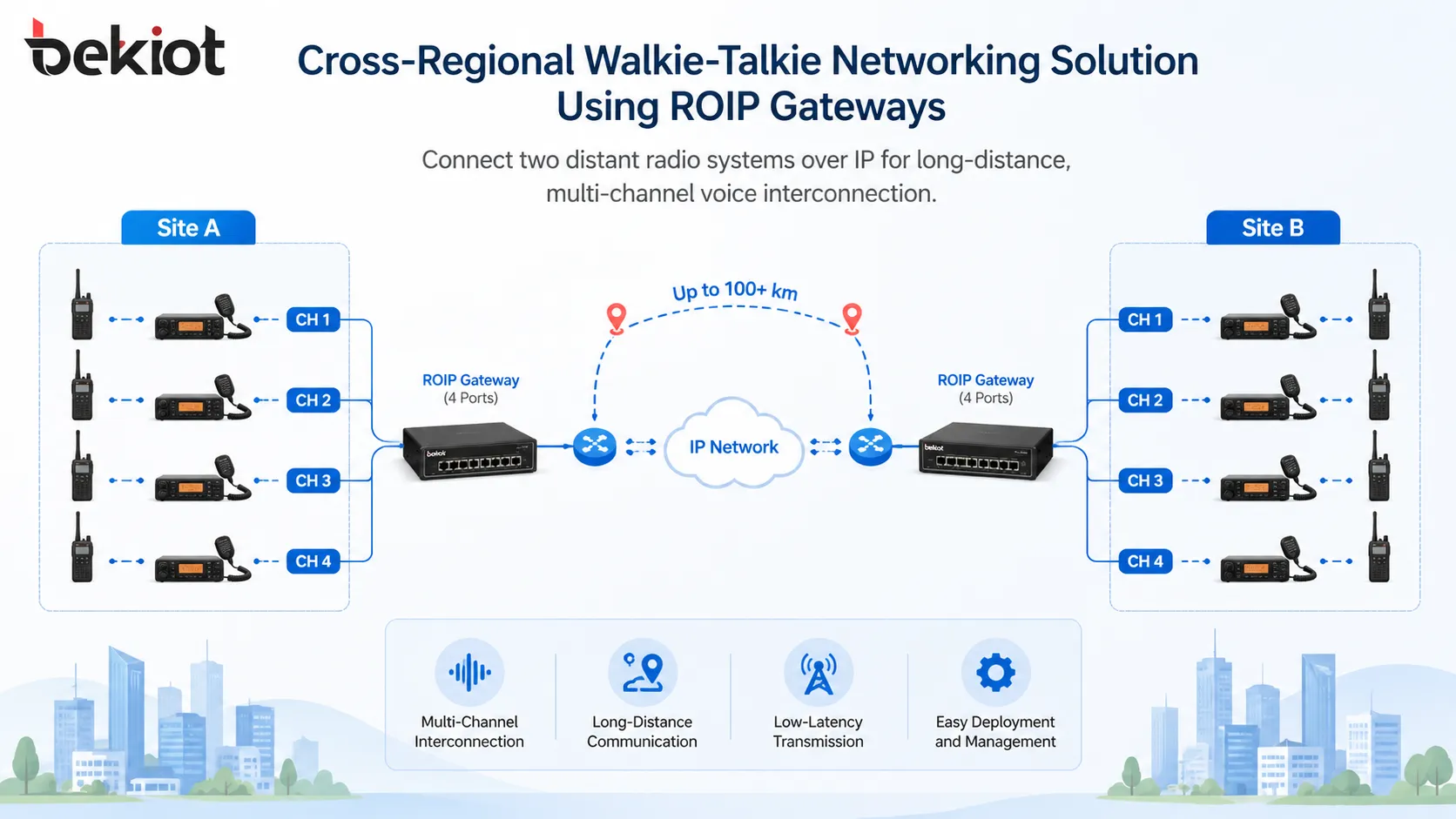
A common deployment uses one 4-port ROIP gateway at Site A and one 4-port ROIP gateway at Site B. At each location, four customized cables connect the gateway to four radio terminals. Each radio terminal corresponds to one local walkie-talkie channel.
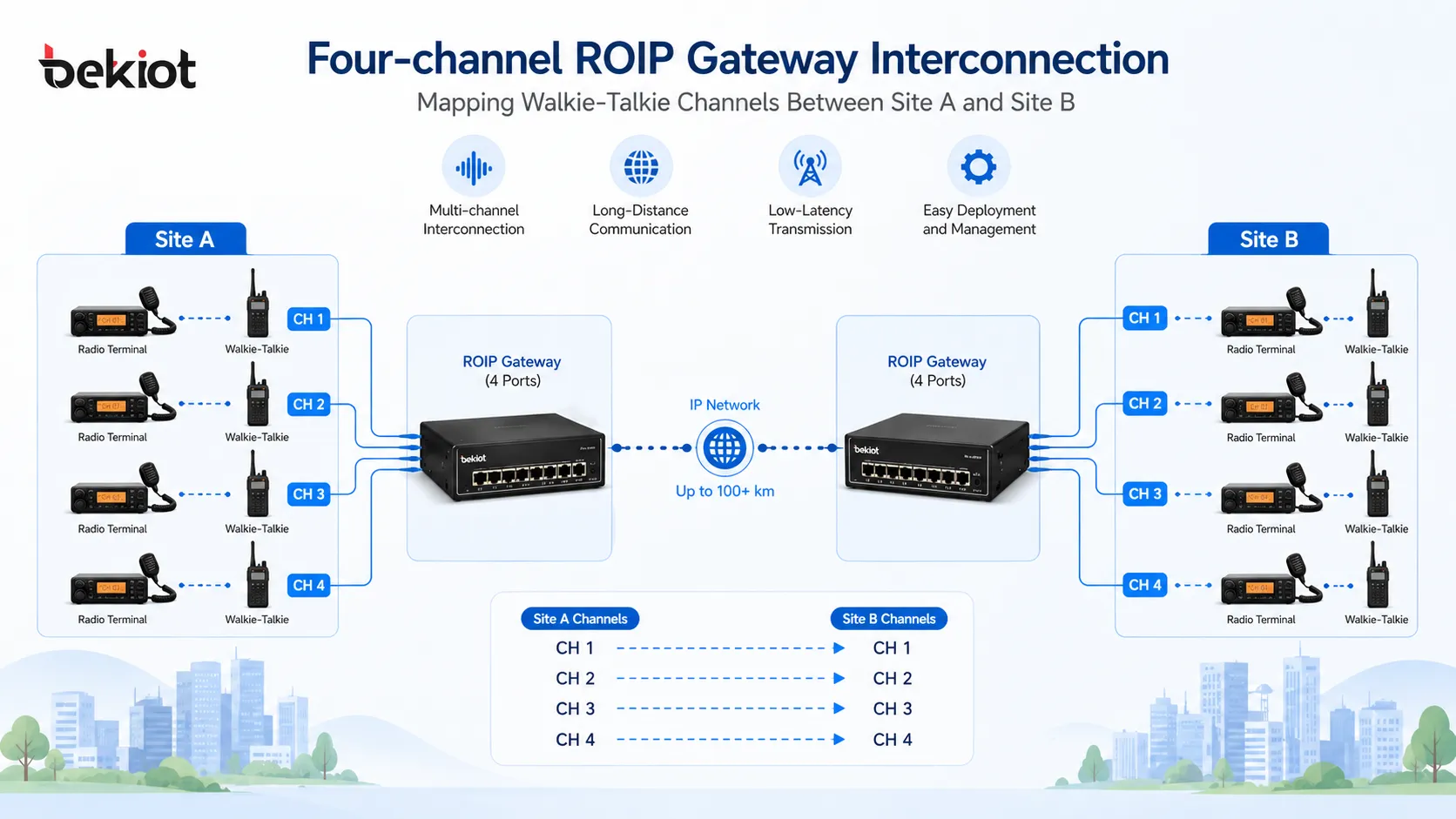
At Site A, Port 1 connects to the radio terminal for Channel 1, Port 2 connects to Channel 2, Port 3 connects to Channel 3, and Port 4 connects to Channel 4. Site B uses the same structure. After both gateways are connected through the IP network, the four channels can be mapped one by one.
In this structure, when a user on Channel 1 at Site A speaks, the voice is transmitted through the ROIP gateway and broadcast on Channel 1 at Site B. When a user on Channel 3 at Site B speaks, the voice is transmitted back and broadcast on Channel 3 at Site A. This one-to-one mapping keeps the communication logic clear and easy to manage.
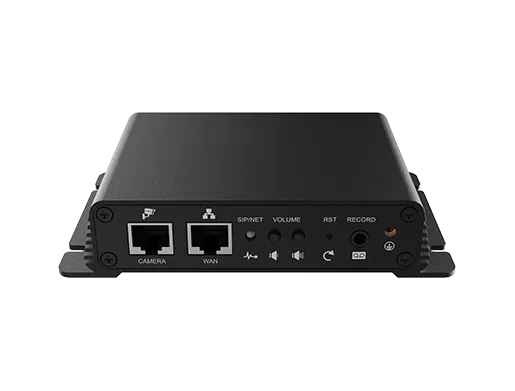
A 4-port ROIP gateway can map multiple walkie-talkie channels between two distant locations.
Channel Mapping for Multi-Channel Radio Systems
Multi-channel mapping is important because different teams often use different channels. A security team may use one channel, maintenance may use another, and an emergency response group may use a dedicated channel. If all channels are mixed together, the system may become confusing and difficult to control.
With a multi-port ROIP gateway, each channel can be connected independently. Site A Channel 1 can be linked only to Site B Channel 1, while other channels remain separated. This helps avoid unnecessary interference between work groups and keeps field communication more organized.
For fixed business scenarios, this is especially practical. The customer does not need to rebuild the whole radio system, replace the radio fleet, or change the habits of field users. The ROIP gateway simply extends the existing channel structure over the network.
Low-Latency Communication and Carrier Detection
One technical point in ROIP interconnection is how the gateway detects radio activity. Some systems rely mainly on voice activation. In that design, transmission starts only after the system detects voice energy. This may cause delay, missed first words, or unstable triggering in noisy environments.
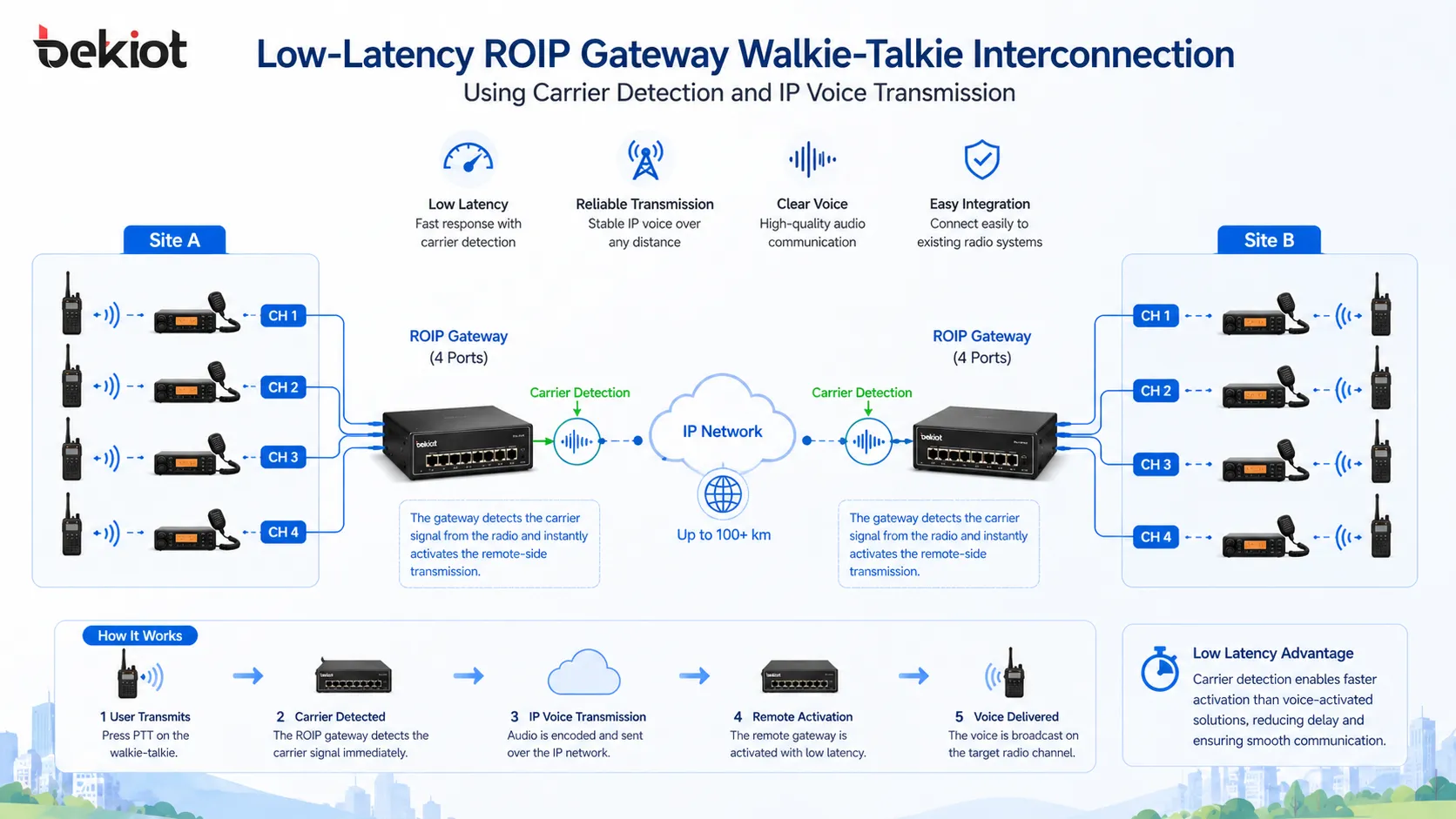
A better approach is carrier detection or radio status detection. When the connected vehicle-mounted radio or base radio receives a valid carrier signal, the ROIP gateway can immediately recognize that the channel is active and trigger remote-side transmission. This helps the system respond faster than ordinary voice-activated solutions.
For emergency dispatch, security patrol, transportation operation, and industrial coordination, low latency is not only a technical benefit. It affects how natural the conversation feels. When a user presses PTT and speaks, the remote side should hear the voice quickly and reliably.
Carrier detection helps ROIP gateways activate remote radio transmission with lower delay.
ROIP Gateway Networking Compared with Repeater Extension
Traditional Repeater-Based Extension
Repeater-based networking is a traditional method for extending radio coverage. It is useful when the goal is to expand radio signal coverage across a large physical area. However, for long-distance cross-regional communication, repeater deployment can become complicated.
A repeater-based solution may require relay stations, towers, antenna systems, site power, maintenance access, and frequency planning. It can be suitable for wide-area radio coverage projects, but it may not be the most efficient choice when the requirement is only fixed channel interconnection between two known locations.
ROIP Gateway-Based Interconnection
ROIP gateway interconnection is more suitable when both locations already have network connectivity and the main goal is to connect existing walkie-talkie channels between sites. Instead of transmitting radio signals across the entire distance, the system converts radio voice into IP data and sends it through the network.
This reduces the need for intermediate repeater stations and simplifies implementation. It is especially suitable for two-site or multi-site projects where the channel relationship is fixed, the number of channels is limited, and the customer wants a practical cross-regional communication path.
Dimension
Phone or Push-to-Talk App
High-Power Repeater Expansion
ROIP Gateway Interconnection
Communication Mode
Usually one-to-one and separate from the radio ecosystem
Radio-based, but often limited by frequency and coverage design
Preserves group PTT communication and existing channel structure
Coverage
Depends on public cellular or Wi-Fi service
Depends on repeater locations, towers, and terrain
Can link sites wherever reliable IP connectivity is available
Multi-Channel Support
Possible, but may not match existing radio group logic
Limited by radio planning and spectrum conditions
Supports independent channel mapping through gateway ports
Terminal Compatibility
May require smartphones or new application accounts
May require compatible radios and repeater infrastructure
Can retain existing radios, base radios, and user habits
Deployment Complexity
Low at the software level, but different from radio operation
Higher, with antennas, towers, power, sites, and licensing work
Moderate, using gateways, radio cables, and the existing IP network
Resilience
Depends on public network availability and app platform stability
Depends on repeater sites and radio coverage continuity
Local radio can still work locally; interconnection resumes when the IP link recovers
Key Advantages of ROIP Gateway Networking
Simpler Deployment
The system does not require a long chain of repeaters between distant locations. Each site needs a ROIP gateway, radio terminals, customized cables, and IP network access. This makes installation and maintenance easier for many fixed-site projects.
Long-Distance Communication over IP
As long as both sites have stable network connectivity, radio voice can be transmitted across long distances. The two locations may be separated by 10 kilometers, 100 kilometers, or more, depending on the network condition and project design.
Multiple Fixed Channels
A multi-port ROIP gateway can support several radio channels at the same time. A 4-port gateway, for example, can connect four local radio channels and map them to four channels at another site. This fits projects where different teams need independent communication paths.
Existing Radio Operation Remains Unchanged
Field users do not need to change their daily communication habits. They continue using their existing walkie-talkies and local channels. The ROIP gateway extends the communication path in the background.
Lower Delay with Radio Signal Detection
Carrier detection or radio status detection can trigger remote transmission faster than ordinary voice activation. This helps reduce delay, avoid missed first words, and improve the stability of cross-site PTT communication.
Suitable Application Scenarios
Industrial Parks and Remote Production Sites
Industrial companies may operate multiple production zones, warehouses, substations, maintenance points, and remote facilities. ROIP gateways can connect local radio systems across these sites and support real-time coordination for production, maintenance, safety, and emergency handling.
Security Patrol and Facility Management
Security teams often work across campuses, office parks, logistics yards, public facilities, or separated service zones. By linking radio channels through ROIP gateways, command centers and patrol teams in different areas can stay connected without replacing their existing radio systems.
Transportation, Logistics, and Port Operations
Transportation and logistics environments usually involve distributed working areas. ROIP gateway networking can connect radio users across terminals, warehouses, checkpoints, dispatch rooms, loading areas, and remote operation zones through an IP network.
Emergency Response and Temporary Projects
Emergency command, disaster response, temporary construction, and event security may require rapid communication deployment. When network access is available, ROIP interconnection can provide a fast way to link radio teams across different locations.
When ROIP Gateway Networking Is the Best Fit
A ROIP gateway-based solution is best suited for projects where the number of channels is relatively small, the communication relationship is fixed, and the customer wants a direct way to connect distant radio systems. A typical case is two sites with four channels each, requiring one-to-one channel mapping.
If the project needs dynamic talk groups, centralized dispatch software, GPS positioning, recording, permission control, emergency command workflows, or integration with a larger communication platform, a more advanced ROIP dispatch system may be more suitable. But for fixed channel-to-channel interconnection, a ROIP gateway is usually a practical and efficient choice.
Becke Telcom ROIP Gateway Solutions
Becke Telcom can provide ROIP gateway solutions and practical integration support for cross-site walkie-talkie networking. The solution can help connect existing radio terminals, walkie-talkie channels, SIP platforms, IP PBX systems, and dispatch communication networks according to project requirements.
For industrial parks, logistics bases, transportation sites, security operations, tunnel projects, emergency command, and remote facilities, Becke Telcom can support device selection, channel mapping, customized cable matching, network planning, and system commissioning. The goal is to keep radio communication familiar for users while extending the communication range through a reliable IP network.
Conclusion
Cross-regional walkie-talkie communication does not have to rely only on radio coverage or long repeater chains. When distant sites already have IP network access, ROIP gateways can connect local radio systems and enable long-distance multi-channel interconnection.
By connecting radio terminals through customized cables, converting radio audio into IP voice transmission, mapping channels one by one, and using carrier detection for faster activation, ROIP gateway networking provides a practical way to extend walkie-talkie communication across regions.
For projects with fixed channels, clear communication relationships, and limited deployment complexity, this approach can help users complete networking quickly while maintaining reliable cross-site PTT communication.
FAQ
Can walkie-talkies communicate across long distances?
Ordinary walkie-talkies have limited communication range. For long-distance or cross-regional communication, users usually need repeaters, IP interconnection, ROIP gateways, or a wider radio communication system.
What is a ROIP gateway?
A ROIP gateway is a device that connects radio equipment to an IP network. It converts radio audio into IP-based voice transmission, allowing walkie-talkie systems in different locations to communicate through a network connection.
How does a ROIP gateway connect two walkie-talkie systems?
The gateway connects to radio terminals through customized cables. When one side receives walkie-talkie voice, the gateway converts the audio into IP data and sends it to the gateway at the remote site. The remote gateway then outputs the audio to the corresponding radio channel.
Is ROIP gateway networking suitable for four-channel systems?
Yes. A 4-port ROIP gateway can connect four radio channels at one site and map them to four channels at another site. This is suitable for fixed multi-channel walkie-talkie interconnection between two locations.
Why is carrier detection useful in ROIP gateway solutions?
Carrier detection allows the gateway to detect radio activity more quickly and accurately than ordinary voice activation. This helps reduce delay, avoid missed first words, and improve the reliability of cross-site walkie-talkie communication.