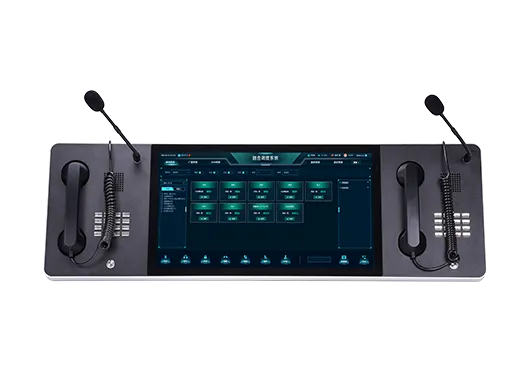
Walkie-Talkie and IP Phone Integration with RoIP Gateway, IP PBX, and Dispatch Systems
Walkie-talkies can connect with IP phone systems through RoIP gateways, IP PBX servers, SIP extensions, and dispatch consoles, creating unified voice communication for industrial, transport, utility, and public safety operations.
Becke Telcom
Walkie-talkies are still one of the most practical tools for instant field communication. Security patrols, factory teams, port workers, railway staff, tunnel maintenance crews, mining operators, oil and gas personnel, and emergency responders use push-to-talk voice because it is fast, direct, and easy to operate under pressure.
The problem is that many radio systems remain isolated from the IP-based voice systems used in offices, control rooms, dispatch centers, and remote command rooms. A technician using a walkie-talkie may not be able to reach an engineering desk phone directly. A dispatcher may need to manually relay messages between a radio group and a SIP phone user. During routine operations this is inconvenient. During emergencies, it can delay decisions and create information gaps.
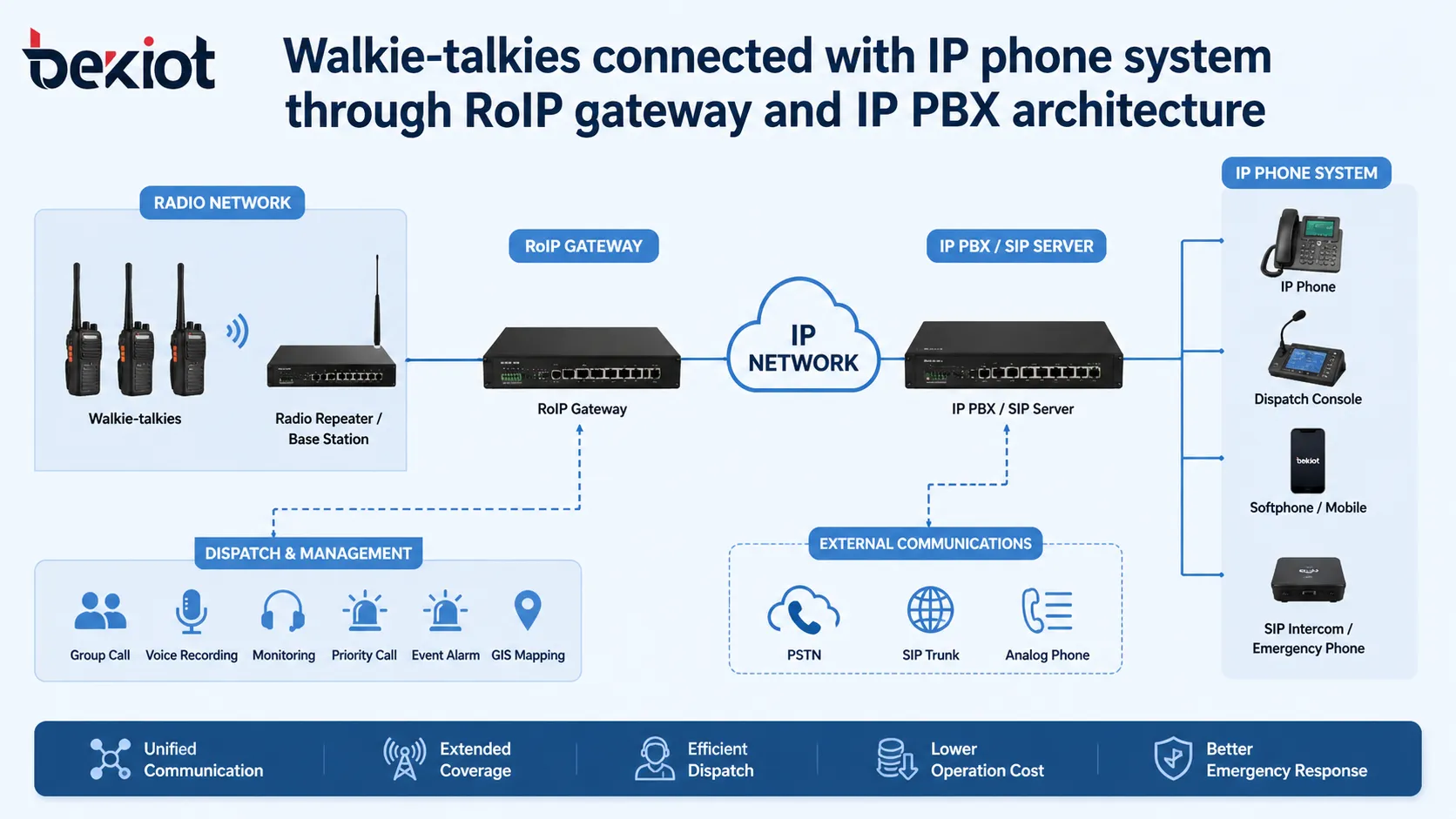
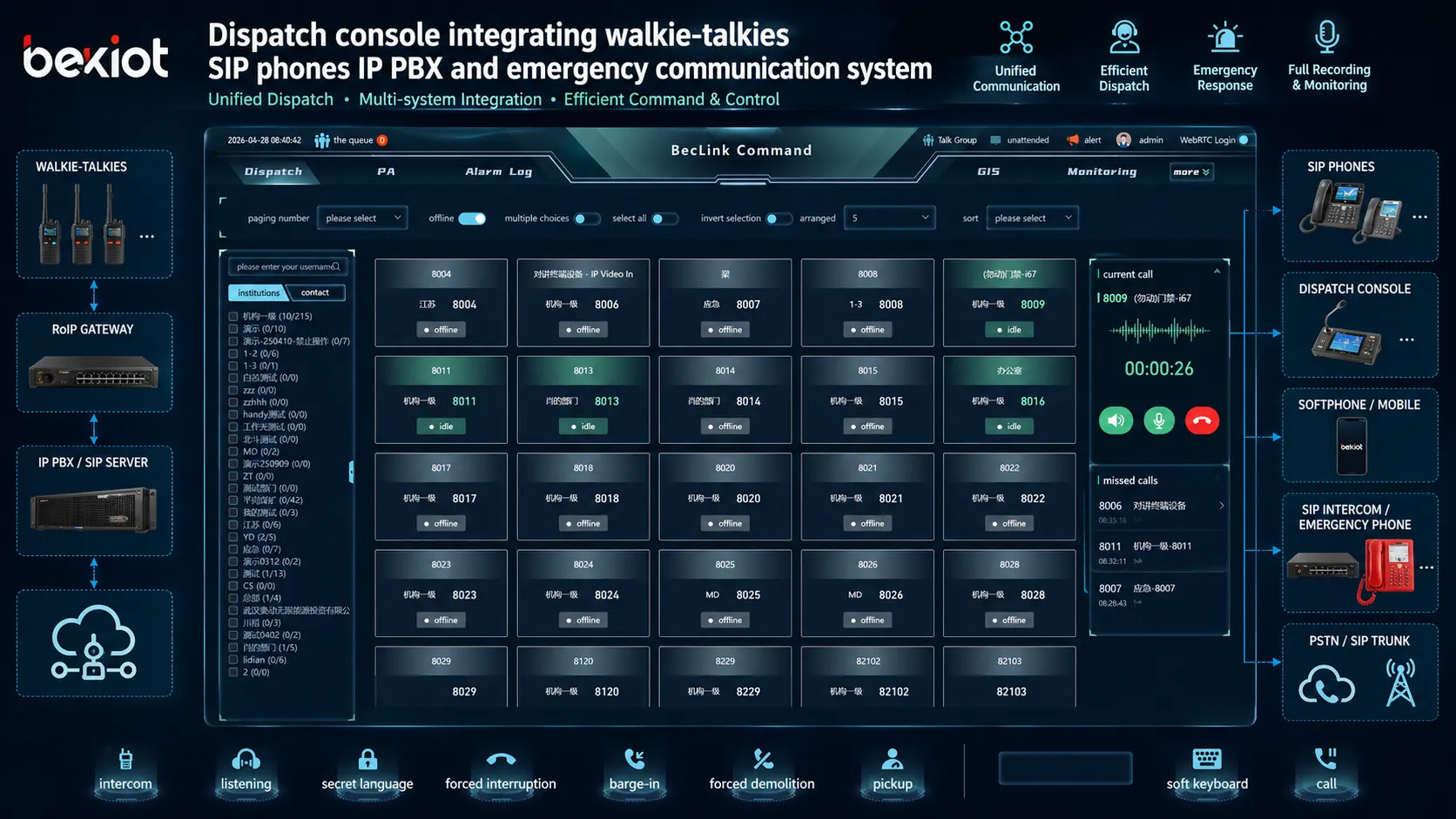
A practical solution is to connect walkie-talkies with an IP phone system through a RoIP gateway, an IP PBX or SIP server, and a dispatch console. With this architecture, a radio channel can become a callable SIP extension. An IP phone can dial a walkie-talkie talk group, a radio call can be routed to a control room phone, and a dispatcher can manage radios, phones, intercoms, paging zones, and emergency terminals from one platform.
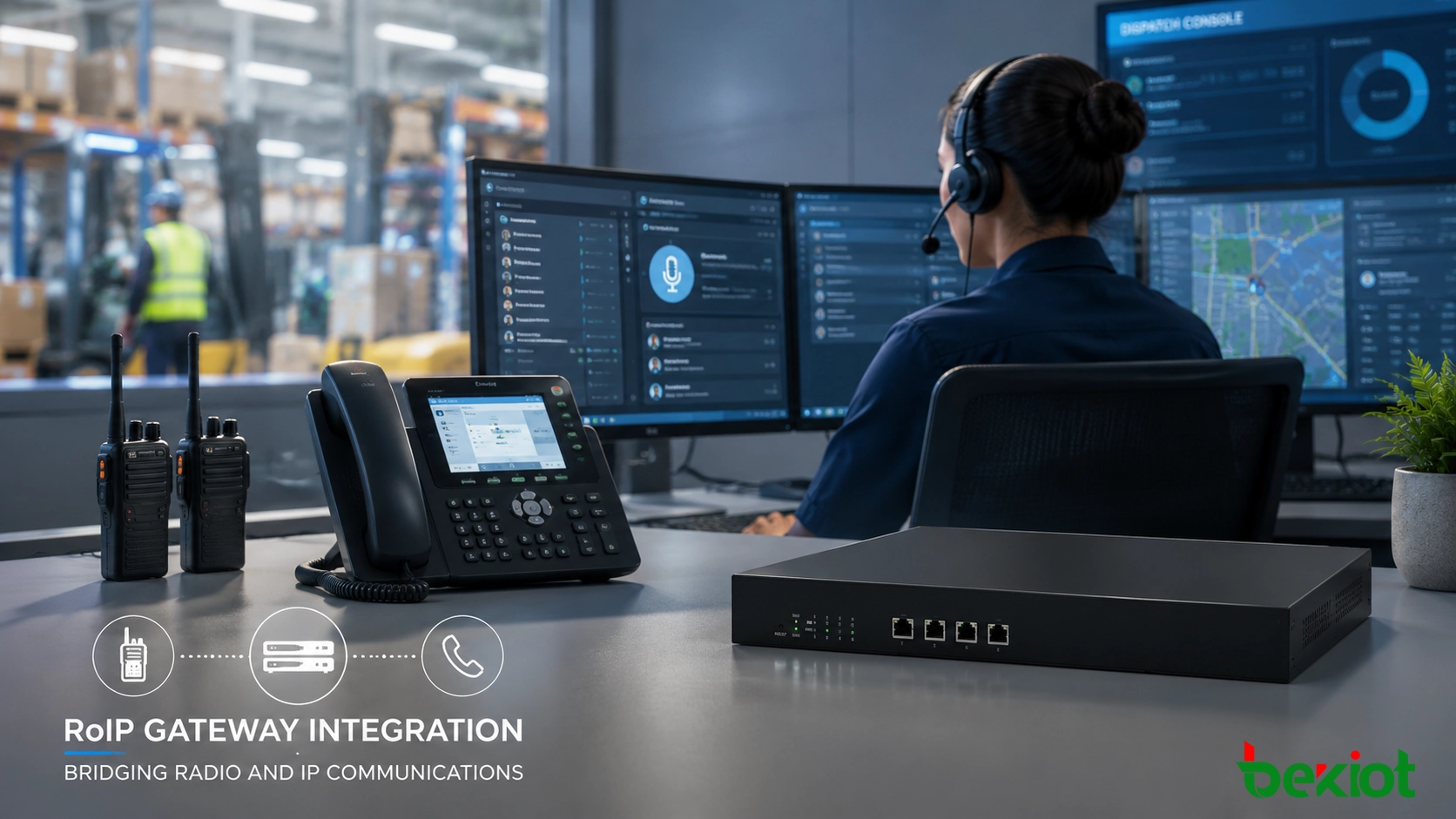
Walkie-talkies can connect with IP phone systems through a RoIP gateway, IP PBX, and dispatch platform.
Why Radio Systems Need IP Phone Integration
Standalone walkie-talkie networks are effective within their own radio coverage area, but they are closed by nature. Office users on SIP phones, softphones, or external phone lines cannot normally join a radio conversation without another person relaying the message. This creates a communication boundary between mobile field users and fixed office or control room users.
Industrial and public safety sites rarely depend on one voice system alone. A typical facility may use walkie-talkies for mobile workers, IP phones for offices, emergency telephones at fixed points, intercom terminals for access or help calls, paging speakers for announcements, and a dispatch console for centralized command. If each system operates separately, operators must switch between devices, repeat messages manually, and review separate logs after an incident.
Integrating radio channels with an IP phone system helps remove that boundary. A supervisor can dial a radio group from an IP phone. A field user can trigger a call to the control room from a radio channel. A dispatcher can patch a radio group to a phone extension, external line, or emergency response team. The result is not only wider reach, but also a more coordinated voice workflow.
The goal of walkie-talkie and IP phone integration is not to replace radio communication. It is to bring radio users, phone users, and dispatch operators into one connected voice environment.
What RoIP Means in This Architecture
RoIP, or Radio over IP, means transmitting radio audio and control signals through an IP network. It does not remove the walkie-talkie system or change the way field users press PTT. Instead, it extends the radio channel into a LAN, WAN, VPN, private network, or IP-based communication platform.
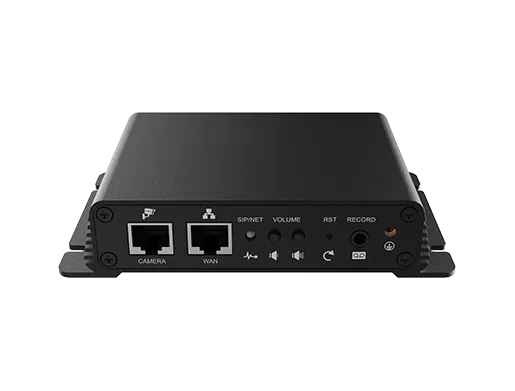
A RoIP gateway is installed between the radio equipment and the IP voice network. On one side, it connects to a base radio, mobile radio, repeater interface, or radio channel through an audio and control cable. On the other side, it connects to the IP network and communicates with the IP PBX, SIP server, dispatch platform, or another RoIP gateway.
When a walkie-talkie user speaks, the radio receives the voice and sends it to the RoIP gateway. The gateway encodes the audio and transmits it as IP voice traffic. When a SIP phone user speaks back, the gateway activates radio-side PTT and sends the voice over the air to the walkie-talkie group.
Core System Components
Walkie-Talkies and Radio Infrastructure
The radio side may include handheld walkie-talkies, vehicle-mounted radios, base radios, repeaters, antennas, and local radio channels. Field users continue using their existing radios and talk groups. This is important because many industrial and security teams already have established radio habits and channel plans.
RoIP Gateway
The RoIP gateway is the bridge between the radio world and the IP voice world. It handles radio audio input and output, PTT activation, carrier detection, SIP registration, and IP voice transmission. A single-channel gateway can connect one radio group, while a multi-channel gateway can connect several radio channels or repeaters at the same time.
IP PBX or SIP Server
The IP PBX manages extensions, dial plans, routing rules, ring groups, call recording, SIP trunks, and permission policies. Once the RoIP gateway registers as a SIP extension, the connected radio channel becomes part of the phone system. For example, security radio channel 1 may become extension 801, logistics channel 2 may become extension 802, and maintenance channel 3 may become extension 803.
Dispatch Console
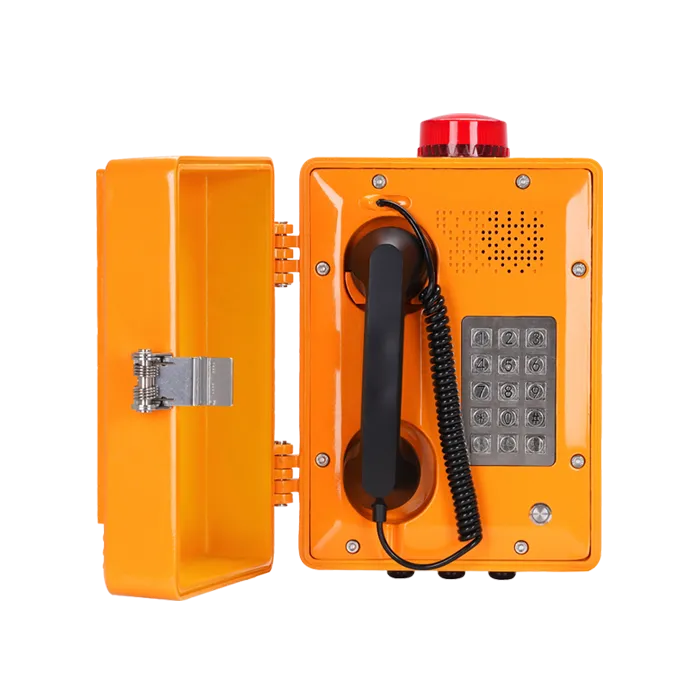
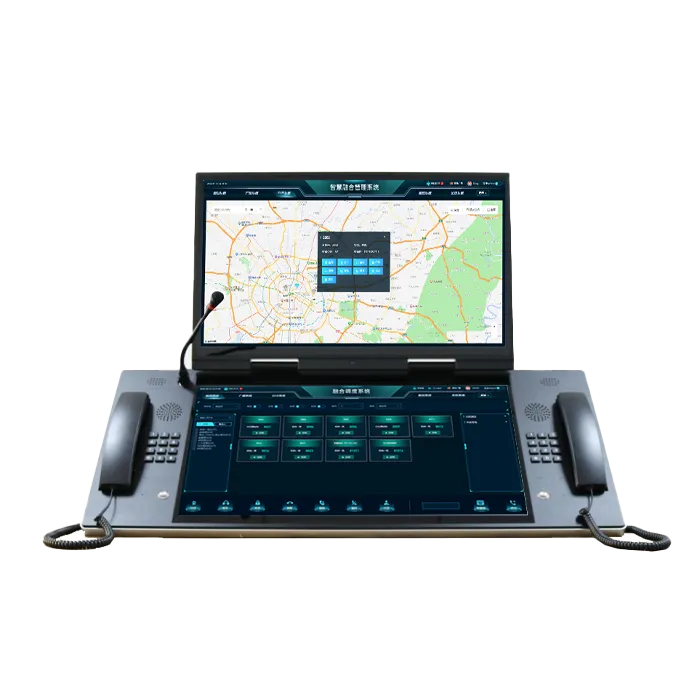
A dispatch console gives operators a visual control interface for radio channels, SIP phones, emergency stations, intercoms, paging speakers, and external lines. Instead of operating several separate devices, the dispatcher can select a radio channel, call an IP phone, start a group call, monitor events, or patch different voice resources from one screen.
How a RoIP Gateway Connects Radio to an IP PBX
Radio Audio Interface
The gateway receives and sends audio through the radio interface. This may be an accessory port, 4-wire interface, custom cable, or repeater interface depending on the radio model. Audio level matching is important. If the level is too low, IP phone users may not hear the radio clearly. If it is too high, distortion or clipping may occur.
PTT Control and Carrier Detection
PTT control is one of the most important parts of RoIP integration. When a phone user speaks to a radio group, the gateway must activate PTT at the right time and release it when the transmission ends. If the timing is wrong, the first words may be clipped or the channel may stay occupied too long.
For incoming radio traffic, many professional solutions use COR, or Carrier Operated Relay, to detect when a valid radio signal is present. Hardware carrier detection is usually more reliable than simple voice activation because it reduces missed syllables and avoids false triggering caused by background noise.
SIP Registration
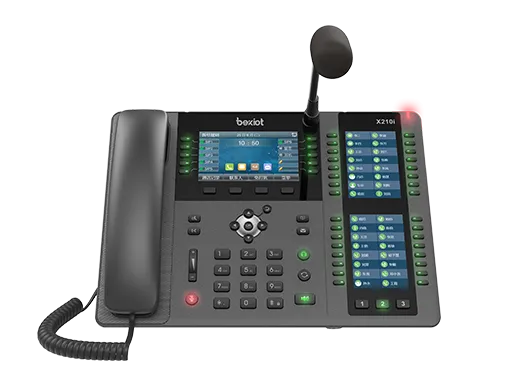
After the gateway is configured, it can register to the IP PBX as a SIP endpoint. The PBX assigns an extension number to the radio channel. Any authorized SIP phone, softphone, dispatch console, or control room terminal can dial that extension and communicate with the radio group.
Routing Rules
The IP PBX defines who can call the radio channel, where incoming radio calls should go, and how emergency or priority calls should be handled. A radio-triggered call may ring a control room phone, a security ring group, a dispatch queue, or an external emergency contact. Different radio groups can have different permissions and routing policies.
Common Communication Workflows
Walkie-Talkie User Calling an IP Phone
A field worker presses PTT and speaks. The radio base station receives the signal and sends the audio to the RoIP gateway. The gateway detects radio activity and sends the call to the IP PBX. The PBX then routes the call to a desk phone, ring group, dispatch console, or control room extension.
IP Phone User Calling a Radio Channel
An office user dials the extension assigned to a RoIP gateway channel. The IP PBX routes the call to the gateway. The gateway activates PTT on the connected radio and transmits the phone user’s voice over the radio channel. Walkie-talkie users hear the message and can respond through their normal PTT operation.
Dispatcher Managing Multiple Radio Groups
A dispatcher may need to communicate with security, maintenance, logistics, emergency response, and operations teams at the same time. Through a dispatch console, each radio channel can appear as a selectable resource. The operator can talk to one group, patch a radio group to an IP phone, or broadcast instructions to several teams when needed.
Remote Command Center Access
Because RoIP uses IP transmission, authorized remote users can access radio channels through VPN or private network connections. This is useful for multi-site operations, remote command rooms, emergency management centers, and supervisors who need access to field radio networks without being physically located at the radio site.
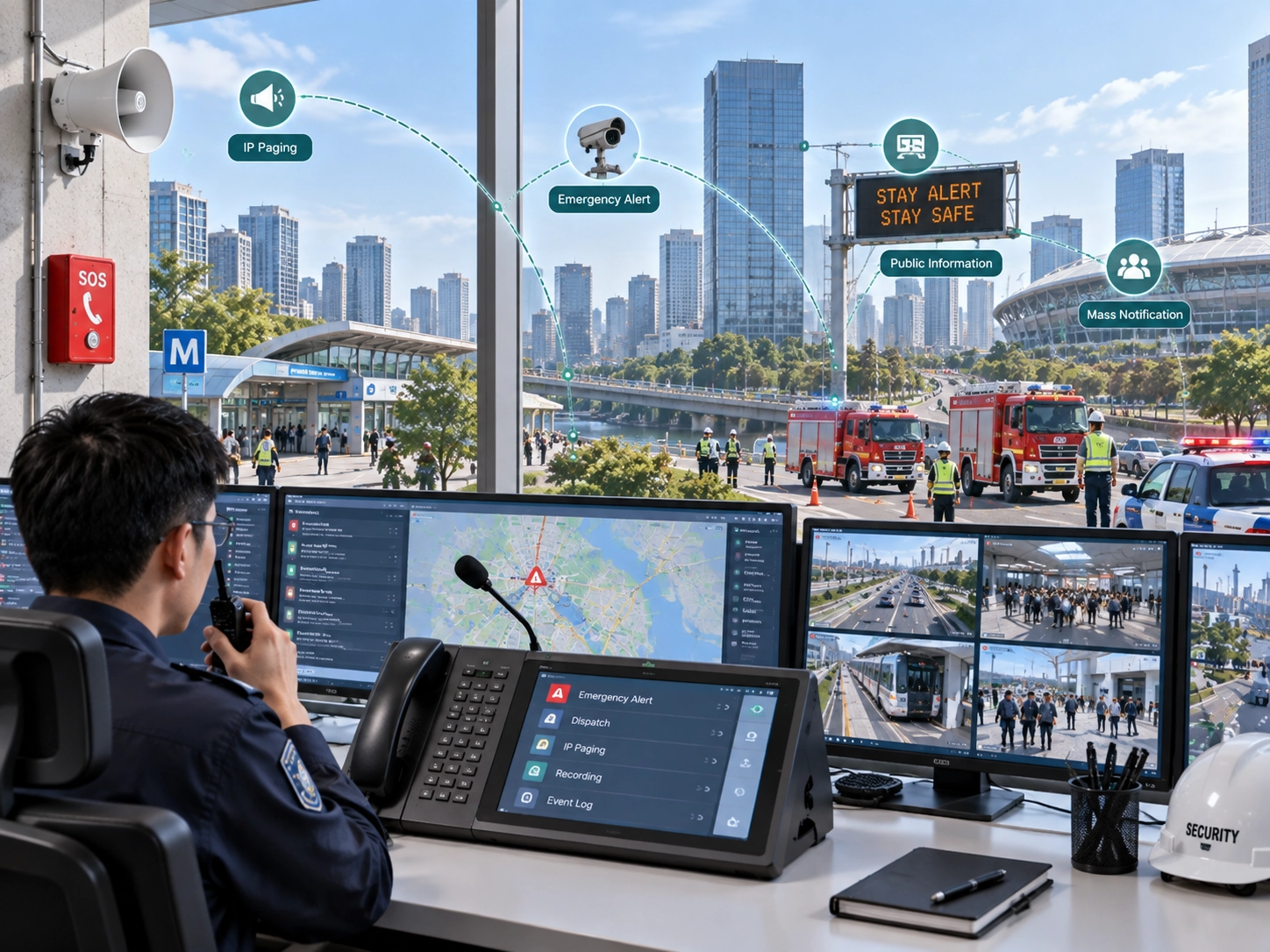
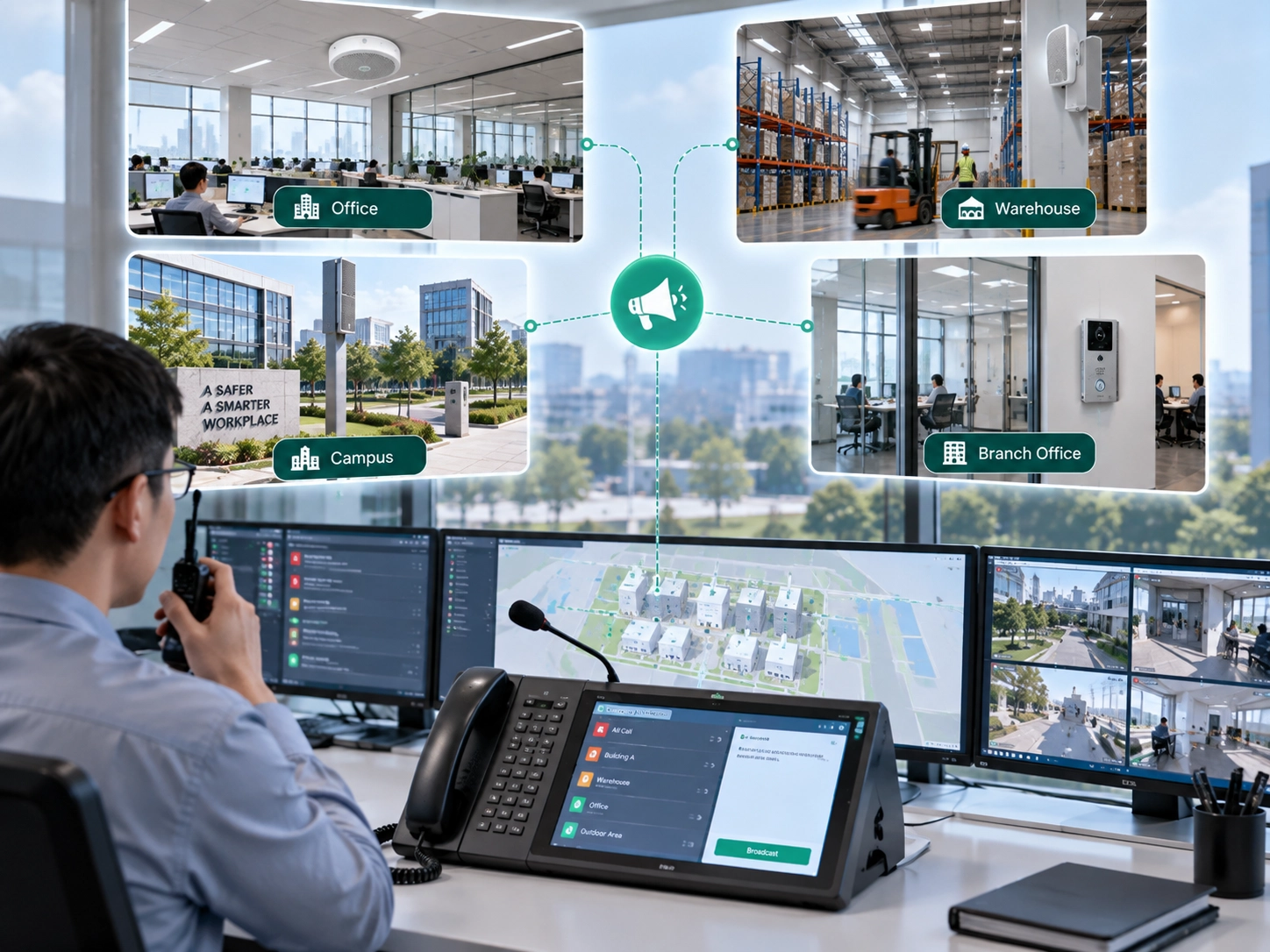
Dispatch integration allows operators to manage walkie-talkies, SIP phones, IP PBX extensions, and emergency communication resources from one interface.
Dispatch Integration for Unified Command
Dispatch integration is what turns a basic radio-to-phone bridge into a complete communication solution. Instead of only allowing one radio channel to call one phone, the dispatch platform can organize many communication resources into one operational view.
Operators can monitor active channels, see which resources are online, select radio groups, call SIP extensions, patch conversations, start group calls, and handle emergency events. In industrial, transportation, utility, and public safety environments, this centralized view can reduce response time and prevent important messages from being lost between separate systems.
Recording is another important value. When radio traffic and telephone traffic are recorded in the same platform, incident review becomes easier. Managers can review who spoke, when the event happened, which channel was used, and how the response was handled. This is useful for safety audits, training, compliance, and operational improvement.
Where This Integration Is Used
Factories and Industrial Parks
Production teams, security patrols, warehouse staff, maintenance crews, and control room operators often use different communication tools. RoIP and IP PBX integration allows office users and radio users to communicate directly, reducing manual relays and improving response speed.
Oil, Gas, Mining, and Power Plants
Large hazardous sites require fast communication between control rooms and field personnel. Integrating walkie-talkies with the IP phone system allows operators to reach field teams, escalate alarms, coordinate emergency response, and record important voice traffic.
Transportation, Ports, Airports, and Railways
Transport operations involve distributed teams, moving vehicles, public areas, and strict safety procedures. RoIP gateways can connect onboard radios, trackside workers, station offices, dispatch rooms, emergency phones, and paging systems into a more unified voice network.
Public Safety and Emergency Response
Command centers often need to connect tactical radio groups with phone users, support agencies, and emergency coordination teams. Dispatch integration allows operators to patch, monitor, and record radio and phone traffic from one position.
Main Benefits of Walkie-Talkie and IP Phone Integration
Benefit
Practical Value
Unified Voice Communication
Radio users, IP phone users, intercoms, and dispatch operators can communicate through one connected system.
Extended Access
Radio channels can be accessed from offices, control rooms, remote command centers, or authorized SIP devices.
Reuse of Existing Radios
Organizations can keep current walkie-talkies and add integration through gateways instead of replacing the whole radio fleet.
Better Dispatch Efficiency
Operators can monitor, patch, call, record, and respond from one console instead of switching between separate systems.
Improved Safety and Traceability
Voice traffic can be recorded and reviewed for incident analysis, training, compliance, and emergency response improvement.
What to Check Before Selecting a RoIP Gateway
Radio Compatibility
The gateway must support the radio model’s audio interface, accessory connector, PTT signal, COR signal, and operating mode. Site testing is important because actual field noise, cable length, radio level, and transmission behavior can affect performance.
SIP and IP PBX Compatibility
The gateway should register reliably with the target IP PBX or SIP server. Important points include SIP account registration, codec support, NAT traversal, DTMF relay, extension routing, and interoperability with the dispatch platform.
PTT Timing and Audio Quality
Configurable PTT timing, carrier detection, audio gain adjustment, and echo control help improve communication quality. Poor tuning may cause clipped words, distorted audio, delayed transmission, or confusing half-duplex behavior.
Network Reliability and Security
RoIP traffic should be protected by a stable network design. VLAN planning, QoS for RTP traffic, VPN for remote access, SIP authentication, firewall control, and limited management access can improve both voice quality and security.
Dispatch Platform Integration
If the project includes a command center, the RoIP gateway should work smoothly with the dispatch platform. Channel selection, call recording, emergency priority, status monitoring, and operator control should be tested before final deployment.
Becke Telcom Walkie-Talkie and IP Phone Integration
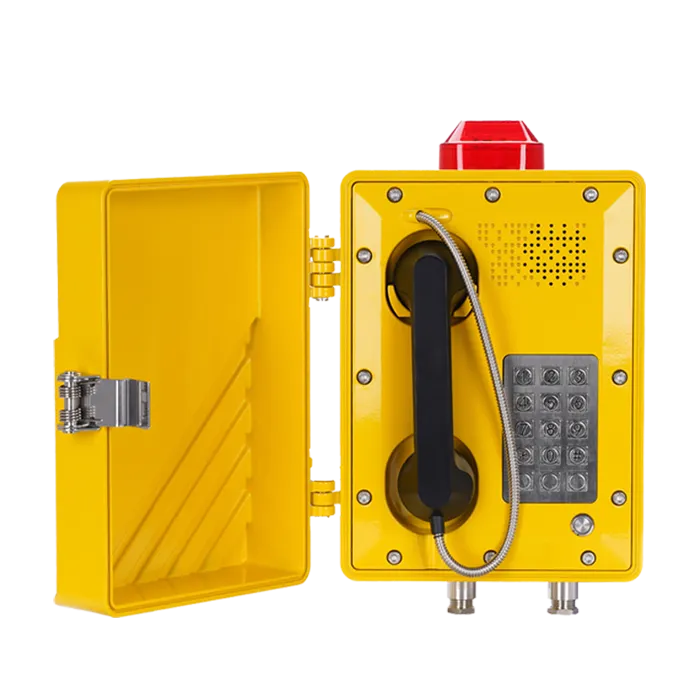
Becke Telcom provides industrial communication solutions that connect walkie-talkies, SIP phones, emergency terminals, paging systems, RoIP gateways, IP PBX platforms, and dispatch centers into one coordinated system. The solution is designed for sites where field radio users, control room operators, office users, and emergency response teams must communicate without delays caused by isolated systems.
In a typical Becke Telcom integration, RoIP gateways bridge radio channels into an IP PBX or SIP-enabled dispatch server. Field radio users can reach office extensions, while dispatch operators can manage radio channels, SIP phones, intercoms, emergency phones, and paging zones from one screen.
For factories, tunnels, ports, energy facilities, transportation systems, mining projects, and public safety environments, Becke Telcom focuses on SIP interoperability, rugged industrial terminals, emergency communication linkage, dispatch console operation, and long-term system reliability.
A practical walkie-talkie and IP phone integration solution connects not only devices, but also field users, office teams, control rooms, emergency workflows, and daily operations.
Conclusion
Walkie-talkies can connect to IP phone systems through a structured combination of RoIP gateway, IP PBX, SIP routing, and dispatch integration. The gateway bridges radio audio and PTT/COR signals into the IP voice network. The IP PBX manages extension dialing, routing, and call control. The dispatch console gives operators centralized visibility and command capability.
For industrial sites, transport hubs, energy operations, utility projects, campuses, and public safety agencies, this architecture improves communication reach, reduces system isolation, supports recording, and makes field teams easier to coordinate. Instead of treating radio channels as separate communication islands, RoIP integration turns them into part of a unified voice network.
FAQ
Can walkie-talkies connect to an IP phone system?
Yes. A RoIP gateway can link a radio channel to an IP network and enable communication with SIP phones, IP PBX extensions, softphones, and dispatch consoles.
What device connects walkie-talkies to an IP PBX?
The core device is a RoIP gateway. It converts radio audio and PTT or COR signals into IP voice traffic and usually registers as a SIP extension with the IP PBX.
Can an IP phone talk directly to a walkie-talkie user?
Yes. When the radio channel is registered as a SIP extension through the RoIP gateway, an IP phone can dial that extension. The gateway handles radio-side PTT so the voice is transmitted to walkie-talkie users.
Is RoIP the same as VoIP?
No. VoIP is mainly used for telephone voice over IP. RoIP transports radio communication over IP. In integration projects, RoIP and VoIP work together through gateways, SIP servers, and IP PBX systems.
Where is walkie-talkie and IP phone integration commonly used?
It is commonly used in factories, industrial parks, oil and gas facilities, mines, power plants, transportation systems, railways, airports, ports, tunnels, large campuses, public safety agencies, and emergency command centers.