RoIP Gateway Integration for Emergency Command Vehicles
RoIP gateways help emergency command vehicles connect local radio channels with IP dispatch platforms through satellite, 4G/5G, or private network backhaul for faster field communication.
Becke Telcom
An emergency command vehicle is built to bring communication, coordination, and field command capability to an incident site. In rescue operations, disaster response, public safety incidents, industrial accidents, utility repair, and temporary command tasks, the vehicle often carries radios, vehicle-mounted transceivers, broadband ad hoc network equipment, 4G/5G routers, satellite communication terminals, video systems, dispatch workstations, and power supply equipment.
These systems help connect the front line with a remote command center. However, field radio communication still has practical limits. Handheld radios and vehicle radios are reliable and familiar for field users, but their coverage is usually tied to a local radio area, a specific channel plan, or a particular radio network. Different teams may also use different radio standards, frequencies, and operating rules.
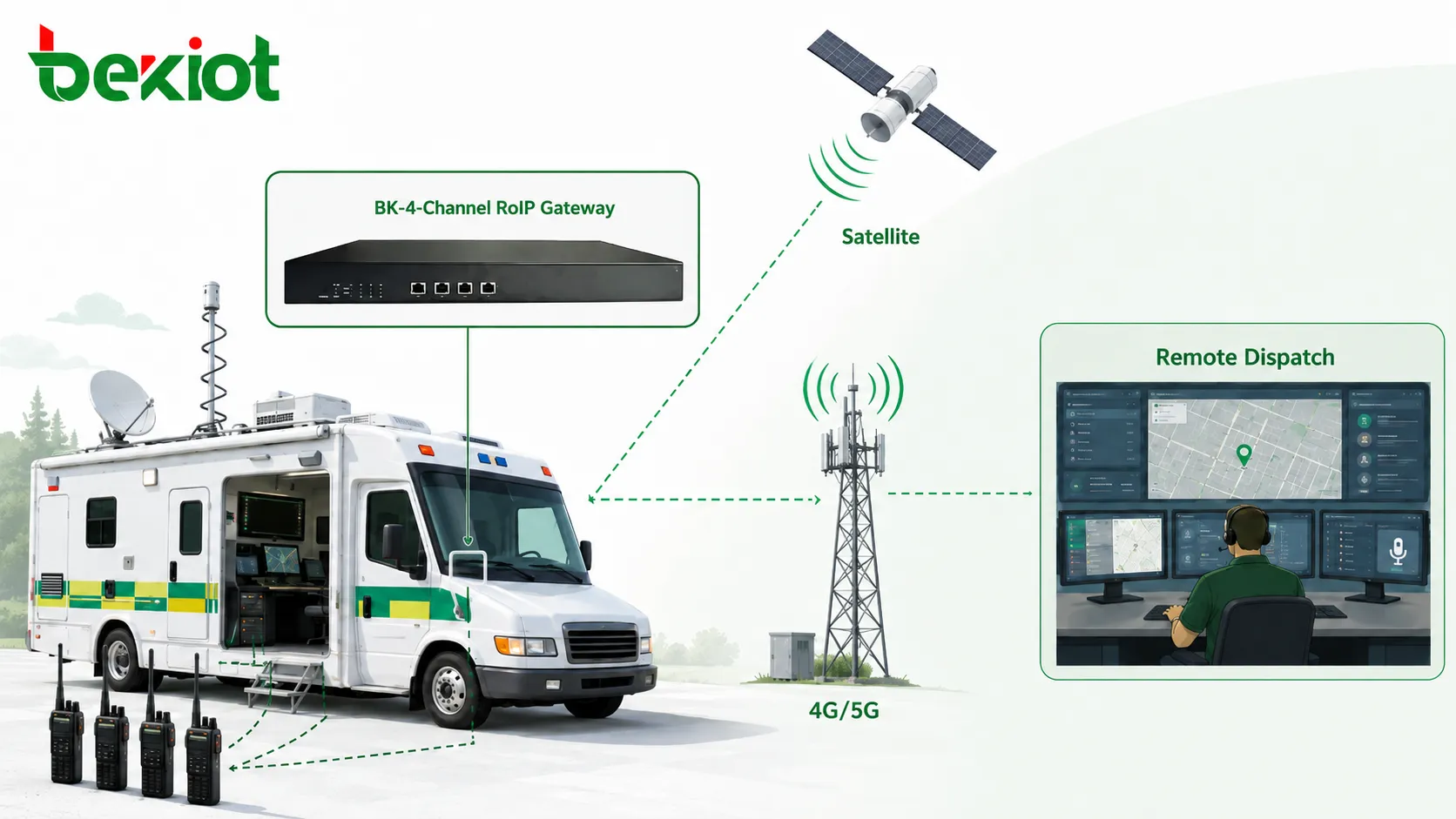
A RoIP gateway helps close this gap. It connects radio channels on the emergency command vehicle to an IP-based dispatch platform, allowing the command center to communicate with on-site radio users more directly. Instead of replacing existing radios, the gateway turns radio channels into dispatch-accessible communication resources.
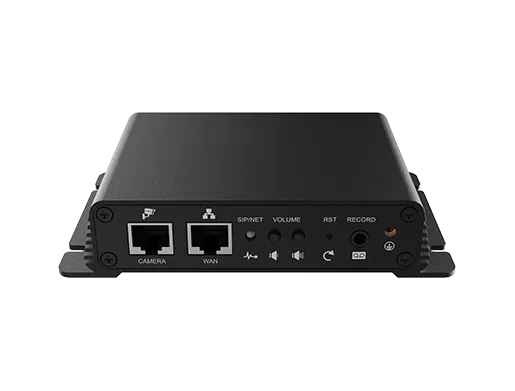
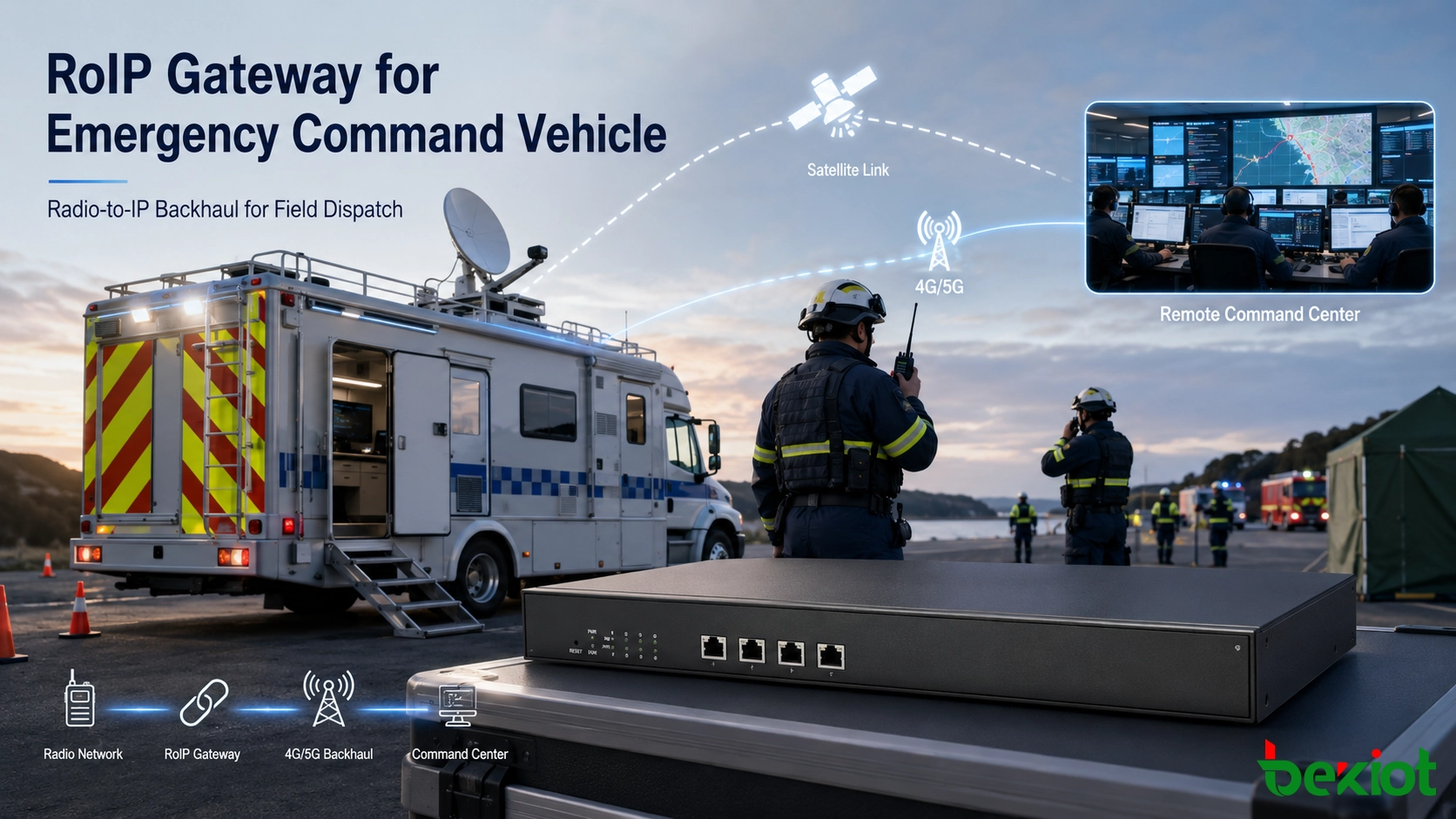
A RoIP gateway can bridge radio channels on an emergency command vehicle with a remote dispatch platform through IP backhaul.
Why field radios still need an IP bridge
Two-way radios remain important in emergency communication because they are fast, simple, and suitable for field use. Rescue teams, security teams, vehicle crews, fire response groups, engineering repair staff, and temporary command teams can use push-to-talk communication without complex operation.
The limitation is that radio communication is usually local. Coverage depends on transmit power, terrain, antenna height, repeater deployment, building blockage, and the radio system being used. At a large disaster site or temporary operation area, local radio coverage may not reach the remote command center directly.
A RoIP gateway creates an IP bridge for these radio channels. It converts radio-side audio and control signals into IP communication resources, allowing dispatchers, SIP phones, command platforms, or remote control rooms to communicate with field radio users through the emergency command vehicle.
Why command vehicles are suitable for RoIP deployment
An emergency command vehicle is often the best place to deploy a RoIP gateway. The vehicle usually stays close to the incident area and already contains communication equipment, network equipment, dispatch terminals, antennas, video transmission devices, and power systems.
By installing the gateway inside the vehicle, local radio equipment can be connected to the command network without changing how field users operate their handheld radios. The vehicle becomes a mobile communication hub between on-site radio users and the remote dispatch center.
This architecture is useful for emergency rescue, flood control, wildfire response, earthquake response, public safety operations, large-event security, military command, industrial accident handling, and temporary field command. It helps solve the last-mile communication problem between the front line and the command center.
How the gateway connects radio channels
A RoIP gateway connects with radios, vehicle-mounted transceivers, or other radio communication equipment through audio and control interfaces. Each connected radio channel can be mapped to a gateway port, SIP extension, dispatch resource, or platform channel.
In a four-channel deployment, one gateway can connect four different radio systems or four channels of the same radio system. For example, one channel may serve rescue operations, one may serve vehicle coordination, one may serve logistics support, and one may serve security or emergency response.
After configuration, the remote dispatcher can select the required channel and speak with field radio users. Field reports can also be sent back to the command center more clearly. This reduces dependence on manual relay by a vehicle operator and makes field communication more organized.
Satellite and 4G/5G backhaul extend radio communication
The gateway connects radio communication to IP communication, but the command vehicle still needs a backhaul network to reach the remote command center. In real deployments, this backhaul may use satellite communication, 4G/5G public network, private LTE or 5G network, broadband ad hoc network, microwave link, or wired broadband when available.
Satellite links are valuable when terrestrial networks are damaged, overloaded, or unavailable. 4G/5G links are useful when mobile network coverage is still available and bandwidth is sufficient. Some command vehicle projects use both paths together to improve resilience.
Once IP backhaul is available, the RoIP gateway can connect local radio channels to the remote dispatch platform. Dispatchers can speak with on-site radio users, and field teams can report status without leaving their normal radio workflow.
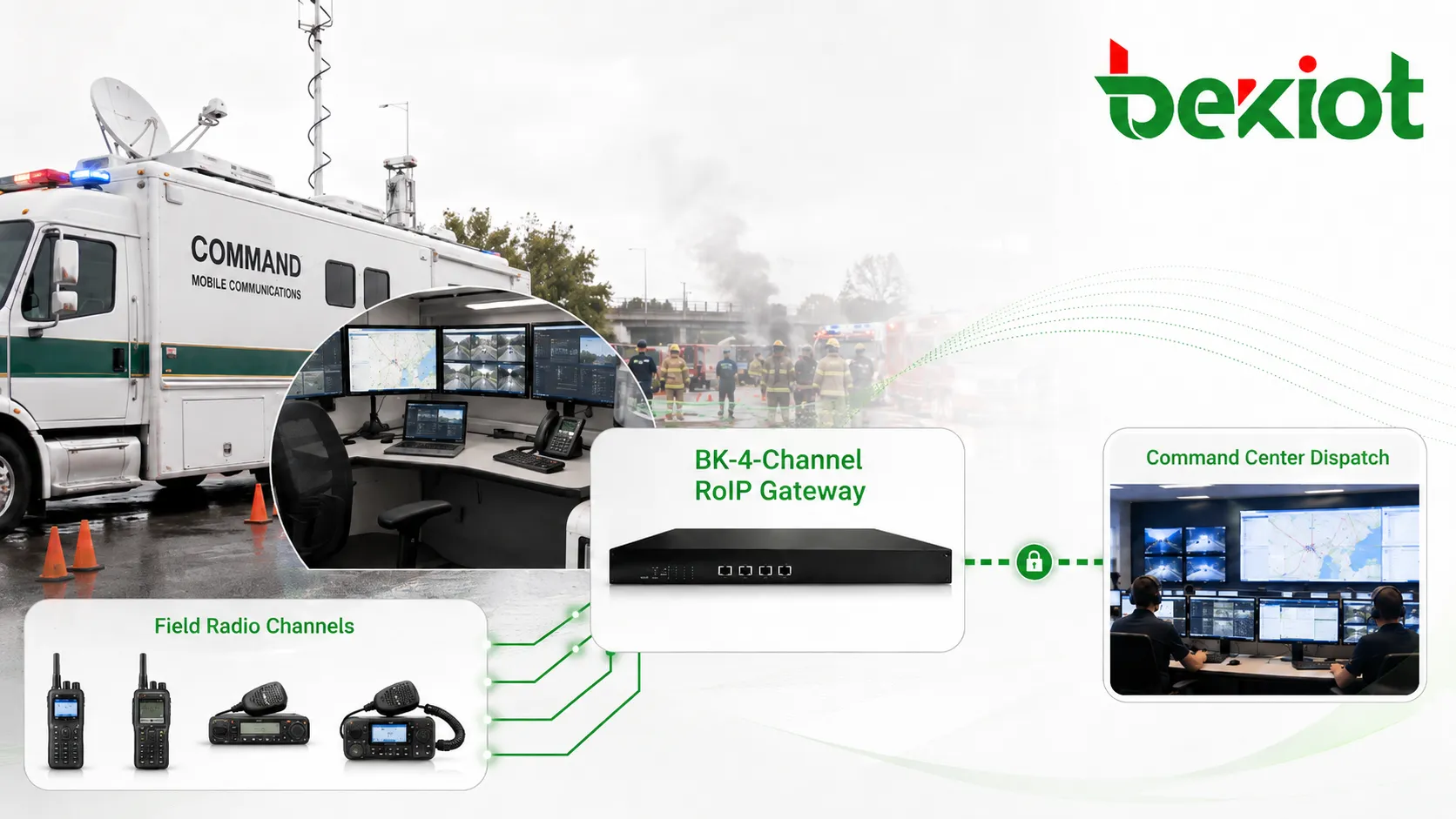
Satellite and 4G/5G backhaul allow radio traffic from the emergency scene to reach the remote command center.
Cross-system communication becomes easier
Emergency scenes often involve many organizations and many radio systems. Fire rescue, police, medical rescue, engineering repair, emergency management, transportation, utilities, and volunteer teams may all bring their own equipment. These systems may use different frequencies, channels, standards, and management rules.
Without integration, each team may only communicate inside its own radio group. The command center may need several radios, several operators, or manual message relay to coordinate different groups. During high-pressure incidents, this increases delay and creates room for communication errors.
A RoIP gateway helps create cross-system communication. Different radio systems can be connected to different gateway ports or channels, and the dispatch platform can organize them into a more unified command workflow. Dispatchers can call one channel, monitor another, or coordinate several teams from the same platform.
Vehicle-based dispatch improves front-line control
If the emergency command vehicle also carries a local dispatch platform, the gateway can connect radio resources into the vehicle-based command system. The vehicle operator can manage local radio groups, communicate with field personnel, and coordinate with the remote command center at the same time.
This is useful when the incident site needs both local autonomy and remote command support. The vehicle can act as the front-line dispatch node, while the command center provides higher-level coordination, resource allocation, decision support, and cross-department communication.
For example, the vehicle operator may handle routine radio traffic at the scene, while the command center joins the channel only when major decisions, evacuation instructions, or cross-agency coordination are required. This reduces communication pressure and keeps the command structure clearer.
Radio channels become manageable resources
A RoIP gateway does not only pass radio audio from one side to another. In a well-designed system, each radio channel becomes a communication resource that can be selected, assigned, monitored, recorded, or prioritized according to the command workflow.
One channel may be dedicated to rescue operations, another to logistics, another to traffic control, and another to emergency command. If different radio standards are used at the scene, the gateway can help bring them into the same dispatch environment.
This flexibility is valuable when an incident develops quickly. New teams may arrive, temporary groups may be created, and communication priorities may change. A gateway-based architecture gives the command team a more flexible way to organize field communication without replacing existing radios.
Typical system architecture
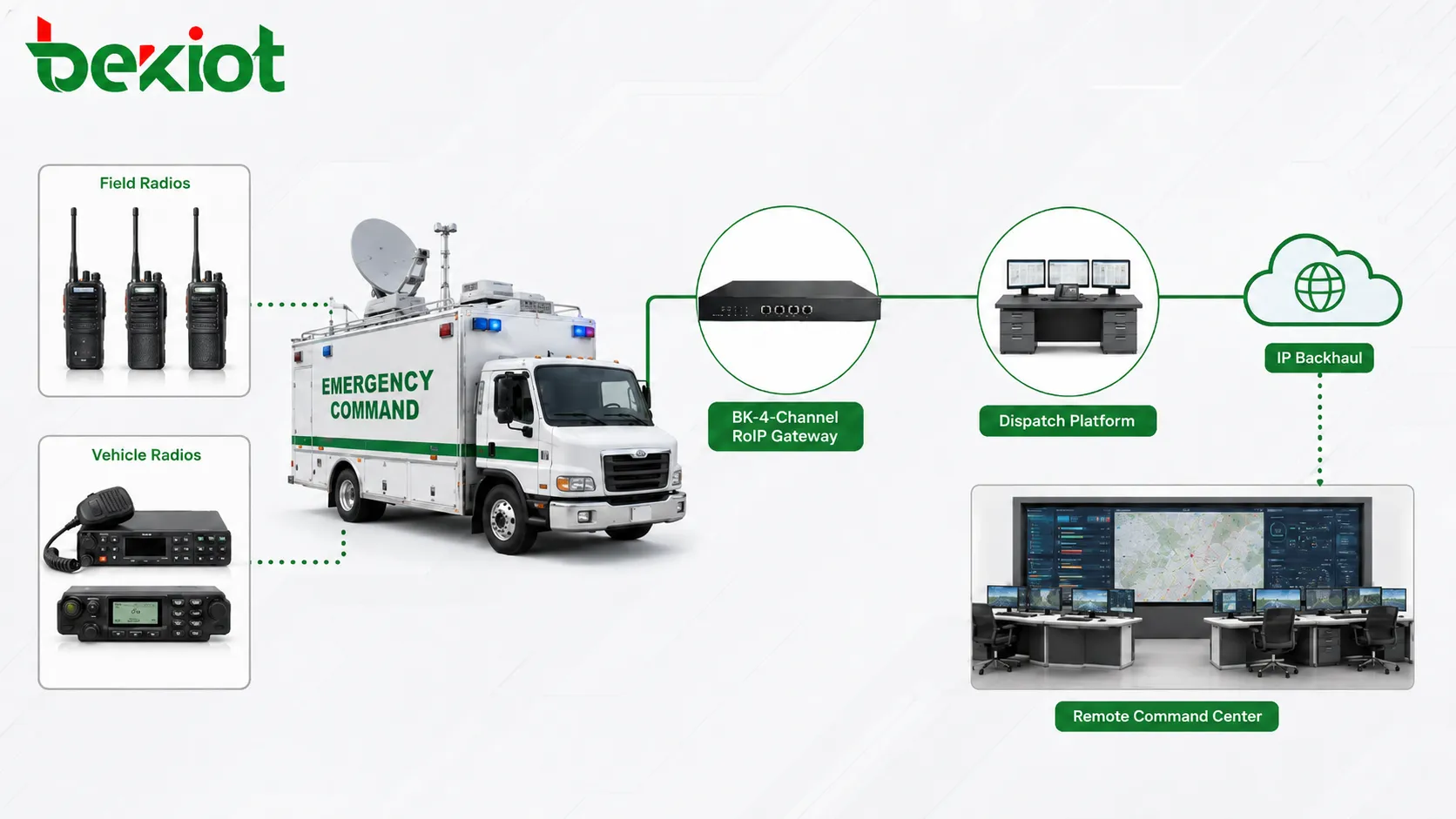
A practical emergency command vehicle communication architecture usually includes field handheld radios, vehicle radios, a RoIP gateway, local network switches, a router, satellite or 4G/5G backhaul equipment, a dispatch console, and a remote command-center platform.
Depending on the project, the system may also include video transmission, IP cameras, drone video, public address devices, recording systems, and emergency power. The radio side handles local push-to-talk communication. The gateway converts radio audio and control signals into IP communication. The network side carries traffic through satellite or mobile network links. The dispatch side allows operators to call, monitor, coordinate, and manage communication resources.
This layered design also supports expansion. A small command vehicle may start with two or four radio channels. A larger vehicle, command shelter, or mobile command post may connect more channels, more dispatch seats, more backhaul paths, and more integrated systems.
A complete vehicle-based communication system can combine radios, RoIP gateway access, IP backhaul, local dispatch, and remote command-center coordination.
Design points before deployment
Before deployment, the project team should confirm how many radio channels need to be connected, which radio standards are used, whether the radios are handheld units or vehicle-mounted transceivers, and how the gateway will connect to each device. Audio interface, PTT control, channel mapping, cable reliability, power supply, grounding, heat dissipation, and installation space should all be checked carefully.
Network planning is equally important. The command vehicle should have a stable LAN, secure routing rules, and a reliable backhaul path. If the system depends on satellite, latency and bandwidth should be considered. If it depends on 4G/5G, coverage, signal strength, data plans, and network congestion should be evaluated.
Communication permissions should also be defined. Not every dispatcher needs access to every channel. Emergency priority, recording, monitoring, call control, temporary group rules, and remote access rights should be configured according to the actual command workflow.
Audio quality and PTT control affect real performance
In emergency communication, audio quality is not a small detail. If the audio level is too low, too loud, distorted, delayed, or noisy, field users may miss important instructions. Gateway gain, radio volume, microphone level, impedance matching, interface wiring, and codec settings should be tested before delivery.
PTT control must also be stable. The gateway needs to handle push-to-talk behavior correctly between the IP dispatch side and the radio side. If PTT timing is not adjusted properly, the first words of a message may be clipped, or radio transmission may not be triggered reliably.
Acceptance testing should include command-center-to-radio calling, radio-to-command-center reporting, long-duration operation, channel switching, network interruption recovery, satellite link delay, and emergency priority communication. These tests help confirm that the system works in real operations, not only in a demonstration environment.
Why this architecture matters
The purpose of deploying a RoIP gateway on an emergency command vehicle is not simply to add another device. Its purpose is to make communication more continuous, coordinated, and controllable when different teams and different networks are involved.
Field teams can continue using familiar radios. The command vehicle can bridge those radio channels into an IP network. The remote command center can receive field reports and issue instructions more directly. This improves the speed and accuracy of emergency communication.
For emergency rescue, military command, public safety operations, utility repair, flood control, wildfire response, and large-event security, this architecture helps connect the front line with the command center and reduces the risk of isolated communication islands.
Summary
A RoIP gateway turns the emergency command vehicle into a stronger mobile communication hub. It connects local radio channels with IP dispatch platforms through satellite, 4G/5G, private networks, or other backhaul links, helping the remote command center communicate with field radio users more directly.
The value is strongest when the system is designed around real operation: correct radio interfaces, reliable PTT control, clear channel mapping, stable backhaul, practical permissions, good audio quality, and complete acceptance testing. With the right design, existing radios can continue serving field teams while becoming part of a wider command dispatch workflow.
FAQ
Can a RoIP gateway connect different radio standards at the same time?
Yes, depending on the gateway interface and project design. A multi-channel gateway can connect different radios or different channels, but each interface must match the radio equipment, cable connection, audio level, and PTT control method.
Does an emergency command vehicle always need satellite backhaul?
Not always. Satellite backhaul is useful when public networks are unavailable or damaged. If stable 4G/5G or private network coverage exists, mobile broadband may be enough. Many projects use both methods for redundancy.
Can the command center talk directly to field handheld radios?
Yes. After the radio channel is connected through the RoIP gateway and mapped to the dispatch platform, the command center can call the corresponding radio channel and communicate with field users through their existing radios.
What should be checked before installing the gateway in a vehicle?
The project team should check power supply, grounding, installation space, antenna layout, radio interface cables, network routing, heat dissipation, vibration resistance, backhaul availability, and maintenance access inside the vehicle.
Is this architecture only for large emergency command vehicles?
No. The same concept can be used in smaller command vehicles, mobile command shelters, temporary field command posts, and fixed emergency dispatch centers. The number of channels and system complexity can be adjusted according to project scale.