VoIP, VoLTE, VoNR and VoWiFi Explained for Modern Communication Systems
A clear comparison of VoIP, VoLTE, VoNR, and VoWiFi, explaining how each voice technology works across IP networks, 4G, 5G, and Wi-Fi, with practical guidance for enterprise and telecom planning.
Becke Telcom
Voice communication has moved far beyond traditional telephone lines. Today, calls may travel through enterprise IP networks, mobile operator cores, 4G LTE access, 5G standalone networks, or Wi-Fi environments. VoIP, VoLTE, VoNR, and VoWiFi are four important technologies behind this change. They all carry voice in a packet-based way, but they do not represent the same architecture, service model, or deployment scenario.
For enterprises, telecom operators, system integrators, and communication engineers, these terms are not only technical labels. They affect how a system is planned, how calls are routed, how users stay connected, which party controls the service, and whether voice can be integrated with video, dispatch, recording, conferencing, emergency communication, and unified communication platforms.
The right choice depends on the network being used, the type of user identity, the role of the operator, the required call quality, and the service scenario. VoIP is the broad foundation of voice over IP communication. VoLTE and VoNR are operator-grade mobile voice technologies for 4G and 5G networks. VoWiFi extends mobile-number-based calling into Wi-Fi coverage areas.
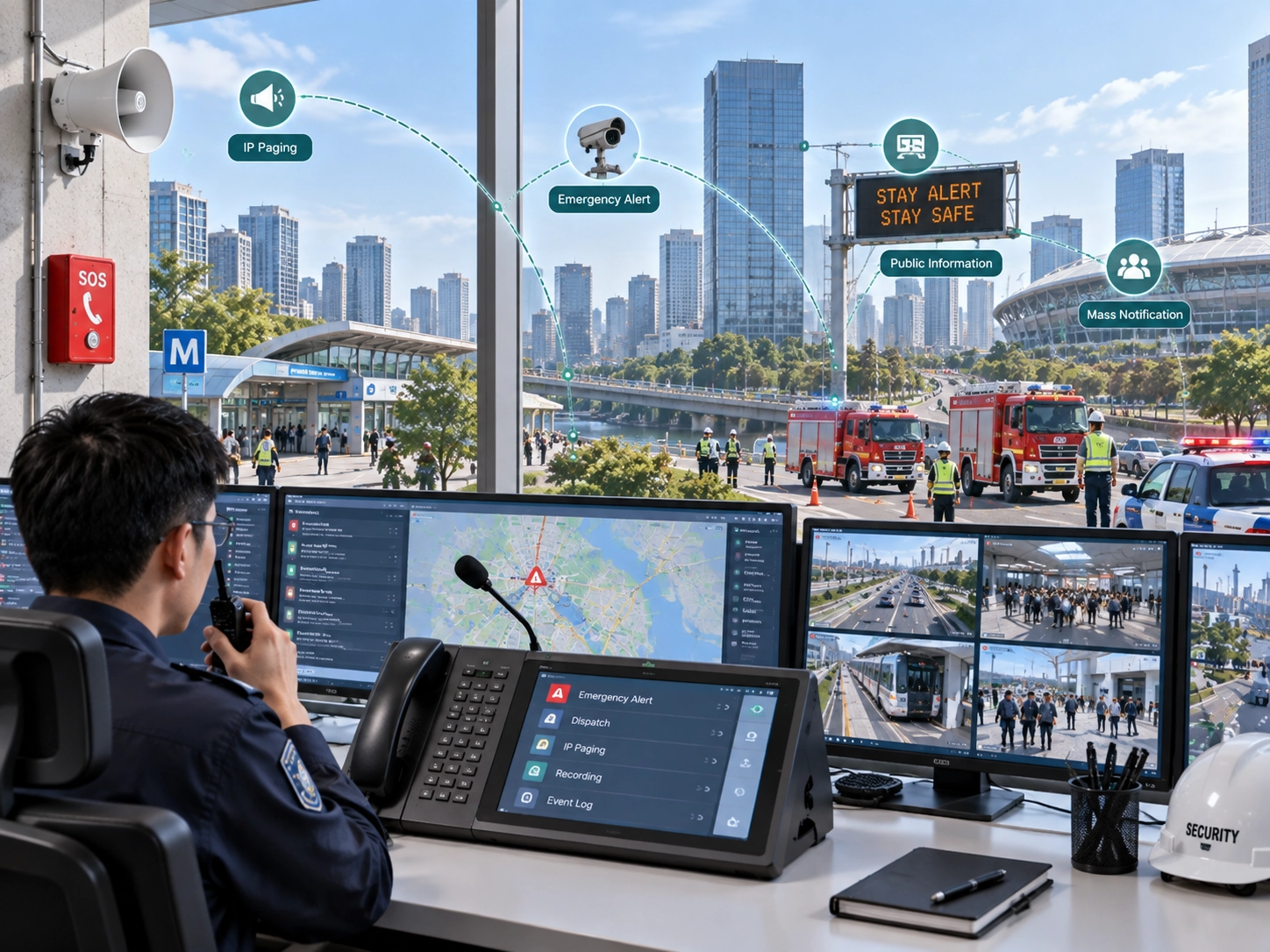
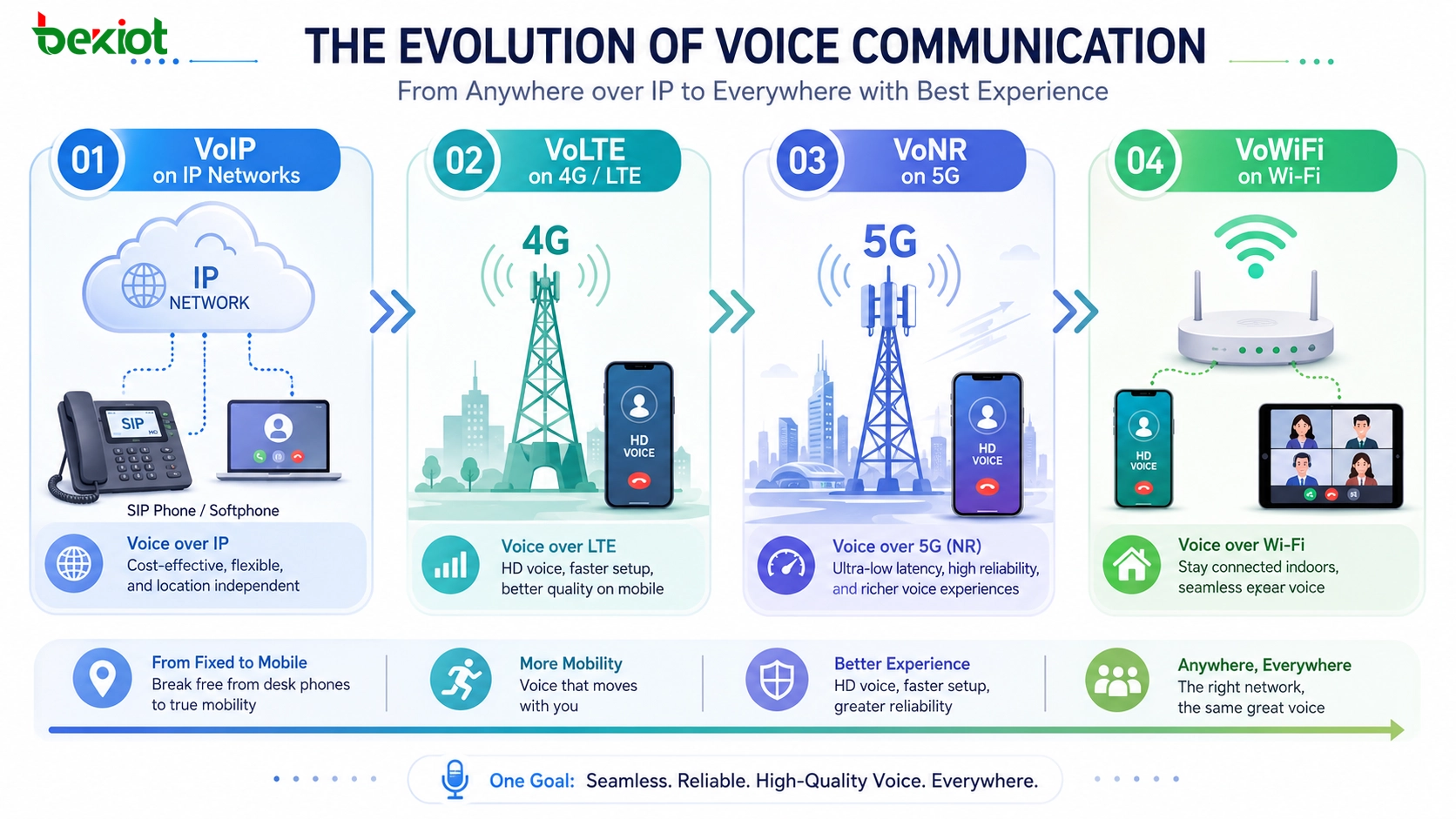
VoIP, VoLTE, VoNR, and VoWiFi show the evolution of voice communication from fixed IP networks to mobile and multi-access environments.
The Common Idea Behind Voice over Networks
The “Vo” in these technologies usually means “Voice over.” VoIP means Voice over Internet Protocol, VoLTE means Voice over LTE, VoNR means Voice over New Radio, and VoWiFi means Voice over Wi-Fi. In each case, voice is carried over a specific type of data network instead of relying only on traditional circuit-switched telephone infrastructure.
The deeper technical shift is the move from circuit-switched voice to packet-based communication. In traditional telephone networks, a dedicated circuit was reserved for a call. In IP-based systems, voice is encoded, divided into packets, transmitted through a data network, and reconstructed at the receiving side. This makes voice easier to combine with video, messaging, routing, recording, conference services, and software-based communication platforms.
Real-time voice is more demanding than ordinary data transfer. A file download can tolerate delay, but a conversation cannot. Voice systems need controlled latency, low jitter, packet-loss handling, codec negotiation, stable signaling, and predictable network behavior. This is why professional voice systems are not only about “making calls over the internet.” They require proper architecture, protocol support, and service control.
VoIP as the Foundation of IP Voice
VoIP stands for Voice over Internet Protocol. It is the broadest concept among the four technologies. VoIP allows voice and video communication to be carried over IP networks, including public internet connections, enterprise LANs, private WANs, VPNs, data center networks, and carrier-managed IP networks.
Before VoIP became common, long-distance and international calls depended heavily on traditional telephone infrastructure. Video communication often required dedicated systems. As IP networks became faster, more stable, and more widely deployed, voice and video traffic began moving to software clients, IP phones, SIP servers, softswitch platforms, cloud communication systems, and enterprise PBX platforms.
In business environments, VoIP is widely used for internal extensions, SIP trunking, customer service centers, video meetings, dispatch consoles, intercom systems, industrial telephony, emergency communication, and unified communication platforms. Its value is not only cost reduction. It gives organizations more control over numbering plans, call routing, endpoint management, recording, conferencing, and integration with business systems.
SIP and RTP in Practical VoIP Systems
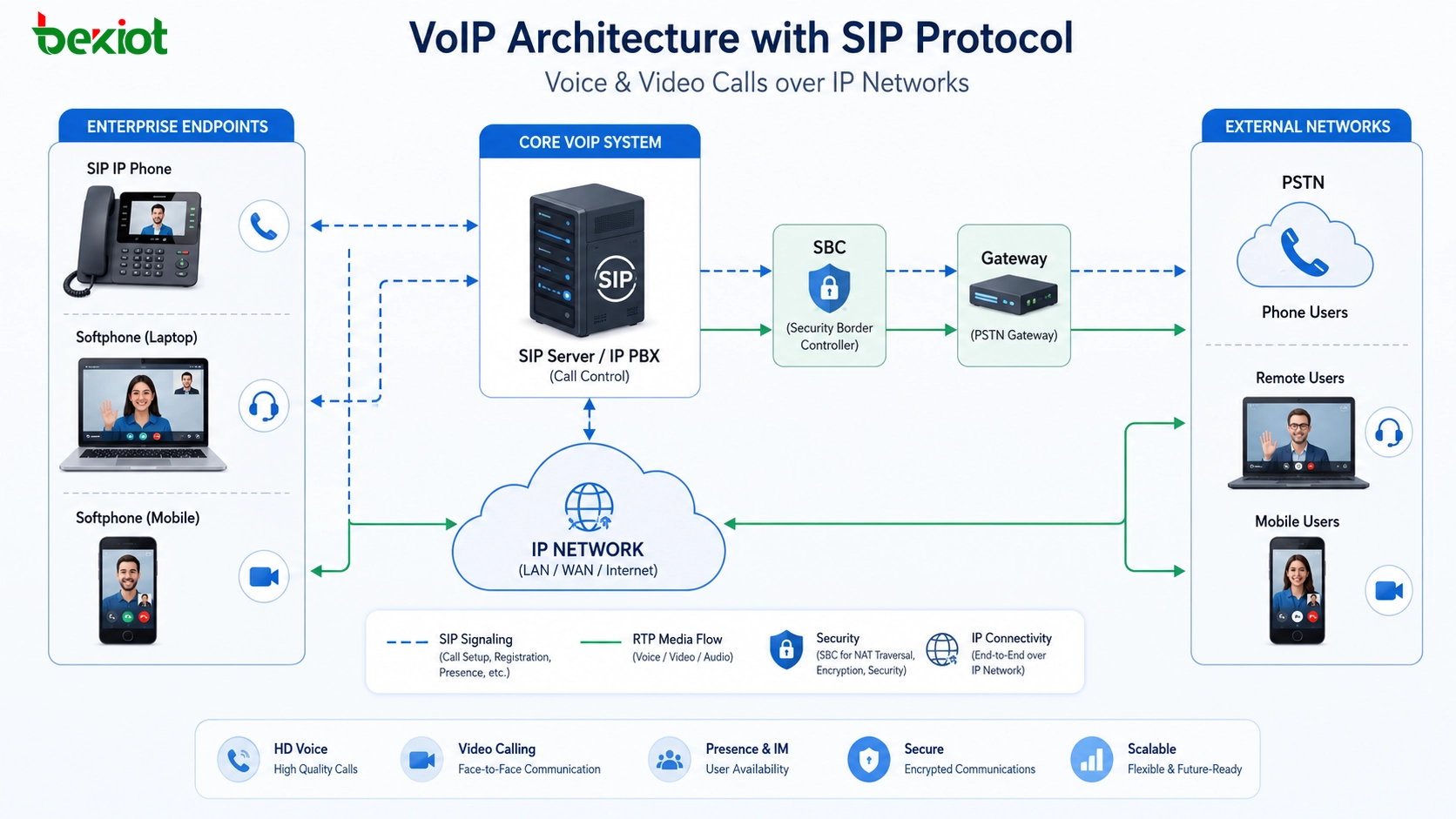
In many VoIP deployments, SIP is one of the most important signaling protocols. SIP, or Session Initiation Protocol, is responsible for establishing, managing, and ending communication sessions. It handles user registration, call setup, ringing, answering, transfer, hold, forwarding, and call release.
SIP normally does not carry the actual voice stream. The media is usually transmitted by RTP or a similar real-time transport protocol. In simple terms, SIP decides how the call is created and controlled, while RTP carries the voice or video packets during the session. This separation makes SIP flexible and suitable for many types of communication systems.
For enterprise and industrial projects, SIP is often the core of the communication architecture. SIP phones, softphones, IP PBX systems, SIP intercoms, paging terminals, gateways, SBCs, dispatch platforms, and recording servers can all work together through a SIP-based structure. This is why VoIP is not just an app-based calling technology. It is also the backbone of many modern business and mission-critical communication systems.
In many VoIP systems, SIP manages signaling while RTP carries the real-time media stream for voice and video communication.
Why 4G Needed Native Mobile Voice
VoLTE stands for Voice over LTE. It was designed to solve a practical problem in 4G mobile networks. LTE was originally built as a high-speed packet data network, but mobile users still needed normal phone-number-based voice service. Without a native LTE voice solution, many networks had to use fallback mechanisms for calls.
Before VoLTE became widely deployed, a mobile phone might fall back from 4G to an older 2G or 3G circuit-switched network when making or receiving a voice call. This could increase call setup time, interrupt the 4G data experience, and reduce service consistency. Users might notice slower data, delayed call connection, or network switching during calls.
VoLTE allows mobile calls to be carried directly over the LTE packet network while still using the user’s normal mobile number. It is controlled by the mobile operator and typically depends on IMS core network support, device compatibility, SIM configuration, service policy, and regional network deployment.
What VoLTE Improves for Users and Operators
The most obvious user benefit of VoLTE is that voice and data can work at the same time on 4G. A user can make a phone call while continuing to use navigation, messaging, mobile office apps, file transfer, or online services. This is a major improvement compared with older fallback-based voice methods.
VoLTE can also improve voice quality when the network and device support high-definition voice codecs. It can reduce call setup time, provide a smoother calling experience, and help operators move voice service into an all-IP mobile core. From the operator’s perspective, VoLTE supports more efficient spectrum use and helps reduce dependence on legacy 2G or 3G voice networks.
It is important to understand that VoLTE is not the same as installing a VoIP app on a smartphone. A VoIP app may use an app account and an internet connection. VoLTE uses the native phone dialer, the mobile number, and the operator’s voice service infrastructure. This makes it part of the carrier-grade mobile communication system rather than a standalone internet calling application.
Native Voice in the 5G Era
VoNR stands for Voice over New Radio. It is the native voice solution for 5G networks, especially in 5G standalone environments. In practical terms, VoNR can be viewed as the 5G-era equivalent of VoLTE, but it is designed for 5G New Radio access and 5G core network architecture.
The main value of VoNR is service continuity on 5G. When VoNR is supported, a mobile device can stay on 5G while making or receiving a voice or video call. Without VoNR, some networks may still fall back to VoLTE over 4G for voice service. This fallback can reduce the sense of a complete 5G experience.
Because 5G networks are designed for higher bandwidth, lower latency potential, and more advanced service capabilities, VoNR can support clearer audio, faster response, and better integration with 5G data services when the full network chain is ready. It is especially relevant as operators expand standalone 5G coverage and move toward a more complete 5G service environment.
Conditions Required for VoNR
VoNR is not guaranteed just because a phone displays a 5G icon. Several conditions must be met. The area needs suitable 5G coverage, the operator must enable VoNR service, the device must support VoNR in hardware and software, and the user’s SIM profile or service plan may also need to support it.
In mixed network environments, it is common for data to use 5G while voice still falls back to VoLTE. This is not necessarily a device fault. It may be caused by incomplete 5G standalone deployment, operator policy, coverage limitations, or service configuration. Users may therefore see different behavior across different regions, operators, and phone models.
For telecom planning, VoNR represents the direction of native 5G voice service. It helps voice, video, messaging, and data services move into a more unified 5G architecture instead of depending on 4G fallback for call handling.
Wi-Fi as an Access Path for Carrier Voice
VoWiFi stands for Voice over Wi-Fi. It allows mobile voice calls to be carried through a Wi-Fi network while still using the user’s mobile number and the operator’s voice service. This is different from an ordinary app call over Wi-Fi because the call remains part of the carrier’s phone-number-based service.
The main reason for VoWiFi is indoor and weak-signal coverage. Many users spend much of their time in homes, offices, hotels, campuses, shopping centers, basements, elevators, underground facilities, or thick-wall buildings. In these places, cellular signal may be weak even when Wi-Fi is strong. VoWiFi allows the phone to use Wi-Fi access to complete voice calls where mobile coverage is limited.
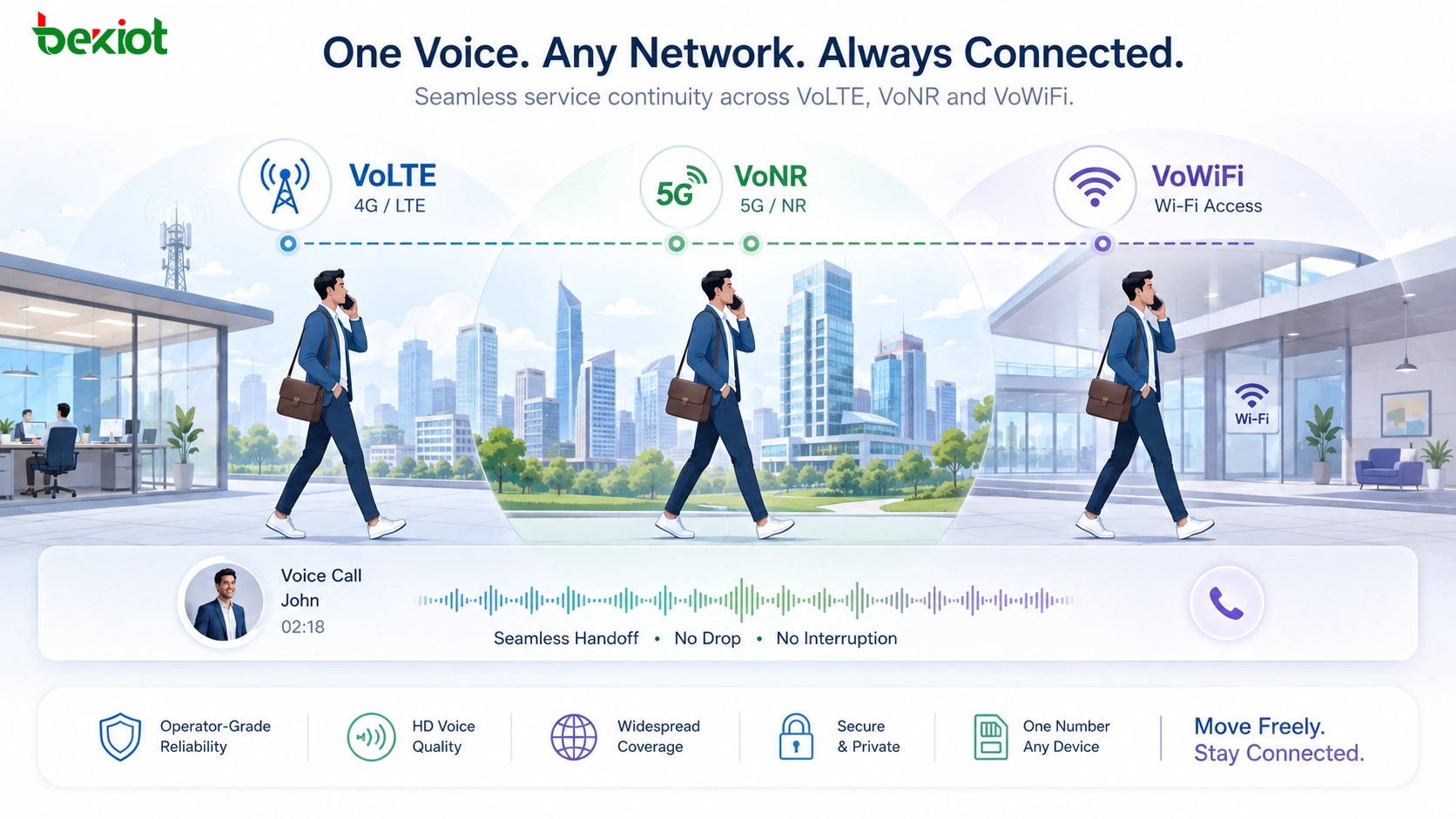
VoWiFi can work together with VoLTE and VoNR when supported by the operator and device. In a mature mobile network, calls may move between Wi-Fi and cellular access with minimal disruption. This improves service availability and can reduce pressure on indoor cellular coverage construction.
VoLTE, VoNR, and VoWiFi help carrier voice services continue across 4G, 5G, and Wi-Fi access networks when supported by the operator and device.
Key Differences in Service Control
The biggest difference between these technologies is not only the access network. It is also who controls the service. VoIP can be deployed by enterprises, service providers, cloud communication platforms, or application providers. A company can build its own SIP platform, connect IP phones, create internal extensions, and manage call routing independently.
VoLTE, VoNR, and VoWiFi are usually controlled by mobile operators. They rely on operator network infrastructure, IMS service capability, mobile number identity, SIM configuration, policy control, billing systems, and device certification. Users may see these services through the native phone interface, but the service logic is still managed by the carrier.
This distinction is important for project planning. An enterprise can design and deploy a VoIP-based IP PBX or dispatch system, but it cannot independently “install VoLTE” in the same way. VoLTE and VoNR require operator-side network support. VoWiFi also requires carrier support even though the access network is Wi-Fi.
Choosing the Right Path for a Project
For enterprise communication, VoIP is usually the correct starting point. If a company needs SIP phones, softphones, IP PBX, dispatch consoles, intercom, paging, recording, SIP trunking, conferencing, or unified communication, a VoIP/SIP architecture gives the organization the most direct control over its internal system.
For public mobile voice services, VoLTE and VoNR are the key operator-side technologies. VoLTE supports native voice over 4G LTE, while VoNR supports native voice over 5G when network conditions allow. These technologies are important for mobile subscribers because they provide normal phone-number-based calling without relying on separate apps.
For indoor coverage improvement, VoWiFi is highly useful. It allows users to keep mobile-number-based calling available in places where cellular signal is weak but Wi-Fi is stable. This makes it valuable for homes, offices, hotels, underground spaces, campuses, and large buildings.
Engineering Considerations for Deployment
When designing a VoIP system, engineers need to consider SIP compatibility, codec selection, RTP media paths, NAT traversal, firewall rules, QoS, jitter buffering, packet loss control, endpoint authentication, encryption, call routing, redundancy, and gateway integration. VoIP is flexible, but poor network design can still lead to delay, echo, dropped audio, or unstable calls.
When evaluating VoLTE or VoNR, the focus shifts to operator support. Engineers and users need to confirm device capability, SIM support, carrier service availability, regional coverage, and whether the service is enabled by the operator. In some cases, a device may technically support VoNR, but the local network or operator profile may not allow it.
For VoWiFi, Wi-Fi quality becomes critical. A weak, congested, or poorly roaming Wi-Fi network can still create poor voice quality. Good VoWiFi performance depends on stable bandwidth, low latency, suitable roaming behavior, reliable internet access, and correct operator-side support.
Where Each Technology Fits Best
VoIP fits enterprise and private communication environments. It is common in office phone systems, industrial communication, SIP dispatch platforms, call centers, conference systems, customer service, intercom networks, and unified communication platforms. It is also the foundation behind many internet audio and video calling applications.
VoLTE fits everyday mobile calling on 4G networks. It allows users to keep data service active during calls and improves the native mobile calling experience. It also helps operators modernize mobile voice services and reduce long-term reliance on older networks.
VoNR fits the evolution of 5G voice. It is important for operators building 5G standalone networks and for users who need a more complete 5G service experience during voice or video calls. As 5G networks mature, VoNR becomes more important for native 5G communication.
VoWiFi fits indoor, underground, and weak cellular coverage scenarios. It is especially useful in places where Wi-Fi is available but cellular signal is unreliable. It helps maintain normal mobile-number-based calls without requiring the user to switch to an app-based communication service.
Misunderstandings That Cause Confusion
A common misunderstanding is treating VoIP and VoLTE as the same thing. VoLTE is built on packet-based principles, but it is a carrier-controlled mobile service for LTE networks. VoIP is a broader category that can be used in many private, public, enterprise, and application-based IP environments.
Another misunderstanding is thinking VoWiFi is the same as making an app call over Wi-Fi. A calling app normally uses an app account and internet service. VoWiFi uses Wi-Fi as the access path for the operator’s mobile-number-based voice service.
A third misunderstanding is assuming 5G always means VoNR. A phone may use 5G for data while still using VoLTE fallback for voice. VoNR depends on network deployment, operator service capability, device support, and account configuration.
Summary
VoIP, VoLTE, VoNR, and VoWiFi are related because they all represent packet-based voice communication, but they serve different purposes. VoIP is the broad foundation for voice and video over IP networks. It is widely used in enterprise communication, IP PBX systems, SIP platforms, dispatch, industrial communication, and unified communication solutions.
VoLTE brings native voice service to 4G LTE networks and helps users make mobile-number-based calls while keeping data service active. VoNR extends native voice into 5G networks, allowing calls to remain on 5G when the operator, device, network, and service profile support it.
VoWiFi adds another access layer by allowing operator voice service to use Wi-Fi where cellular coverage is weak. Together, these technologies show how voice communication has evolved from fixed circuits to IP networks, mobile broadband, 5G, and multi-access service continuity. For enterprise system design, VoIP and SIP remain the best starting point. For carrier mobile service, VoLTE, VoNR, and VoWiFi define how modern mobile voice is delivered.
FAQ
Does VoIP require a public internet connection?
No. VoIP can run on the public internet, but it can also work on a private LAN, enterprise WAN, VPN, data center network, or carrier-managed IP network. Many professional VoIP systems are deployed in controlled private networks for better quality and security.
Why does a phone sometimes switch from 5G to 4G during a call?
This usually means the device or local network is using VoLTE fallback for voice service. VoNR may not be enabled, supported, or available in that specific area, even if 5G data service is visible.
Can enterprises build their own VoLTE or VoNR system?
Not in the same way they build a VoIP or SIP system. VoLTE and VoNR are operator-grade mobile services that depend on carrier core networks, IMS infrastructure, SIM profiles, radio access networks, and operator service policies.
Is VoWiFi useful if cellular signal is already strong?
It can still be useful, but its biggest value appears where cellular coverage is weak and Wi-Fi is stable. In strong cellular areas, the phone may prefer VoLTE or VoNR depending on operator policy and device settings.
Which technology is most relevant for IP PBX and SIP dispatch systems?
VoIP is the most relevant technology for IP PBX, SIP dispatch, intercom, paging, recording, and enterprise communication platforms. VoLTE, VoNR, and VoWiFi are mainly used for operator-controlled mobile voice services.