AudioCodes Annual Analysis: Voice Infra & AI Strategy Market Outlook
AudioCodes annual report analysis covering financial resilience, SBC and gateway market position, regional demand, risk factors, VoiceAI expansion, GenAI integration and the company’s shift toward intelligent communications.
Becke Telcom
AudioCodes’ latest annual report offers a useful view of where the company stands today and where it is trying to move next. For investors, channel partners and enterprise communication buyers, the report is more than a routine disclosure. It shows how AudioCodes is balancing a mature voice infrastructure business with a faster shift toward AI-enabled communications, cloud collaboration and intelligent service platforms.
The company remains closely tied to enterprise voice, session border controllers, gateways, Microsoft Teams ecosystems and service provider communications. At the same time, its annual report makes clear that future growth is increasingly connected to software, managed services, VoiceAI, contact center automation and generative AI integration.
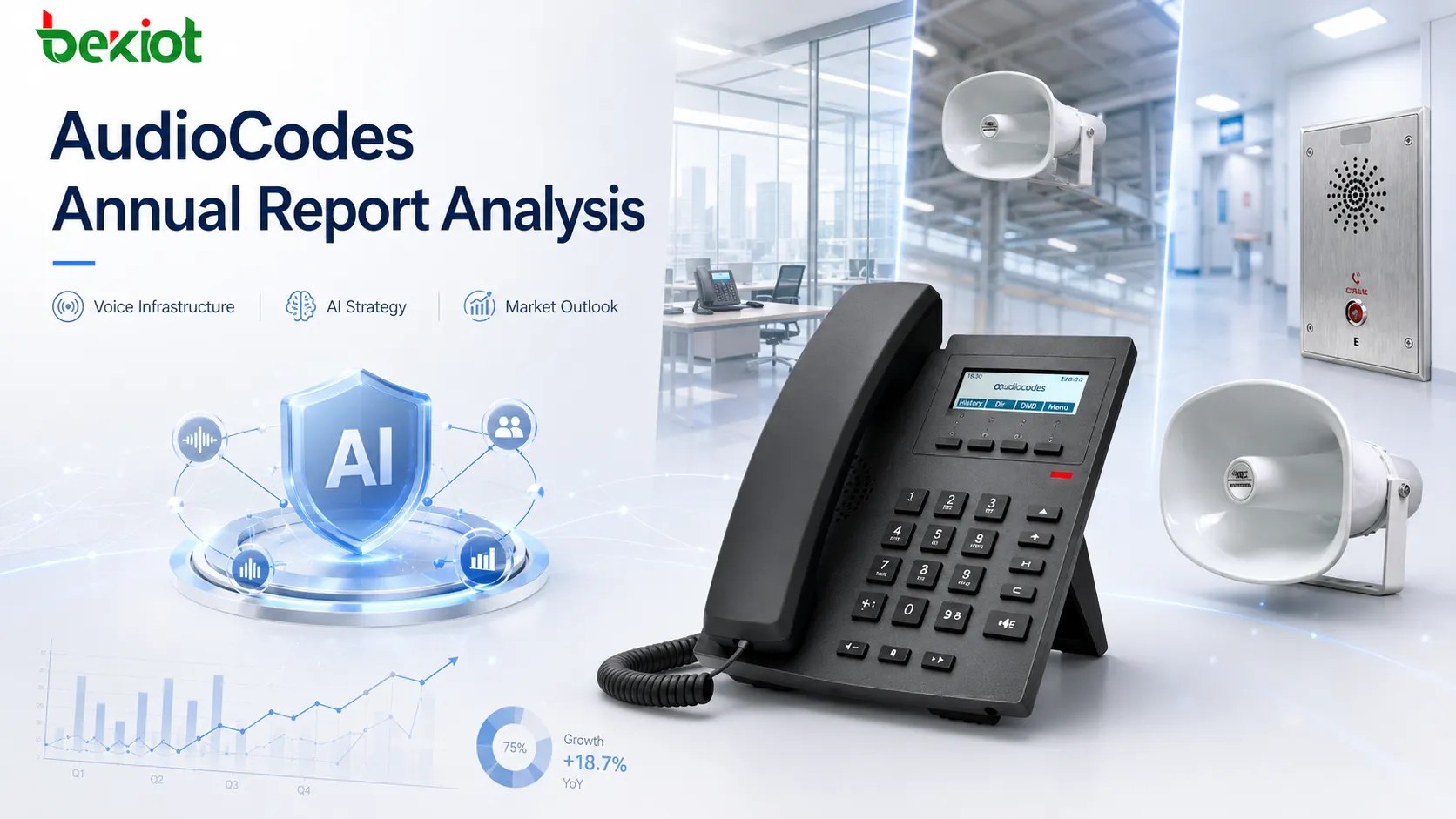
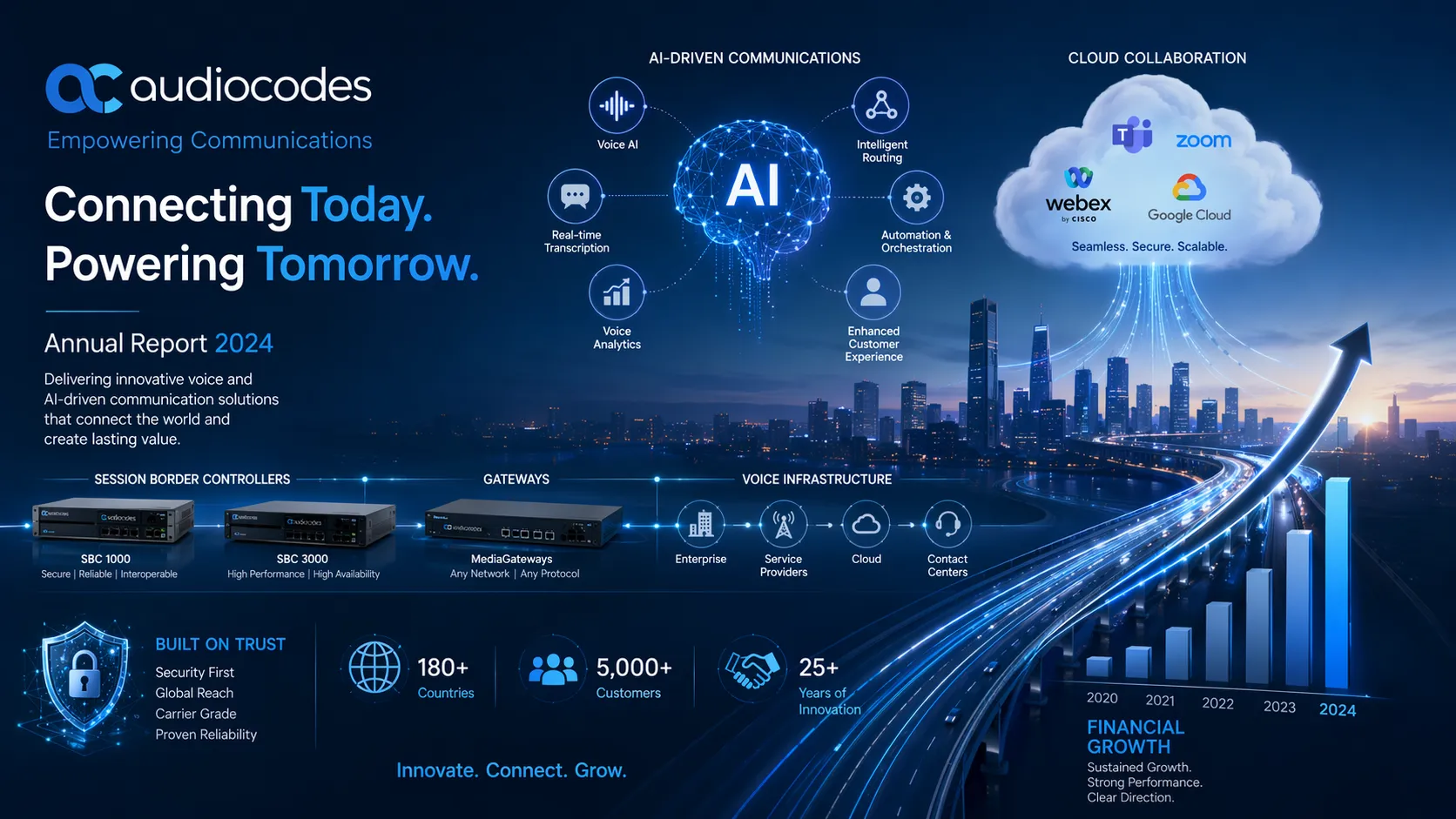
AudioCodes’ annual report highlights a business model built on voice infrastructure strength, cloud communications and AI-driven product expansion.
Annual report signals stability with strategic pressure
The report presents AudioCodes as a company with a stable foundation, but not without pressure. Its core voice infrastructure business remains relevant, especially in enterprise and service provider environments where secure, reliable and scalable voice connectivity is still required. However, the wider market is changing quickly. Cloud migration, AI adoption, regulatory complexity, supply chain risk and geopolitical uncertainty are all shaping the company’s operating environment.
One of the important messages in the report is that AudioCodes understands these risks. The filing discusses uncertainty around regional instability, global inflation, supply chain fragility, changing regulation and technology transition. This does not weaken the company’s story; instead, it gives the report a more realistic tone. The company is not only presenting growth themes, but also acknowledging the conditions that could affect execution.
Regional demand remains an important support
AudioCodes’ regional performance suggests that demand for enterprise voice infrastructure has not disappeared. While some local or domestic market pressure exists, international demand continues to support the company’s business. This matters because AudioCodes is not dependent on one single geography or one narrow product category.
A diversified regional structure gives the company more room to absorb market fluctuations. For customers, it also shows that AudioCodes remains active in global communications projects where voice reliability, cloud collaboration, contact center migration and secure connectivity are still high-priority requirements.
SBC and gateway products remain a core strength
AudioCodes continues to hold a strong position in access devices, enterprise session border controllers and gateways. These categories may not sound as new as AI software, but they remain essential in real communication networks. Enterprises still need to connect cloud platforms, SIP trunks, legacy PBX systems, contact centers, branch offices and security-sensitive voice environments.
In the enterprise SBC market, AudioCodes competes with vendors such as Oracle, Ribbon Communications and Cisco. The company’s value is built around voice security, interoperability, stability under high concurrency and flexible deployment. These strengths are especially important in finance, energy, transportation, command centers and other environments where voice service continuity cannot be treated casually.
In analog and digital gateway markets, AudioCodes faces competition from Ribbon Communications, Cisco, Grandstream and Sangoma. Even so, its long experience in telephony migration, hybrid voice networks and enterprise connectivity continues to give the company relevance where customers need to bridge old and new communication systems.
Business Area
Strategic Role
Market Meaning
Session border controllers
Secure SIP connectivity, cloud voice access, service continuity.
Supports enterprise migration to cloud communications and Teams environments.
Gateways
Bridge analog, digital and IP voice systems.
Helps customers modernize without replacing all legacy infrastructure at once.
VoiceAI solutions
Meeting intelligence, interaction analytics, contact center automation.
Moves the company beyond hardware into AI-enabled software value.
Managed service platforms
Analytics, monitoring, partner visibility and lifecycle support.
Strengthens recurring service and operational management value.
AI is becoming the center of the next growth story
The most important strategic direction in the report is artificial intelligence. AudioCodes is no longer positioning AI as a small feature added to existing products. It is treating AI as a central driver of future communications value.
This direction reflects a broader enterprise trend. Businesses no longer want voice systems that only transmit calls. They want communication platforms that can capture conversations, extract insights, summarize meetings, automate service interactions, improve compliance review and connect voice data with business workflows.
For AudioCodes, this creates a clear transition path. The company can use its voice infrastructure experience as a base, then add AI layers that turn calls, meetings and customer interactions into more useful business data.
VoiceAI portfolio shows the software transition
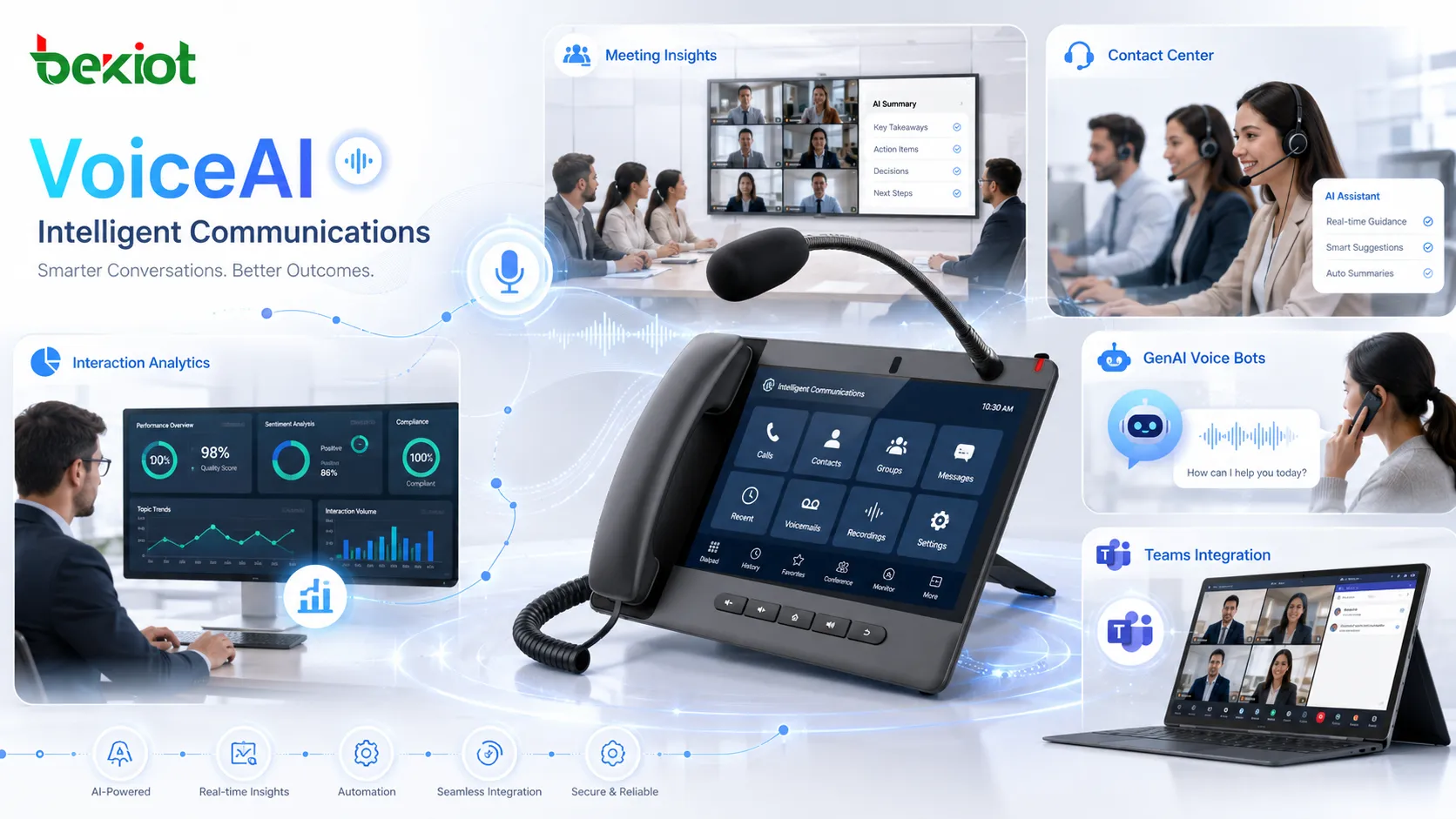
AudioCodes’ VoiceAI portfolio is one of the clearest signs of this shift. Meeting Insights is designed to record, transcribe and analyze meetings. Its value is not only in storing meeting content, but in generating summaries, action items and structured takeaways that help teams work more efficiently after the meeting ends.
Voca CIC is another important example. Positioned as an AI-first omnichannel contact center solution for Microsoft Teams, it combines conversational IVR, virtual agents and AI-generated summaries. This makes it relevant for organizations that want customer engagement tools to work more closely with their existing collaboration platform.
Interaction Insights adds another layer by applying AI analytics to recording, compliance, quality assurance and training. This is important because recorded voice data is no longer just an archive. In modern service environments, it can become a source of operational intelligence.
AudioCodes is extending its voice expertise into AI-powered meetings, contact centers, interaction analytics and generative voice applications.
Bridging traditional telephony and GenAI
A practical part of AudioCodes’ AI strategy is the bridge between traditional telephony and modern AI frameworks. Many enterprises still operate complex voice environments that include PBX systems, SIP trunks, contact centers, gateways and cloud collaboration tools. They cannot replace everything overnight just to use AI.
Solutions such as VoiceAI Connect and Live Hub are positioned around this problem. They allow organizations to connect existing voice systems with large language models, cognitive speech services, voice bots and virtual agents. This approach is valuable because it supports modernization without forcing a full communication infrastructure replacement.
In practical terms, AudioCodes is trying to become an enablement layer for enterprise AI adoption in voice communication. That may be more sustainable than competing only as a traditional gateway or SBC vendor.
AI is also reaching devices and meeting rooms
The report also shows that AudioCodes is applying AI beyond software platforms. Its room and meeting solutions are using AI for speaker tracking, noise reduction and more natural video collaboration. These features matter because workplace communication is no longer limited to voice calls or conference bridges.
Hybrid work has created demand for smarter meeting spaces. Users expect clearer audio, better video framing, automated notes and easier collaboration. By bringing AI into meeting rooms and devices, AudioCodes is connecting its infrastructure experience with daily workplace productivity.
Unified communications and contact center are converging
Another key theme is the convergence of unified communications and contact center functions. Microsoft Teams and similar cloud collaboration platforms are increasingly becoming shared environments for internal communication and customer-facing workflows.
AudioCodes is aligning its products with this trend by combining voice connectivity, contact center automation, AI summaries, virtual agents and analytics. For enterprises, the appeal is simpler architecture, fewer management layers and a more connected experience between employees and customers.
Analytics and managed services add recurring value
AudioCodes is also expanding the value of its Live Platform through real-time analytics and AI-based insights. This gives service providers and partners better visibility into usage, quality, performance and operational issues.
This is important because communications infrastructure is increasingly managed as a lifecycle service. Customers want reliability, monitoring, optimization and fast troubleshooting. Partners want tools that help them operate services more efficiently. Analytics can turn AudioCodes’ platform from a product sale into a more continuous service relationship.
Risks and opportunities are both visible
The annual report does not present a risk-free picture. AudioCodes still faces competition, geopolitical uncertainty, supply chain exposure, inflation pressure and the challenge of executing a technology transition while protecting its core business. These are real issues, especially for a company operating across global enterprise and service provider markets.
At the same time, the opportunity is clear. Voice is not disappearing. It is becoming more connected to cloud platforms, AI automation, analytics, contact center modernization and compliance workflows. AudioCodes has a credible position because it already understands the voice layer that many enterprises still rely on.
Conclusion
AudioCodes’ annual report shows a company moving through a careful transition. Its SBC and gateway business still provides a stable foundation in enterprise voice infrastructure, while its AI strategy points toward a higher-value software and service future.
The company’s challenge is to balance both sides. It must continue supporting secure and reliable voice infrastructure while proving that VoiceAI, GenAI integration, contact center automation, meeting intelligence and managed service analytics can become meaningful growth drivers. If that balance works, AudioCodes may remain relevant not only as a voice infrastructure vendor, but as an intelligent communications platform provider.
FAQ
What is the main takeaway from AudioCodes’ annual report?
The report suggests that AudioCodes remains stable in core voice infrastructure while investing more heavily in AI, cloud communications, VoiceAI products and intelligent service platforms.
Which product areas remain important for AudioCodes?
Session border controllers, gateways, Microsoft Teams voice solutions, contact center tools, VoiceAI products and managed service platforms remain important parts of the company’s strategy.
Who are AudioCodes’ main competitors in SBC and gateway markets?
In SBC markets, AudioCodes competes with vendors such as Oracle, Ribbon Communications and Cisco. In gateway markets, competitors include Ribbon Communications, Cisco, Grandstream and Sangoma.
Why is AI important to AudioCodes?
AI helps AudioCodes move beyond traditional voice connectivity into meeting intelligence, contact center automation, interaction analytics, virtual agents, voice bots and service optimization.
What risks does the company still face?
Key risks include geopolitical uncertainty, supply chain pressure, inflation, regulatory complexity, strong competition and the challenge of turning AI strategy into sustained business growth.