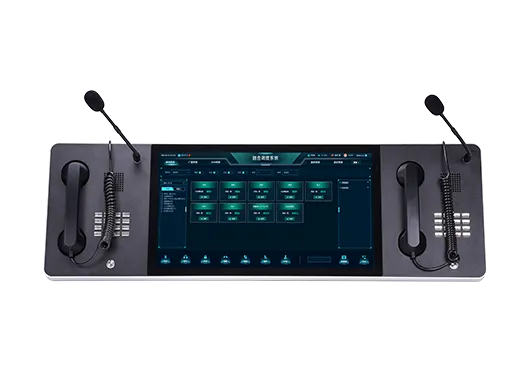
Highway Toll Station SIP Intercom and Camera Linkage for Control Room Response
Highway toll station SIP intercom and camera linkage systems connect one-touch help points with live video, dispatch consoles, video access gateways and control-room workflows for faster lane response.
Becke Telcom
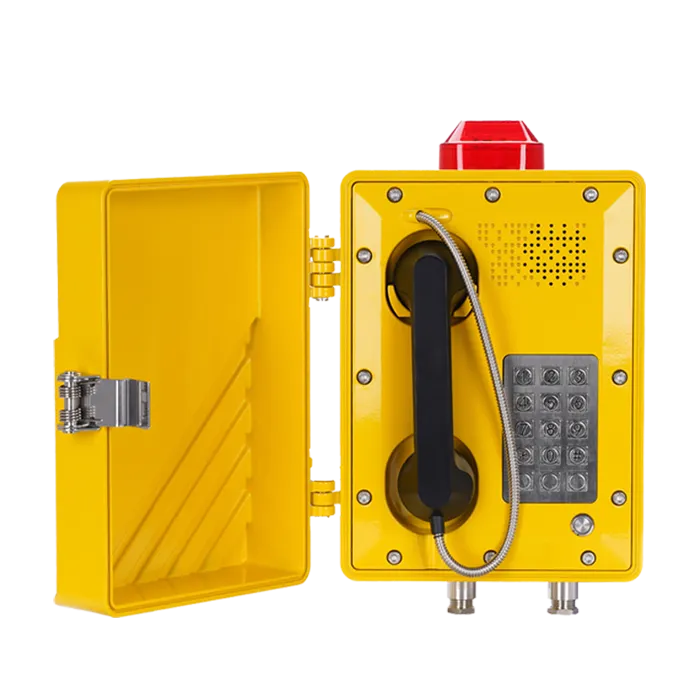
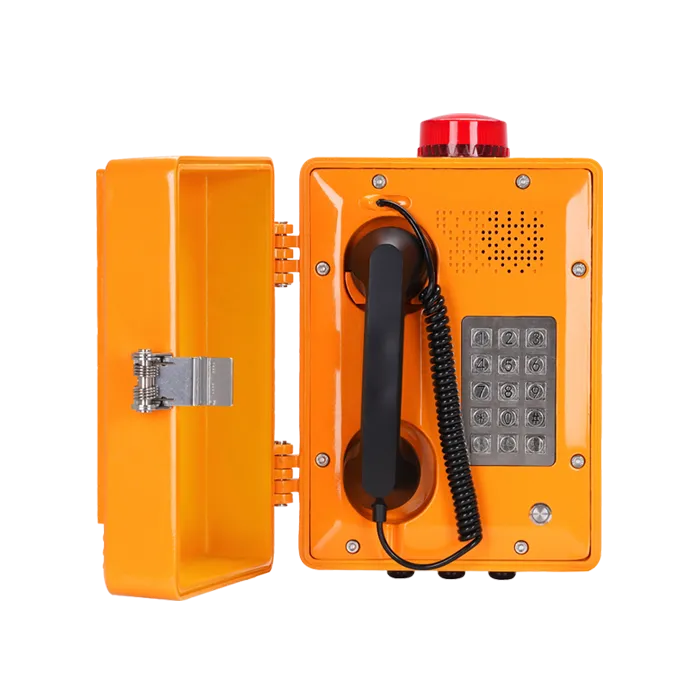
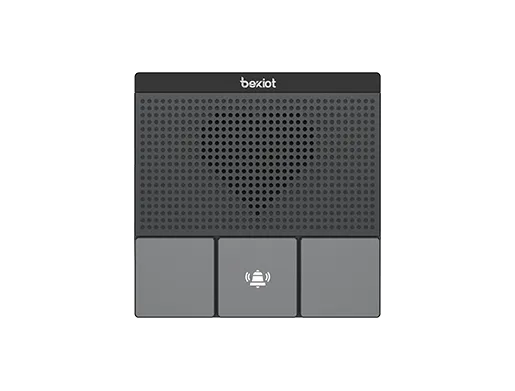
Highway toll stations, unattended parking exits, service entrances and roadside help points all need a simple way for drivers or staff to contact the control room. In many projects, a one-touch SIP intercom is used for this purpose. The user presses one button, the call reaches the dispatch center, and the operator can speak with the person at the lane or help point without complicated operation.
Voice alone, however, is often not enough. A toll lane problem may involve payment failure, vehicle blocking, equipment fault, driver dispute, accident risk or an emergency request. If the operator can only hear the caller but cannot see the lane, the first response may depend too much on verbal description. That is why toll station intercom systems are often linked with nearby surveillance cameras.
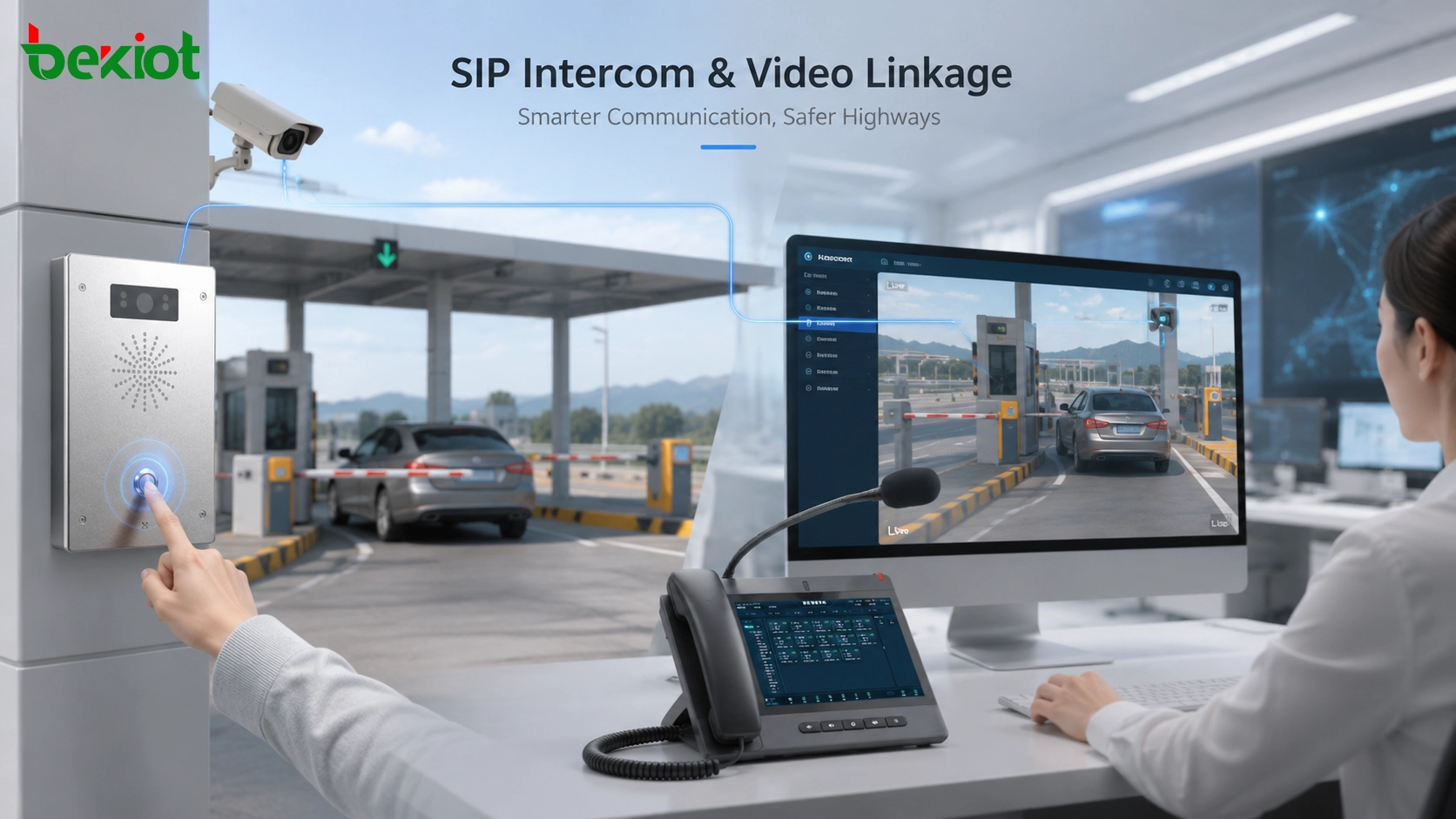
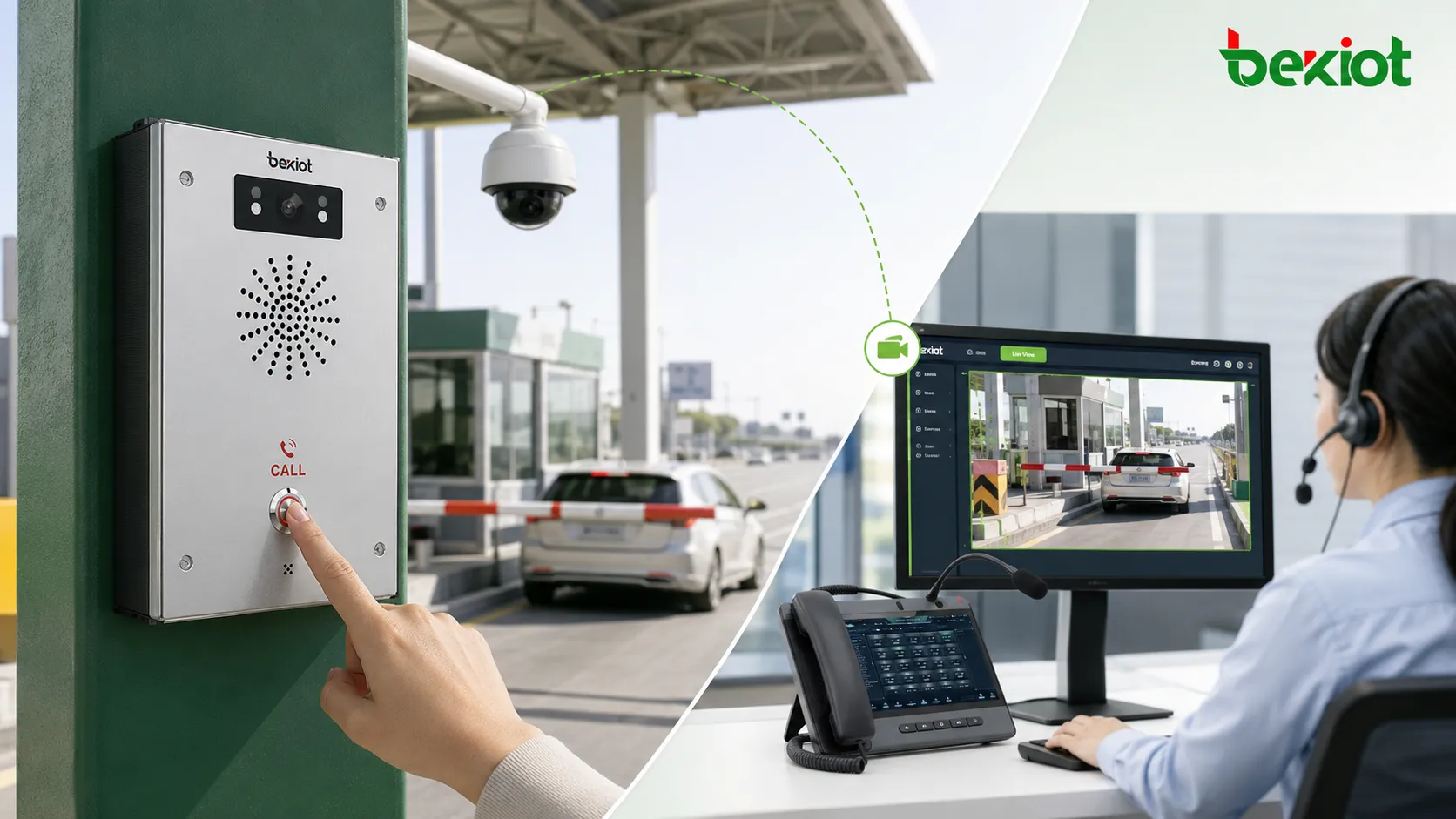
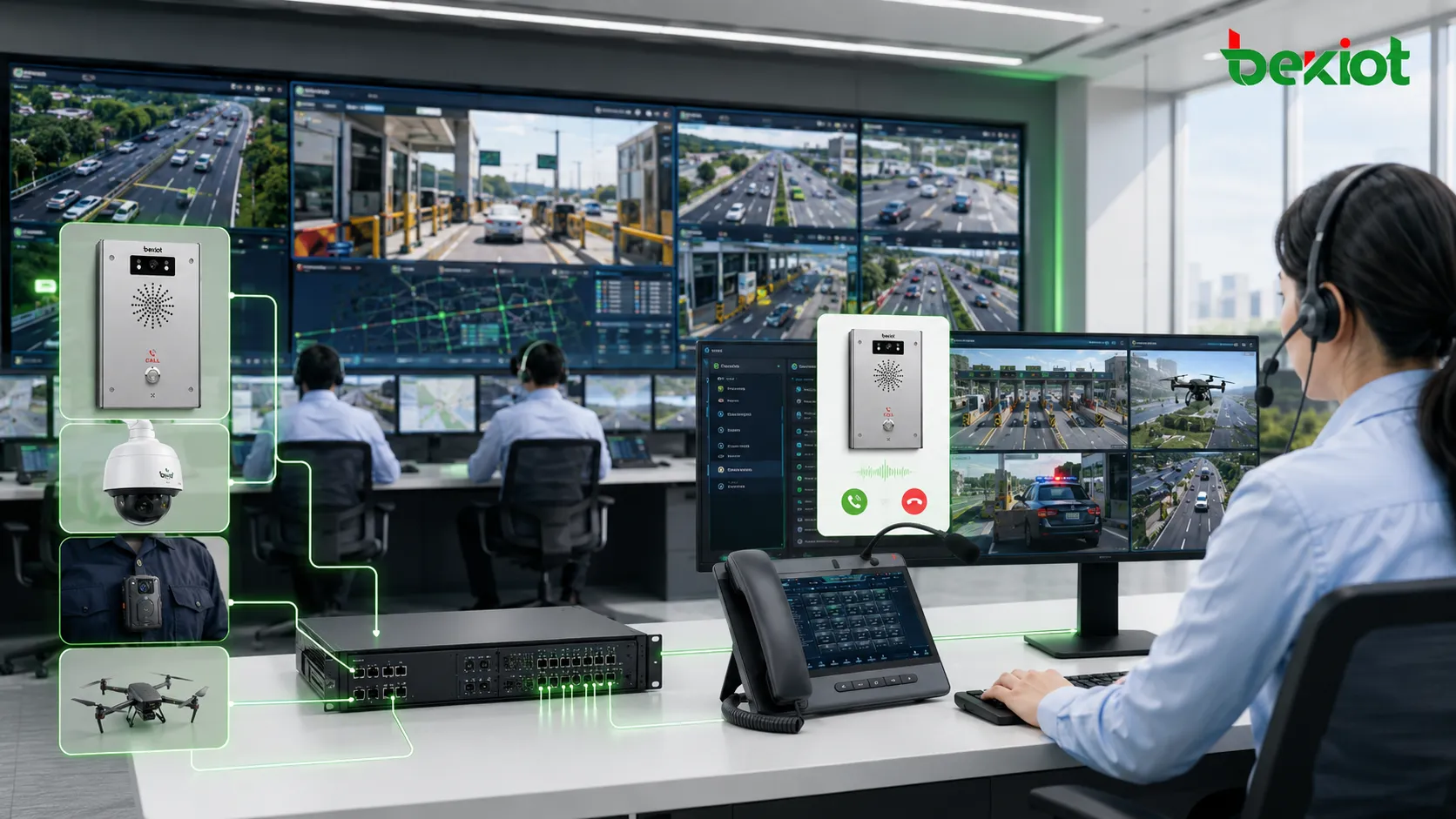
When the intercom button is pressed, the system can start a SIP voice call and automatically display the related camera stream on a dispatch console, video phone or monitoring workstation. This gives the control room both real-time voice communication and live visual confirmation, making the response faster and more accurate.
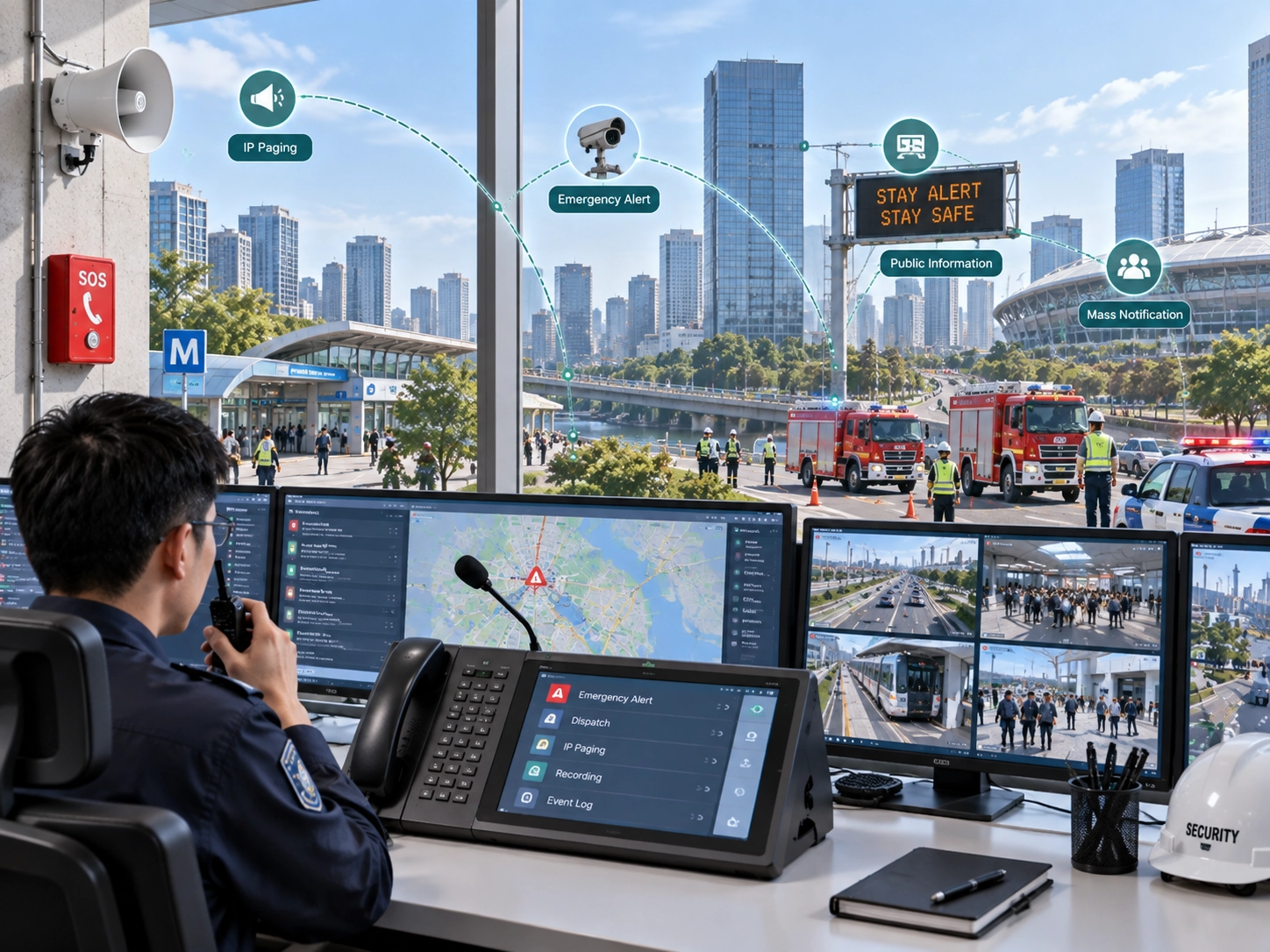
At a toll booth or help point, one-touch SIP intercom calling can trigger the related camera stream and display live video on the dispatch console.
Where This System Is Used
Toll lanes, booths and unattended service points
A one-touch intercom and camera linkage system is suitable for highway entrance lanes, exit lanes, ETC and MTC lanes, toll booths, parking exits, public help points and unattended management areas. When a driver encounters payment issues, lane blockage, barrier failure, ticket problems or emergency help needs, the intercom provides a direct communication path to the control room.
The camera linkage adds another layer of information. The operator can see the vehicle position, lane status, surrounding traffic, nearby obstacles and user behavior before deciding whether to guide the driver, notify maintenance staff, contact security personnel or escalate the event to the monitoring center.
Why voice and video should work together
In toll station operation, voice explains the problem, while video verifies the scene. If the caller says the barrier cannot open, the operator can immediately check whether the vehicle is positioned correctly, whether another car is blocking the lane, or whether the equipment appears abnormal. If the caller requests emergency assistance, the operator can assess the surrounding situation more quickly.
This voice-and-video linkage is especially useful in semi-unattended and unattended scenarios. It reduces repeated questioning, improves judgment accuracy and helps the control room respond with clearer instructions.
Direct Camera Pulling for Simple Projects
Using RTSP for one-to-one linkage
The most basic method is to bind an RTSP stream address to a specific intercom terminal or dispatch-side device. For example, if one intercom is installed beside lane 3, the system can bind that intercom account to the RTSP address of the camera covering lane 3.
When the user presses the call button, the dispatch console or video phone answers the SIP call and pulls the corresponding RTSP stream. This method is easy to understand and can work well in small projects where there are only a few cameras, a few help points and a clear one-to-one relationship between intercom and camera.
Limitations of direct camera access
Direct RTSP pulling becomes less convenient as the project grows. A highway system may use cameras from different manufacturers, different resolutions, different video formats and different network segments. Some cameras may output H.265, while the dispatch terminal or video phone may only support H.264. Some streams may be too large for smooth playback on an embedded terminal.
Another problem is repeated stream pulling. If several operators, video phones or platforms pull the same camera stream directly, the camera or NVR may face unnecessary pressure. Cross-network access, user permission, stream security and protocol compatibility can also make project delivery harder.
Why a Video Access Gateway Is Often Needed
Centralized stream access and conversion
A video access gateway can be placed between the toll station camera system and the intercom dispatch system. Instead of allowing every dispatch terminal or video phone to pull video directly from cameras, the gateway centrally receives, converts and distributes video resources.
In toll station projects, the gateway may support RTSP, GB/T28181 and other video access methods. In larger highway networks, GB/T28181 can also be used to connect with an upper-level video platform, making video resources easier to manage across stations, service areas and regional control centers.
A more manageable video layer
With a gateway-based architecture, cameras, NVRs, video platforms, intercom terminals and dispatch consoles do not need to be connected in a scattered way. The gateway becomes a controlled video middle layer. It can normalize stream access, provide compatible output and reduce repeated integration work.
This is valuable when a project expands from several lanes to multiple toll stations, service areas, tunnels, bridges and regional command platforms. The architecture remains easier to maintain because video access rules, stream naming, protocol conversion and distribution logic are handled through one defined layer.
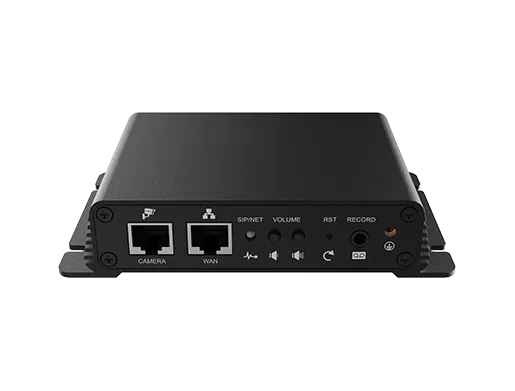
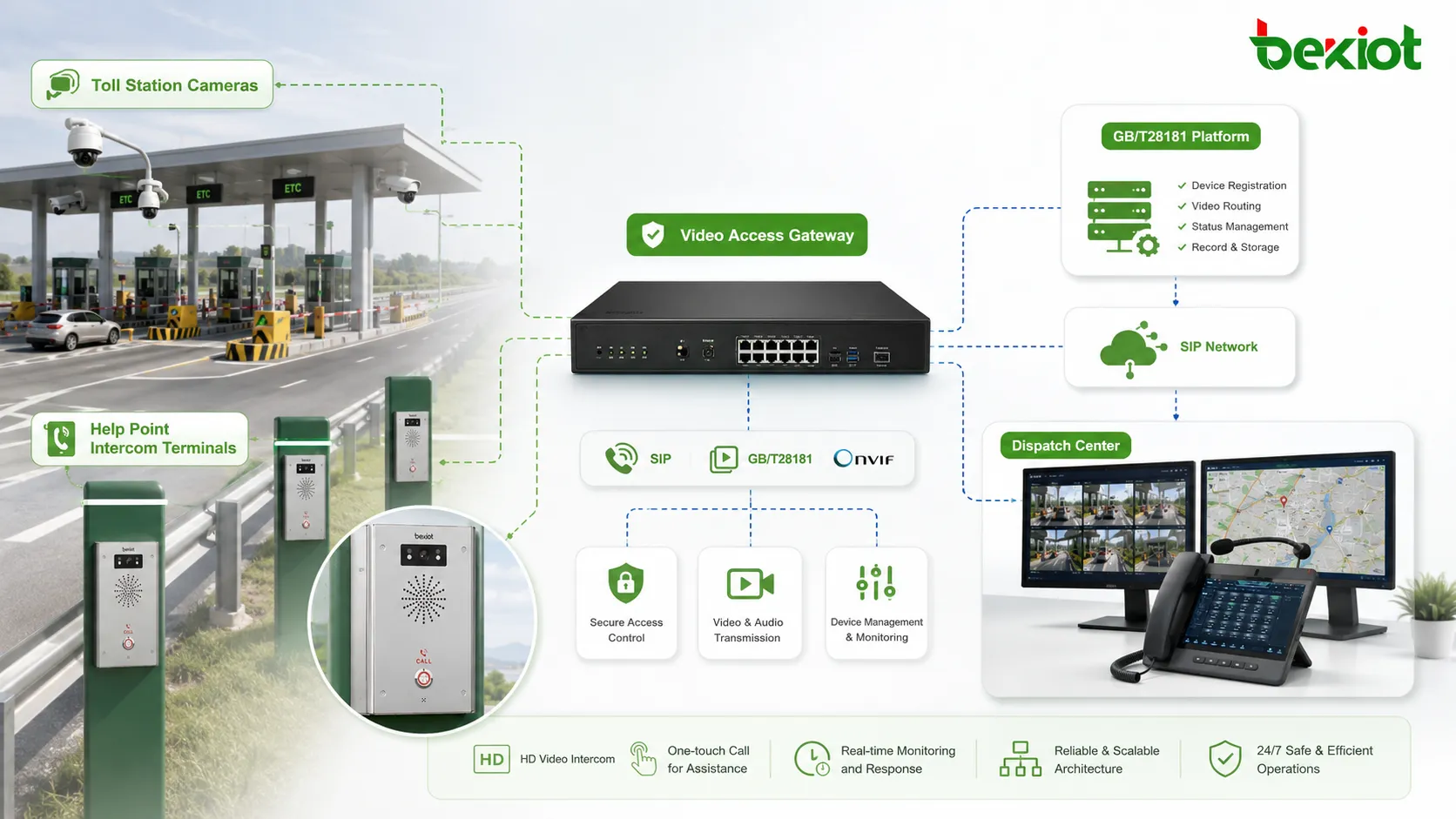
A video access gateway can centralize toll station camera streams and provide stable video linkage for SIP intercom terminals and dispatch platforms.
Recommended Toll Station System Architecture
Field layer
The field layer includes one-touch SIP intercom terminals, IP cameras, toll lane cameras, booth cameras, emergency help points, NVRs and network switches. These devices are installed near toll lanes, booths, parking exits or service points.
The intercom provides the voice entrance, while the camera provides the visual scene. Good installation planning should ensure that the camera view actually covers the user position and lane area related to each intercom terminal.
Access layer
The access layer includes the SIP server or IP-PBX, video access gateway, video platform, network routing equipment and security policies. This layer handles SIP registration, call routing, camera access, RTSP or GB/T28181 stream management, video conversion and communication between the toll station and the command center.
In a small station, this layer may be simple. In a multi-station highway project, it should be planned carefully so that video streams, SIP calls and dispatch functions can work across network segments without unstable access.
Dispatch layer
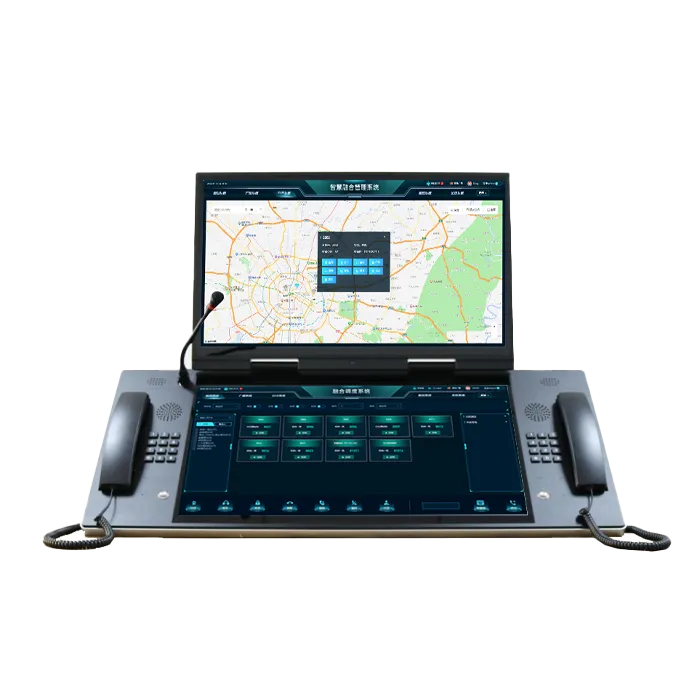
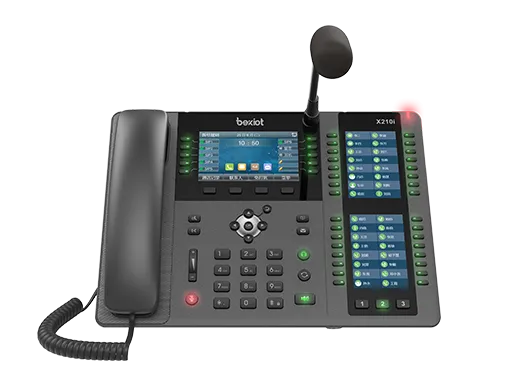
The dispatch layer includes the dispatch console, video phone, monitoring workstation, recording system and operation management platform. When a one-touch call is triggered, the operator can answer the SIP call and view the related camera stream on the same screen or on a linked display.
Depending on the system design, the event can also be recorded, logged and reviewed later. This is helpful for dispute handling, service quality review, equipment fault tracking and emergency response evaluation.
Typical Linkage Workflow
The workflow usually starts when a driver or staff member presses the intercom button. The SIP intercom sends a call request to the dispatch center. At the same time, the system identifies the related camera according to the intercom ID, lane number, SIP account, device binding table or predefined linkage rule.
The dispatch console answers the voice call and opens the matching video stream from the camera, NVR, video platform or video access gateway. If the stream needs conversion, the gateway outputs a compatible video format to the dispatch terminal. The operator can then speak with the caller, view the lane, guide the user and decide whether to escalate the event.
Handling Video Format and Performance Problems
Converting H.265 to H.264 for terminal compatibility
Many modern cameras support H.265 high-definition video, but not every video phone, embedded dispatch terminal or SIP communication device can decode H.265 smoothly. Some terminals may require H.264, lower resolution or reduced bitrate for stable playback.
A video access gateway with transcoding capability can re-encode the stream before sending it to the intercom or dispatch system. It can convert H.265 to H.264, reduce high-resolution video to a more suitable size, or adjust bitrate according to the terminal and network condition.
Reducing overload from repeated stream pulling
A gateway can also reduce pressure on cameras and NVRs. Instead of allowing multiple devices to pull directly from one camera, the gateway can receive one upstream stream and distribute it to several downstream users. This is useful when the same lane video needs to be viewed by a dispatch console, video phone, monitoring workstation and management platform at the same time.
For busy toll stations with many lanes, cameras and control seats, this design helps prevent stream interruption, camera overload and unstable playback during peak traffic or emergency response.
More Than One-Touch Intercom Linkage
Calling cameras from video phones and dispatch consoles
The video access gateway is not limited to passive intercom-triggered video pop-up. In some projects, operators can actively call or select camera resources from a video phone, dispatch console or command terminal. This makes video access more flexible during routine operation.
For example, the operator may open a lane camera before traffic builds up, check a remote help point, verify whether a booth is unattended, or inspect a service entrance without waiting for a user to press the intercom button.
Expanding to mobile and temporary video sources
Highway operation centers may also need access to mobile video resources such as drones, portable monitoring devices, patrol vehicle cameras, body-worn recorders and temporary surveillance terminals. These sources may use different media protocols and transmission methods.
A video gateway can help unify these resources and deliver them to the dispatch platform, monitoring center or emergency command system. This turns the gateway into a broader video capability layer, not only a toll lane linkage tool.
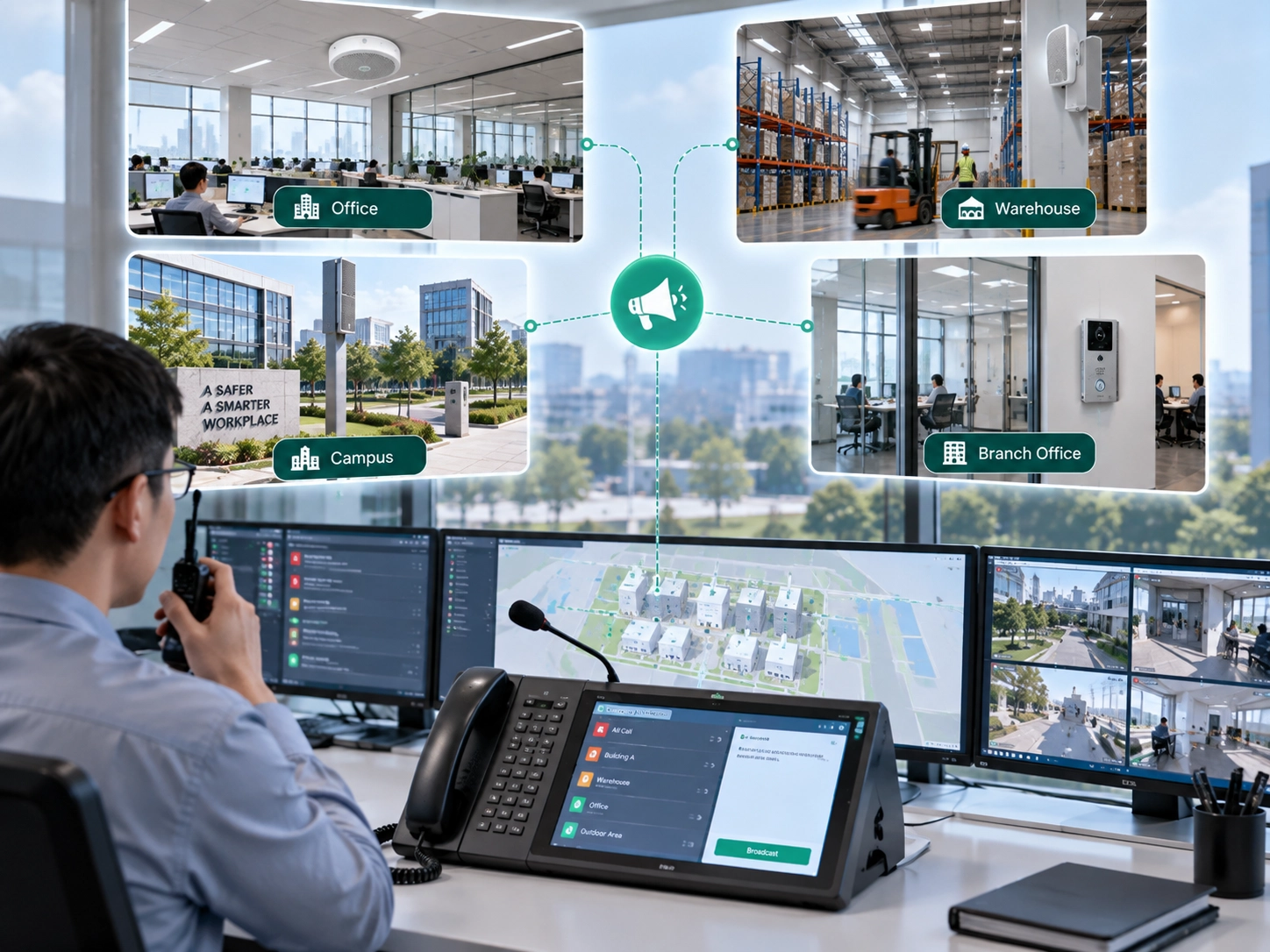
Beyond toll lane linkage, the same architecture can support command center video access, mobile source integration and multi-site response coordination.
Deployment Recommendations
Prepare the device binding table early
Before installation, the project team should create a clear binding table between each intercom terminal and its related camera. The table should include intercom location, lane number, SIP account, camera IP address, RTSP address, GB/T28181 device ID, stream type, display terminal and dispatch group.
This preparation reduces confusion during testing and operation. When a call is triggered, the system can immediately identify which video stream should appear and where it should be displayed.
Check codec, resolution and network conditions
The project team should confirm whether the camera outputs H.264 or H.265, whether the video phone supports the selected codec, whether the stream resolution is suitable and whether network bandwidth is enough for real-time viewing. For cross-network projects, routing, firewall rules, VLAN planning and security policy should also be checked.
For projects involving multiple stations or upper-level platforms, a video access gateway is recommended to standardize stream access and conversion. Becke Telcom can be considered where SIP intercom terminals, dispatch communication, emergency help points and video linkage need to be integrated into a practical highway communication solution.
Project Planning Checklist
Planning Item
What to Confirm
Why It Matters
Intercom location
Toll lane, booth, parking exit, help point or service entrance
Defines the call source and response workflow
Camera binding
Camera IP, RTSP URL, GB/T28181 ID, lane number and viewing angle
Ensures the correct video pops up during a call
Video format
H.264, H.265, resolution, bitrate and terminal decoding capability
Prevents black screen, delay and playback failure
Network path
LAN, VLAN, VPN, firewall rules, station-to-center connection and bandwidth
Keeps SIP calls and video streams stable
Dispatch response
Call group, video display location, recording rule and escalation process
Makes the system usable for real operation
Operational Value for Highway Management
Faster response and clearer judgment
When voice and video are linked, the operator can quickly understand what is happening at the toll lane. This reduces repeated questioning, improves event judgment and helps staff respond more accurately. For unattended or semi-unattended service points, this is especially important.
The system can support daily service requests, payment assistance, equipment fault reporting, emergency help, lane abnormality handling and incident verification. It improves the practical value of both the intercom system and the video surveillance system.
A scalable foundation for highway communication
A well-designed intercom and camera linkage system is more than a single-function help point project. It can become part of a larger highway communication and command platform. With SIP communication, video access gateway integration, GB/T28181 video management and dispatch linkage, the system can expand across toll stations, service areas, tunnels, bridges and regional command centers.
This architecture helps highway operators move from isolated devices to coordinated voice and video response. It improves compatibility, reduces repeated integration work and provides a stronger foundation for long-term operation and maintenance.
Final Notes
Highway toll station SIP intercom and camera linkage combines simple user operation with stronger control-room awareness. A driver or staff member only needs to press one button, while the control room receives both the voice call and the related live video.
Small projects can use direct RTSP binding when the relationship between intercom and camera is simple. Larger projects are better served by a video access gateway, especially when the system involves multiple cameras, multiple stations, GB/T28181 platforms, stream conversion, terminal compatibility and future expansion.
The best design is not only one that can make a call or open a video stream. It is one that helps operators understand the scene faster, respond more accurately and manage highway communication resources in a scalable way.
FAQ
Can one camera be linked with multiple intercom terminals?
Yes. In some toll station layouts, several nearby help points may share one wide-angle camera or PTZ camera. The system should define clear binding rules so the dispatch operator can still identify which intercom triggered the call.
Should each toll lane use a fixed camera or a PTZ camera?
Fixed cameras are suitable for stable lane views, while PTZ cameras are useful when one camera needs to cover a larger area or follow different positions. For critical toll lanes, a combination of fixed camera and PTZ camera can provide better coverage.
Is recording required for both voice and video?
It is recommended for operation review and dispute handling. Voice recordings, video clips, call time, device ID, operator action and event notes can help the management team review service quality and incident handling.
How can the system handle camera failure?
The platform should support offline status detection, fault alarms and fallback rules. If the primary camera is unavailable, the dispatch console can switch to a nearby backup camera or display a warning message to the operator.
What should be tested before project acceptance?
Acceptance testing should include button calling, SIP registration, video pop-up speed, RTSP or GB/T28181 stream access, codec compatibility, dispatch display, recording linkage, network delay, overload conditions and recovery after device or network interruption.