Open Source SIP Server Selection Guide for VoIP IP PBX and Unified Communication Projects
Open source SIP server selection guide comparing Kamailio, OpenSIPS, Asterisk, and FreeSWITCH for VoIP routing, IP PBX, SIP trunking, media services, security, scalability, and industrial communication.
Becke Telcom
Choosing the right SIP server is one of the most important decisions in a VoIP, IP PBX, or unified communication project. A SIP server is not just a tool for registering phones. In a real communication network, it may handle user registration, SIP routing, trunk access, call policy, failover, load balancing, media services, NAT traversal, and integration with gateways, dispatch platforms, public address systems, and emergency communication endpoints.
Open source SIP platforms are widely used because they offer flexibility, transparency, community support, and strong customization potential. However, not every platform is designed for the same role. Some are built for high-performance SIP signaling and routing. Others are better suited for PBX features, call queues, IVR, conferencing, recording, and media processing.
For engineers, system integrators, VoIP service providers, and enterprise IT teams, the key is to select the platform according to the actual network role. A small office phone system, a hosted VoIP service, an industrial emergency communication network, and a carrier-grade SIP routing platform may all use SIP, but they do not require the same architecture.
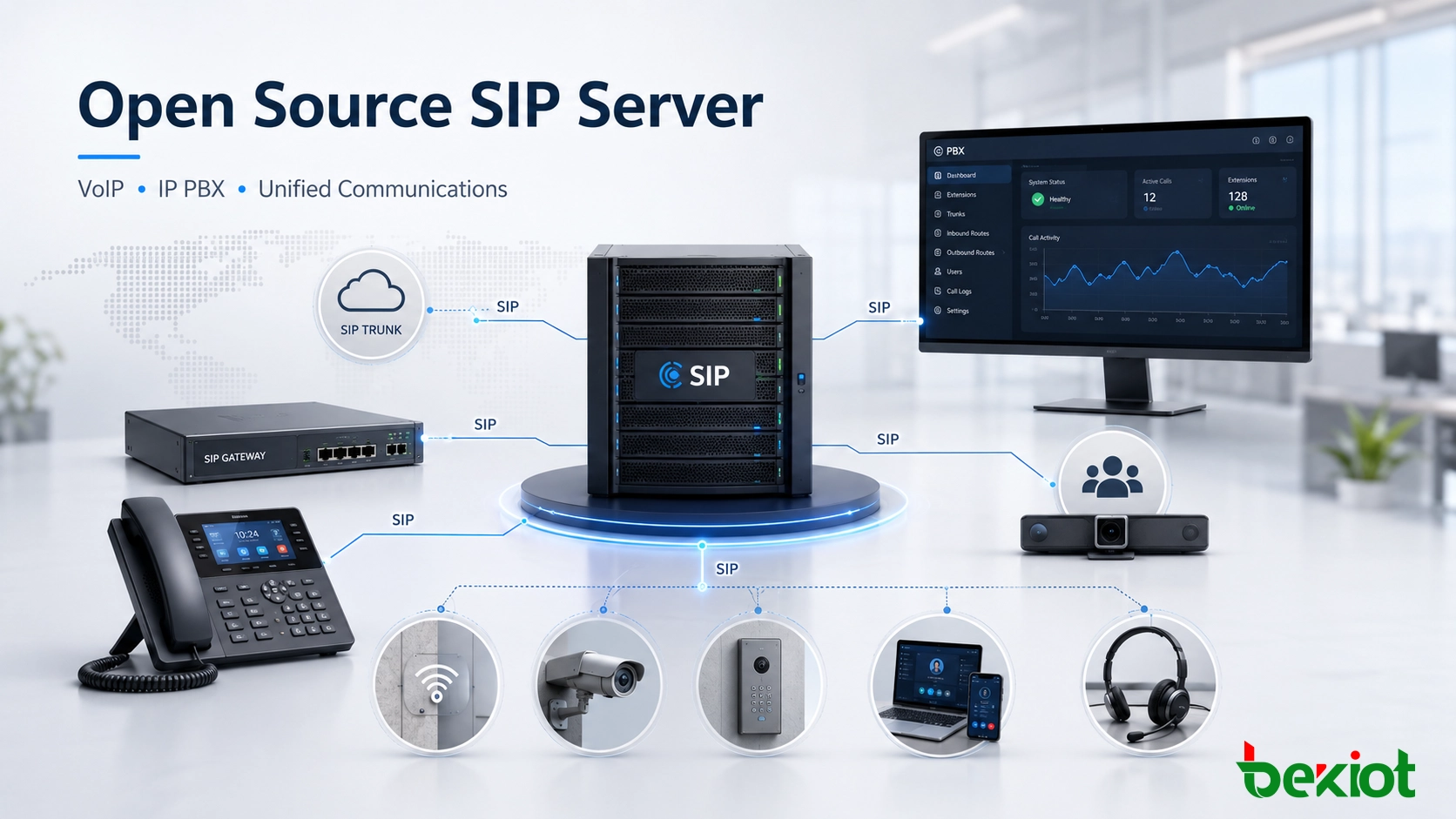
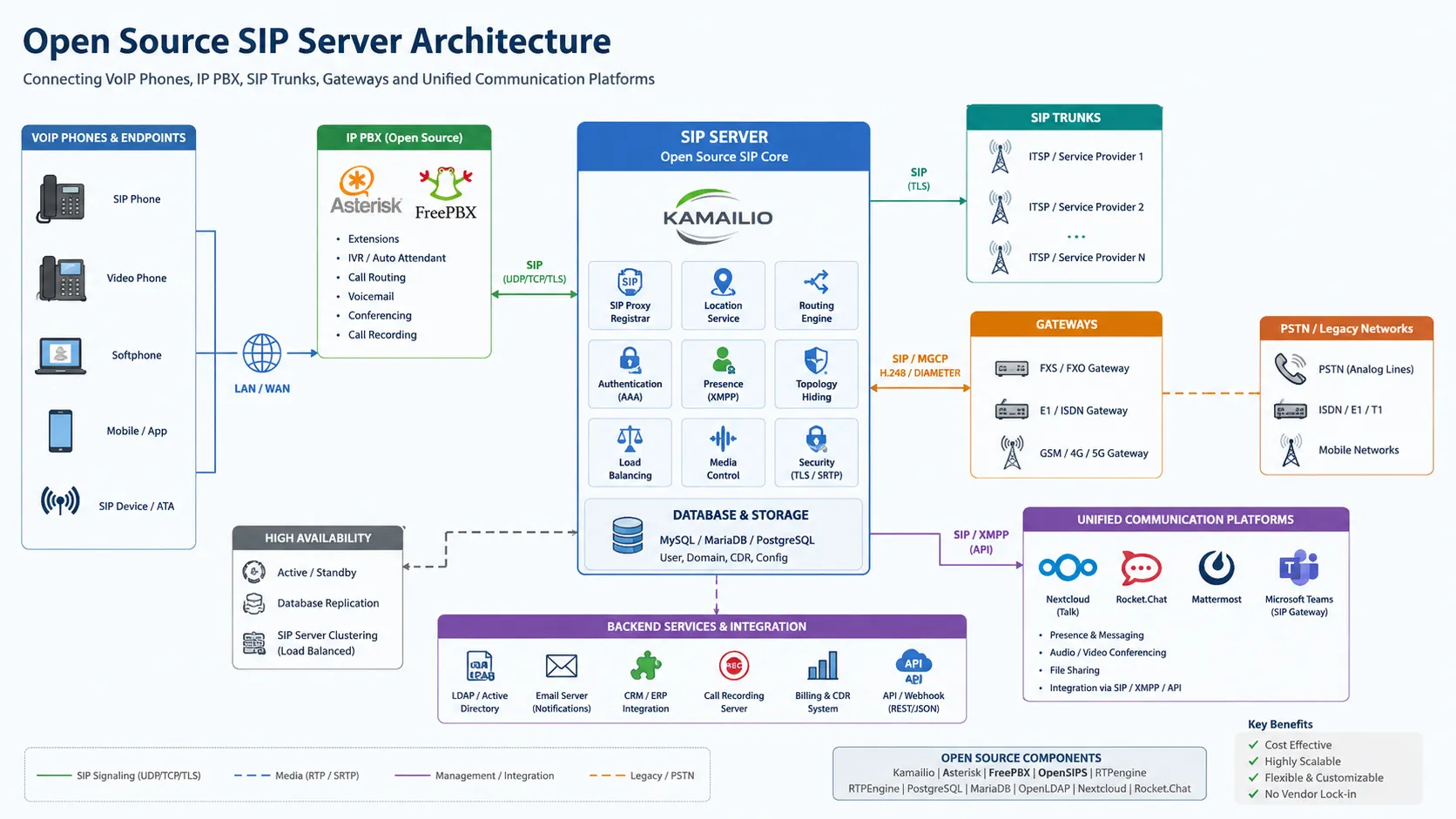
Open source SIP server architecture can connect SIP endpoints, IP PBX functions, gateways, trunks, and unified communication applications.
Why SIP Server Selection Matters
SIP is the signaling protocol that establishes, modifies, and terminates communication sessions. In practical VoIP systems, the SIP server decides how endpoints register, how calls are routed, how SIP trunks are selected, how incoming calls are distributed, and how users or devices are authenticated.
A poor platform choice can create serious problems later. The system may become hard to scale, difficult to secure, unstable under trunk failover, or too complex to maintain. In small deployments, these problems may only cause inconvenience. In service provider, hospital, campus, industrial, transportation, or emergency communication environments, they can affect daily operation and response reliability.
Different Projects Need Different Server Roles
Some projects mainly need a SIP registrar and proxy to route calls between endpoints and trunks. Others need a full PBX with voicemail, IVR, call queues, conferencing, call recording, and business telephony features. Larger systems may need both: a high-performance SIP proxy at the front and PBX or media servers behind it.
This is why Kamailio and OpenSIPS are often selected for SIP routing, load balancing, and carrier-grade signaling control. Asterisk and FreeSWITCH are more commonly used when the project needs PBX functions, media handling, conferencing, and application-level communication features.
A SIP server should be selected according to its role in the architecture, not only according to popularity. The best platform for high-volume SIP routing may not be the best platform for office PBX features, and the best PBX platform may not be the best front-end proxy for carrier-scale signaling.
Main Categories of Open Source SIP Server Software
SIP Proxy, Registrar, and Routing Server
A SIP proxy or routing server focuses mainly on signaling. It receives SIP requests, applies routing logic, and forwards messages to the correct destination. It may also act as a registrar, storing the location of SIP users after they register from phones, softphones, gateways, intercom terminals, or other endpoints.
This type of platform is commonly used for SIP trunk routing, multi-tenant VoIP services, SBC-adjacent deployment, load balancing, and large endpoint registration. Kamailio and OpenSIPS are strong examples in this category. They are highly programmable and suitable for complex routing logic, database integration, authentication, failover, and scalable signaling control.
PBX and Telephony Application Server
A PBX-oriented platform provides user-facing calling features. Typical functions include extension management, voicemail, call transfer, ring groups, IVR menus, call queues, conference rooms, call recording, time-based routing, and connection with PSTN or SIP trunks.
Asterisk is one of the most widely known open source PBX platforms. It is often selected by small and medium-sized businesses, system integrators, service desks, call centers, and organizations that need a customizable IP PBX. FreeSWITCH can also provide PBX functions, but it is often used as a broader communication framework.
Softswitch and Media-Capable Communication Framework
A softswitch or communication framework is useful when the project needs more than simple call routing. It may support conference bridging, media mixing, transcoding, WebRTC connectivity, custom applications, and real-time communication services.
FreeSWITCH is commonly considered in this area because it can be used to build scalable voice platforms, conferencing systems, contact center infrastructure, hosted communication platforms, and media-rich applications. In larger systems, it is often paired with a SIP proxy layer that handles routing and access control.
Popular Open Source SIP Platforms
Kamailio
Kamailio is a mature open source SIP server designed for high-performance SIP routing. It is commonly used as a SIP proxy, registrar, redirect server, load balancer, and signaling control layer. Its modular architecture allows developers and system integrators to add database connectivity, authentication, accounting, NAT traversal support, presence functions, topology hiding, and advanced routing policies.
Kamailio is especially suitable when the project requires large-scale SIP registration, SIP trunk routing, distributed VoIP infrastructure, multi-tenant service platforms, or a front-end layer for Asterisk and FreeSWITCH clusters. It is powerful, but it also requires strong SIP knowledge and careful configuration.
OpenSIPS
OpenSIPS is another powerful open source SIP server focused on routing, proxying, registration, load balancing, and service logic. It is often selected for carrier-grade VoIP platforms, wholesale routing, SIP trunk management, enterprise edge routing, and multi-site signaling control.
Like Kamailio, OpenSIPS can integrate with databases, scripts, monitoring tools, and custom routing logic. The choice between OpenSIPS and Kamailio often depends on team experience, preferred configuration style, available modules, documentation preference, and long-term maintenance strategy.
Asterisk
Asterisk is best known as an open source PBX and telephony toolkit. It can turn a standard server into a communication system that supports extensions, SIP trunks, call queues, IVR, voicemail, conferencing, recording, and many business phone system features.
Asterisk is usually easier to understand for PBX-oriented deployments than pure SIP proxy platforms. It is a strong choice when the goal is to build a feature-rich business telephone system, especially when combined with a web-based management interface such as FreePBX.
However, for very large-scale SIP routing or carrier front-end signaling, Asterisk is often placed behind a dedicated SIP proxy such as Kamailio or OpenSIPS.
FreeSWITCH
FreeSWITCH is an open source communication framework and softswitch platform. It is often used for scalable voice services, conferencing, media handling, contact center applications, SIP interconnection, and real-time communication systems.
FreeSWITCH can be used as a PBX, but many teams choose it for larger or more customized communication platforms. It is suitable for conferencing platforms, hosted voice services, WebRTC gateways, call center media layers, and applications where voice, video, or media control are central to the system design.
Yate, Flexisip, Routr, and Other Projects
Beyond the major platforms, there are other open source or open-core SIP-related projects that may fit specific use cases. Yate is often associated with telephony and routing applications. Flexisip is used in SIP-based communication services and is connected with the Linphone ecosystem. Routr may appeal to teams building cloud-native or API-oriented communication services.
These projects may not be the first choice for every enterprise VoIP deployment, but they are worth considering when the architecture, development model, or application requirement is specific. In most business and industrial projects, Kamailio, OpenSIPS, Asterisk, and FreeSWITCH remain the main platforms engineers compare first.
Comparison by Use Case
High-Volume SIP Routing and Trunk Control
For large-scale SIP routing, Kamailio and OpenSIPS are usually the first platforms to evaluate. They are designed to process SIP signaling efficiently and can be used to build routing layers in front of PBX servers, media servers, SBCs, and SIP trunk providers.
A common architecture is to deploy Kamailio or OpenSIPS as the front-end SIP proxy, then forward calls to Asterisk or FreeSWITCH for PBX functions, IVR, recording, or conferencing. This separates signaling control from media and application logic, improving scalability and operational clarity.
Business IP PBX and Office Telephony
For office phone systems, Asterisk is often the most direct choice. It provides familiar PBX features such as extensions, voicemail, IVR, call queues, call transfer, ring groups, call recording, and SIP trunk connection.
FreeSWITCH can also support business telephony, especially when the project requires more advanced media handling, conferencing, or custom application development. For a small office, Asterisk may be simpler. For a larger customized communication platform, FreeSWITCH may offer more flexibility.
Carrier, Hosted Voice, and Service Provider Platforms
Carrier and hosted voice platforms often need multi-tenant routing, failover, load balancing, SIP trunk policy, fraud control, registration management, and integration with billing or customer management systems.
In these projects, Kamailio and OpenSIPS are commonly used as core signaling platforms, while Asterisk or FreeSWITCH may handle voicemail, media applications, conferencing, recording, or other value-added services. A single-server PBX design may be enough for a small deployment, but service provider networks usually require distributed architecture.
Contact Centers, Conferencing, and Media Applications
When the project includes call queues, recording, IVR, conferencing, media mixing, or real-time communication applications, Asterisk and FreeSWITCH become more relevant. Asterisk is strong for PBX and call center logic, while FreeSWITCH is often selected for scalable media services and conference-heavy workloads.
For larger systems, a front-end proxy can protect and distribute traffic to multiple media servers. This allows the SIP routing layer to remain stable while media capacity grows horizontally behind it.
Industrial Communication and Emergency Response
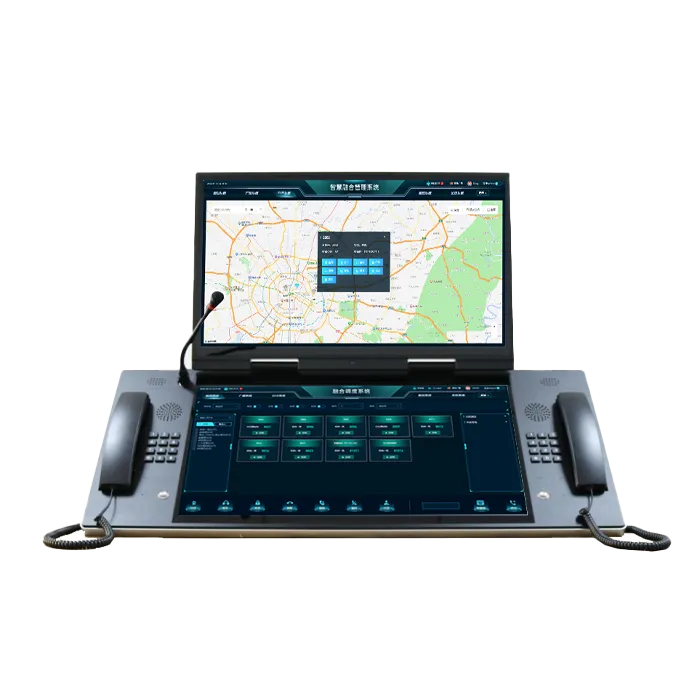
In industrial sites, transportation networks, campuses, hospitals, and public safety environments, SIP servers often connect more than office phones. The system may include industrial SIP phones, emergency call stations, SIP intercoms, IP speakers, paging gateways, analog gateways, radio gateways, CCTV linkage, alarm inputs, and command dispatch software.
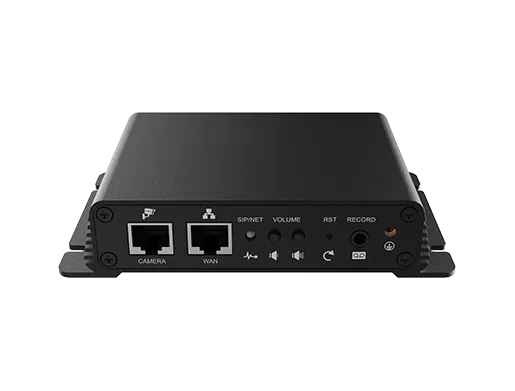
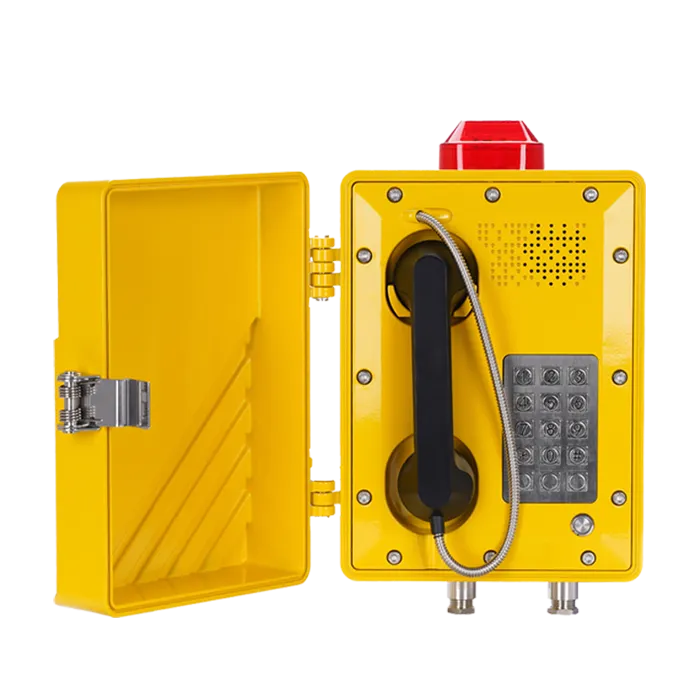
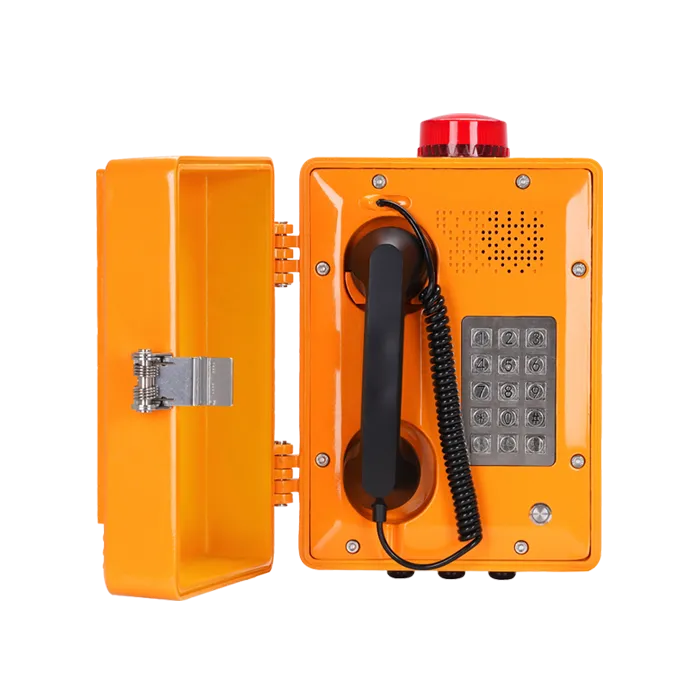
In this type of deployment, the SIP server should be evaluated together with endpoints and field devices. Becke Telcom can support the endpoint and integration layer around the SIP communication system, including industrial telephones, SIP intercoms, paging gateways, broadcast terminals, and communication integration for harsh or mission-critical environments.
For a broader deployment reference, the VoIP Telephone System solution can help connect open source SIP server planning with practical enterprise communication architecture.
Technical Criteria for Selection
Performance and Scalability
Performance should be evaluated according to registration volume, concurrent calls, call setup rate, database dependency, routing complexity, NAT keepalive traffic, trunk failover behavior, and monitoring requirements. A SIP proxy may handle signaling efficiently, but media processing is a different workload.
For high-volume networks, engineers should test registration storms, peak call setup, trunk failover, database response time, and backend server behavior. Performance depends not only on the software name, but also on configuration, hardware, operating system tuning, database design, and network quality.
Routing Flexibility and Customization
SIP routing can be simple or very complex. A company may only need extension-to-extension calling and one SIP trunk. A service provider may need prefix routing, least-cost routing, multi-tenant domains, number normalization, emergency route priority, time schedules, failover trunks, and custom policy checks.
Kamailio and OpenSIPS are very strong when advanced signaling-layer routing is required. Asterisk and FreeSWITCH are strong when routing must be connected with PBX features, IVR, media applications, and user-level telephony services.
Security and Access Control
Security is essential for any SIP deployment because VoIP systems are often exposed to registration attacks, SIP scanning, toll fraud attempts, malformed packets, and unauthorized trunk access. Important security capabilities include authentication, IP allowlists, TLS support, SRTP planning, rate limiting, topology hiding, fraud detection, logging, and firewall coordination.
For public-facing networks, many organizations place a SIP proxy or SBC in front of PBX servers. This reduces direct PBX exposure and allows the edge layer to handle filtering, routing, and policy enforcement. Open source SIP servers can be part of this architecture, but they must be configured carefully and monitored continuously.
NAT Traversal and Remote Users
Many SIP problems come from NAT, firewalls, and remote endpoints. SIP signaling contains contact addresses and media negotiation details that may fail if the server does not correctly handle public and private network boundaries.
Depending on the platform and architecture, the solution may require SIP proxy configuration, RTP relay, media anchoring, ICE/STUN/TURN support, SBC functions, or VPN access. A good SIP server design should define where signaling is terminated, where media flows, and how remote endpoints remain reachable.
Operations, Monitoring, and Maintenance
A SIP server is not finished after installation. Long-term success depends on monitoring, log analysis, backup strategy, version control, configuration documentation, traffic capture, alerting, and clear maintenance procedures.
Engineers should prepare tools for SIP trace review, registration monitoring, trunk status checks, packet capture, call quality analysis, and failover validation. Documentation should include call flows, trunk rules, emergency routes, codec choices, firewall policies, device registration rules, and recovery procedures.
Common Deployment Architectures
Single-Site Business PBX
A single-site business PBX is usually the simplest design. Asterisk or FreeSWITCH can register SIP phones, connect to SIP trunks, manage extensions, and provide PBX features. This architecture is suitable for small offices, service desks, branch sites, and organizations that need a manageable internal phone system.
The main advantage is simplicity. The main limitation is resilience. If the server fails, the entire phone system may be affected. For critical environments, backup servers, redundant trunks, power protection, and recovery procedures should be included.
Proxy in Front of PBX Servers
A more scalable design places Kamailio or OpenSIPS in front of one or more Asterisk or FreeSWITCH servers. The proxy handles registrations, routing, access control, and load balancing, while backend servers handle PBX features, voicemail, IVR, recording, conferencing, or media services.
This model is common in hosted VoIP, enterprise multi-site communication, and service provider networks. It allows engineers to scale the signaling layer and application layer separately. It also makes it easier to isolate failures and add capacity over time.
Distributed Multi-Site System
A distributed design connects headquarters, branches, control rooms, gateways, dispatch centers, and remote endpoints through SIP routing policies. The system may use local gateways for PSTN access, central SIP trunks for external calls, and regional servers for redundancy.
For industrial and public infrastructure projects, this architecture may also connect tunnel phones, emergency call boxes, paging gateways, intercom stations, IP speakers, CCTV platforms, and alarm systems. The SIP server becomes part of a larger communication and response workflow, not just a telephone exchange.
Powerful but needs careful design and operational planning
Asterisk
Open source PBX and telephony toolkit
Business phone systems, IP PBX, IVR, call queues
Excellent PBX features, less ideal as the only carrier-scale proxy
FreeSWITCH
Softswitch and communication framework
Conferencing, media services, hosted voice, WebRTC, custom platforms
Flexible and scalable, but architecture design is important
Yate / Flexisip / Routr
Specialized SIP or telephony projects
Custom communication services and specific development needs
Evaluate community activity, documentation, and long-term support
How to Make the Final Decision
Start from the Call Flow
Before selecting software, draw the call flow. Identify where users register, how internal calls are routed, how outbound calls reach SIP trunks, how inbound calls enter the system, how emergency calls are prioritized, and how gateways or dispatch consoles connect.
A clear call flow often shows whether the project needs a PBX, a SIP proxy, a softswitch, or a combination of components. A company that only needs extension calling and SIP trunk access may choose Asterisk. A provider that needs to route calls for many customers may choose OpenSIPS or Kamailio. A conferencing platform may choose FreeSWITCH.
Match the Platform to the Team’s Skills
Open source does not mean zero cost. The software may be free to download, but successful deployment requires engineering time, SIP knowledge, Linux administration, monitoring, security planning, and long-term maintenance.
A platform that looks powerful on paper may not be the best choice if the team cannot maintain it confidently. For internal IT teams, Asterisk may be easier to approach for PBX features. For telecom engineers and VoIP providers, Kamailio and OpenSIPS may provide the control needed for advanced routing. For developers building real-time communication services, FreeSWITCH may offer a better foundation.
Test with Real Endpoints and Trunks
Lab tests should include actual SIP phones, softphones, gateways, SIP trunks, firewalls, remote users, and network conditions. Many issues only appear when real devices register, codecs are negotiated, NAT is involved, or carriers enforce specific SIP header requirements.
Testing should cover registration, internal calling, outbound trunks, inbound trunks, transfer, hold, voicemail, emergency routes, failover, network interruption, codec negotiation, DTMF, caller ID, and audio quality. For industrial environments, tests should also include SIP intercoms, emergency phones, paging gateways, and alarm-triggered call flows.
Where Becke Telcom Fits in a SIP-Based System
Open source SIP servers provide the software foundation, but real communication projects also depend on reliable endpoints, gateways, paging devices, and integration workflows. In industrial, transportation, campus, healthcare, and public safety environments, SIP endpoints must often operate in harsh conditions, high-noise areas, outdoor spaces, or emergency response scenarios.
Becke Telcom can support this layer with SIP industrial telephones, emergency intercoms, paging gateways, broadcast terminals, and converged communication solutions that connect with SIP servers, IP PBX systems, dispatch platforms, CCTV linkage, and alarm workflows.
The role of Becke Telcom in this type of architecture is not to replace open source SIP software, but to help turn the SIP communication layer into a practical field-ready voice, paging, and emergency communication system.
For B2B projects, the strongest architecture is often a combination: open source SIP server software for flexible signaling, professional endpoints for field communication, and a well-planned integration layer for paging, dispatch, alarms, and operational response.
Conclusion
There is no single best open source SIP server for every VoIP project. Kamailio and OpenSIPS are strong choices for SIP routing, registration, load balancing, trunk control, and carrier-style signaling. Asterisk is a practical platform for IP PBX and business telephony features. FreeSWITCH is well suited for scalable media services, conferencing, softswitch applications, and custom communication platforms.
The right decision depends on call flow, routing complexity, PBX feature requirements, endpoint types, security exposure, NAT conditions, team skills, scale, monitoring needs, and future expansion. In many professional deployments, the best architecture combines several components rather than forcing one platform to do everything.
For industrial and emergency communication projects, the SIP server should also be considered together with field endpoints, paging systems, dispatch platforms, alarms, and control room workflows. A well-designed SIP architecture can become the foundation for reliable business, industrial, and mission-critical communication.
FAQ
What is the best open source SIP server?
There is no single best choice for every project. Kamailio and OpenSIPS are strong for SIP routing, proxying, registration, and high-volume signaling. Asterisk is strong for IP PBX and business telephony features. FreeSWITCH is strong for softswitch, conferencing, media services, and custom communication platforms.
Is Kamailio better than OpenSIPS?
Kamailio and OpenSIPS are both powerful SIP routing platforms. The better choice depends on the team’s experience, required modules, routing design, documentation preference, and support model. Both can be used in professional VoIP and carrier-grade SIP networks.
Is Asterisk a SIP server or a PBX?
Asterisk can handle SIP communication, but it is best known as an open source PBX and telephony toolkit. It is usually selected when the project needs extensions, voicemail, IVR, call queues, conferencing, recording, and business phone system features.
Is FreeSWITCH better than Asterisk?
FreeSWITCH and Asterisk overlap in some areas, but they are often used for different priorities. Asterisk is widely used for PBX-style business telephony. FreeSWITCH is often selected for scalable media services, conferencing, softswitch applications, and customized real-time communication platforms.
Can Kamailio or OpenSIPS replace Asterisk?
They can replace Asterisk only if the project mainly needs SIP routing, registration, and proxy functions. If the project needs PBX features such as voicemail, IVR, call queues, conferencing, and recording, Asterisk or FreeSWITCH may still be required behind the proxy layer.
Can open source SIP servers work with industrial phones and paging systems?
Yes. SIP-based industrial phones, emergency intercoms, paging gateways, IP speakers, and dispatch systems can often connect to open source SIP servers or IP PBX platforms. Before deployment, engineers should test registration, call routing, DTMF, codec compatibility, priority calls, multicast paging, and alarm-triggered workflows.