Open Source SIP Servers Compared: Kamailio, OpenSIPS, Asterisk, and FreeSWITCH
Compare Kamailio, OpenSIPS, Asterisk, and FreeSWITCH by architecture, SIP signaling, PBX logic, media handling, scalability, and best-fit deployment scenarios.
Becke Telcom
Open source SIP servers are often discussed as if they serve the same purpose, but in real communication systems they usually play different roles. Some platforms are built for SIP signaling, registration, routing, and edge control. Others are better suited for PBX features, IVR, call queues, conferencing, media handling, and programmable communication workflows.
That is why a useful comparison should not only ask which SIP server is more popular. The better question is which platform fits the architecture, workload, scale, and operational model of the project. Kamailio, OpenSIPS, Asterisk, and FreeSWITCH are all important open source communication platforms, but they are not interchangeable.
In general, Kamailio and OpenSIPS are strong choices for high-performance SIP routing, registration, load distribution, and signaling-layer policy control. Asterisk is widely used for PBX logic, business telephony, IVR, voicemail, queues, and call workflows. FreeSWITCH is often selected when media control, conferencing, event-driven integration, and programmable real-time communication are central to the project.
Open source SIP platforms are best compared by architectural role rather than by a single generic category.
Why Architecture Matters First
Many projects begin with the wrong question: which open source SIP server is the best? In practice, there is no single winner because each platform is designed around a different responsibility. A SIP routing edge, a hosted registration service, a business PBX, a conferencing platform, and a media application engine do not create the same type of workload.
A platform that performs very well as a SIP proxy may not be the best choice for media-heavy conferencing. A PBX-oriented system may be excellent for business call flows, but not the lightest option for large-scale signaling ingress. Once the system grows, these differences become more visible.
Small deployments can sometimes let one platform handle many tasks. Larger systems usually benefit from separation of responsibilities. SIP signaling, registration, authentication, topology control, and traffic distribution can sit at the edge, while PBX services or media engines run behind that layer.
The most practical SIP server comparison is not “which platform wins,” but “which component belongs in which part of the architecture.”
What Counts as an Open Source SIP Server
SIP signaling and routing platforms
Some platforms are mainly designed to process SIP signaling efficiently. Their strengths include registration, routing, policy control, load balancing, SIP normalization, and edge behavior. Kamailio and OpenSIPS are the most common examples in this category.
These platforms are often selected when a deployment needs to manage large numbers of registrations, distribute SIP traffic across multiple back-end systems, apply routing rules, or control SIP behavior at the edge of a VoIP environment. They are highly scriptable and well suited to horizontal scaling.
In many architectures, Kamailio or OpenSIPS works as the front-end signaling layer. It can protect downstream PBX or media systems, normalize traffic from different providers or endpoints, and keep ingress signaling separate from service execution.
PBX and telephony application platforms
Another category includes platforms built for telephony services and business communication applications. Asterisk is the clearest example. It is not only a SIP-capable server; it is a communications framework used for IP PBX systems, VoIP gateways, IVR, voicemail, queues, conference services, and custom call control.
Asterisk is especially relevant when the project needs practical business telephony. If the goal is office extensions, auto attendants, call routing, ring groups, call queues, voicemail, or branch communication, Asterisk is often more suitable than a pure SIP proxy.
The tradeoff is that Asterisk usually carries more call-state and media-related responsibility than a lightweight signaling proxy. For many SMB and enterprise PBX deployments, that is exactly what the project needs. For very large signaling-heavy systems, it is often better to place Asterisk behind a dedicated SIP routing layer.
Media-centric communication engines
FreeSWITCH is often chosen when media control and programmable communication behavior are important. It is modular, event-driven, and well suited to conferencing, media orchestration, and custom real-time communication applications.
This does not mean FreeSWITCH is limited to conferencing. It can support a wide range of communication services. The important point is that teams often choose it when they need a programmable telecom engine with strong media and application behavior, rather than the lightest possible SIP proxy.
Platform Comparison
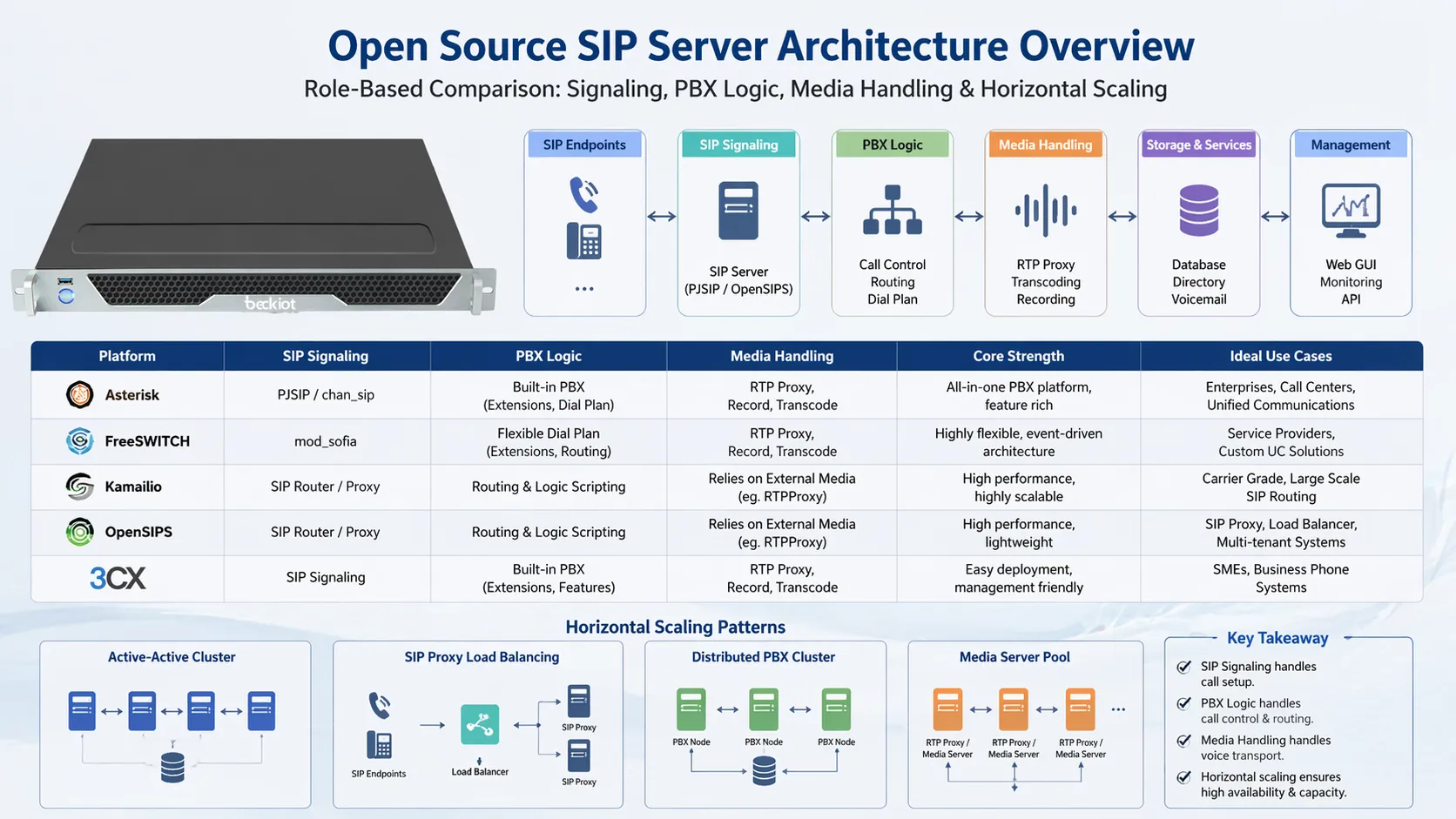
A fair comparison should judge each platform by the role it was designed to perform. The table below focuses on practical architecture rather than marketing-style feature lists.
Kamailio and OpenSIPS are strongest when the project needs SIP routing, registration, and policy enforcement at the edge. They are commonly used to authenticate requests, maintain location data, distribute traffic, steer calls to downstream systems, and enforce routing rules.
This makes them well suited for large registration farms, SIP interconnection environments, SBC-adjacent signaling layers, hosted VoIP platforms, and multi-node services. Their scripts and modules allow operators to customize SIP behavior in detail.
PBX logic and business telephony
Asterisk is strongest when the required system looks like a business telephony platform. It handles auto attendants, voicemail, ring groups, queues, call recording, extension logic, dialplan routing, and many common PBX features very well.
This is why Asterisk remains widely used in enterprise PBX, SMB telephony, branch phone systems, and call workflow applications. It gives teams a mature framework for building practical communication services without requiring every telephony function to be developed from scratch.
Media control and programmable RTC
FreeSWITCH is often a better fit when conferencing, media control, and programmable communication behavior are central to the project. It is suitable for multi-party communication services, event-driven applications, conference platforms, and custom telecom workflows.
Asterisk and FreeSWITCH can both support advanced call services, but they are often selected for different reasons. Asterisk is commonly chosen for PBX and business call-flow familiarity, while FreeSWITCH is often chosen for media-centric flexibility and deeper event-driven control.
Developer extensibility
All four platforms are extensible, but their extension models differ. Kamailio and OpenSIPS are usually extended through routing scripts, modules, databases, billing engines, provisioning systems, and external policy logic. Their value lies in shaping SIP behavior precisely.
Asterisk and FreeSWITCH are more often evaluated by how they support application-level call and media control. Asterisk offers mature telephony application patterns, while FreeSWITCH is widely used in event-driven communication environments. The best developer experience depends on whether the team is building SIP routing logic or communication services.
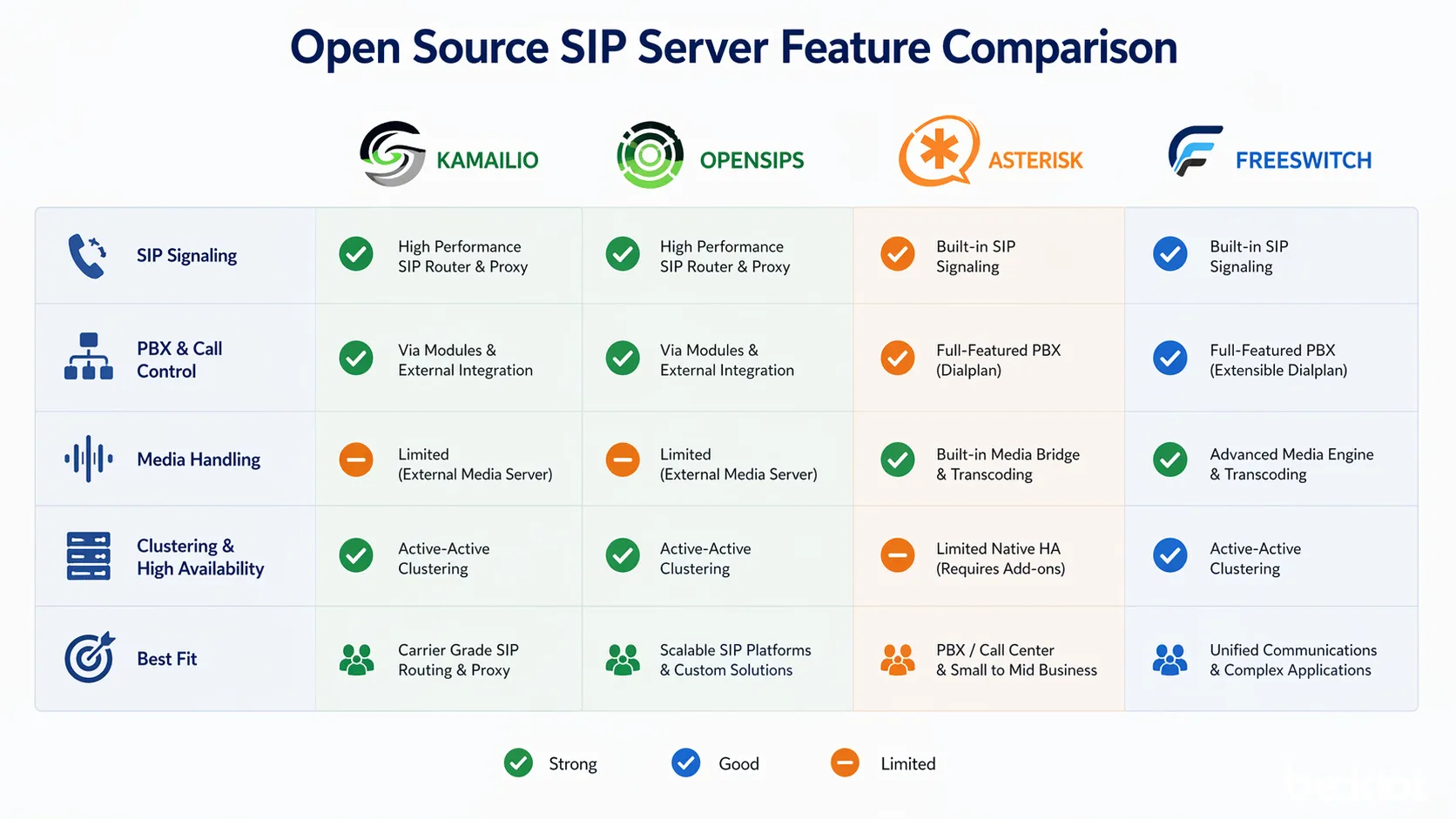
Feature comparisons are most useful when signaling, PBX, media, and clustering responsibilities are separated clearly.
Performance in Real Deployments
Signaling throughput is not the same as media workload
SIP platform performance is often misunderstood because different workloads are compared as if they were the same. A server that handles SIP routing and registrations is solving a different problem from a server running IVR, bridging calls, processing media, or hosting conferences.
Kamailio and OpenSIPS generally perform very well when the workload is dominated by SIP signaling, registration handling, and routing policy. Asterisk and FreeSWITCH naturally consume more resources when they are responsible for PBX logic, call-state control, conferencing, or media operations.
This does not mean one category is better than the other. It means performance must be judged against responsibility. A server doing more application or media work will have a different resource profile from a lightweight SIP proxy.
Resource behavior and system design
Kamailio and OpenSIPS are often used as lightweight front-end SIP processing layers. They can absorb signaling traffic, route requests, and protect downstream systems. Asterisk and FreeSWITCH often carry more functional responsibility per node because they execute business telephony, media, conferencing, or application logic.
Architects should match platform profile to expected workload. If the main need is registration, ingress signaling, and request distribution, a signaling-focused layer is usually cleaner. If the project needs IVR, queues, prompts, bridges, or conferencing, the heavier application or media workload becomes part of the design.
Operational visibility matters
Performance is not only about calls per second. A production platform must be observable, maintainable, and easy to troubleshoot. A SIP proxy needs disciplined routing logic, tracing, and monitoring. A PBX or media engine needs clear dialplan control, codec awareness, event monitoring, and predictable service behavior.
Teams should evaluate not only raw efficiency, but also documentation, upgrade practices, logging, configuration clarity, monitoring options, and whether the platform fits their operational habits. A system that is theoretically powerful but difficult for the team to run may not deliver the best real-world result.
In SIP infrastructure, performance should always be measured against responsibility. Different roles create different resource patterns.
Scalability and High Availability
Scaling SIP signaling
Kamailio and OpenSIPS are often strong choices when SIP signaling needs to scale horizontally. They can distribute traffic, share or replicate location-related information, and build front-end SIP layers that spread load across downstream systems.
This is useful because signaling growth does not always match media growth. A platform may see more registrations, more tenants, more trunk traffic, or more regional ingress points without needing the same increase in conferencing or media capacity. A dedicated signaling layer lets teams scale the part of the system that is under pressure.
Scaling PBX and media services
Asterisk and FreeSWITCH can also scale, but their scaling model is often different. Instead of simply adding more edge routers, teams may distribute PBX logic, separate media resources, or place application nodes behind a signaling tier.
For example, Asterisk can sit behind SIP proxies so that user registration, trunk distribution, and ingress policy do not overload the PBX layer. FreeSWITCH can sit behind a signaling-aware front end so conferencing and media nodes can scale according to real usage while the external SIP view remains controlled.
Layered production architecture
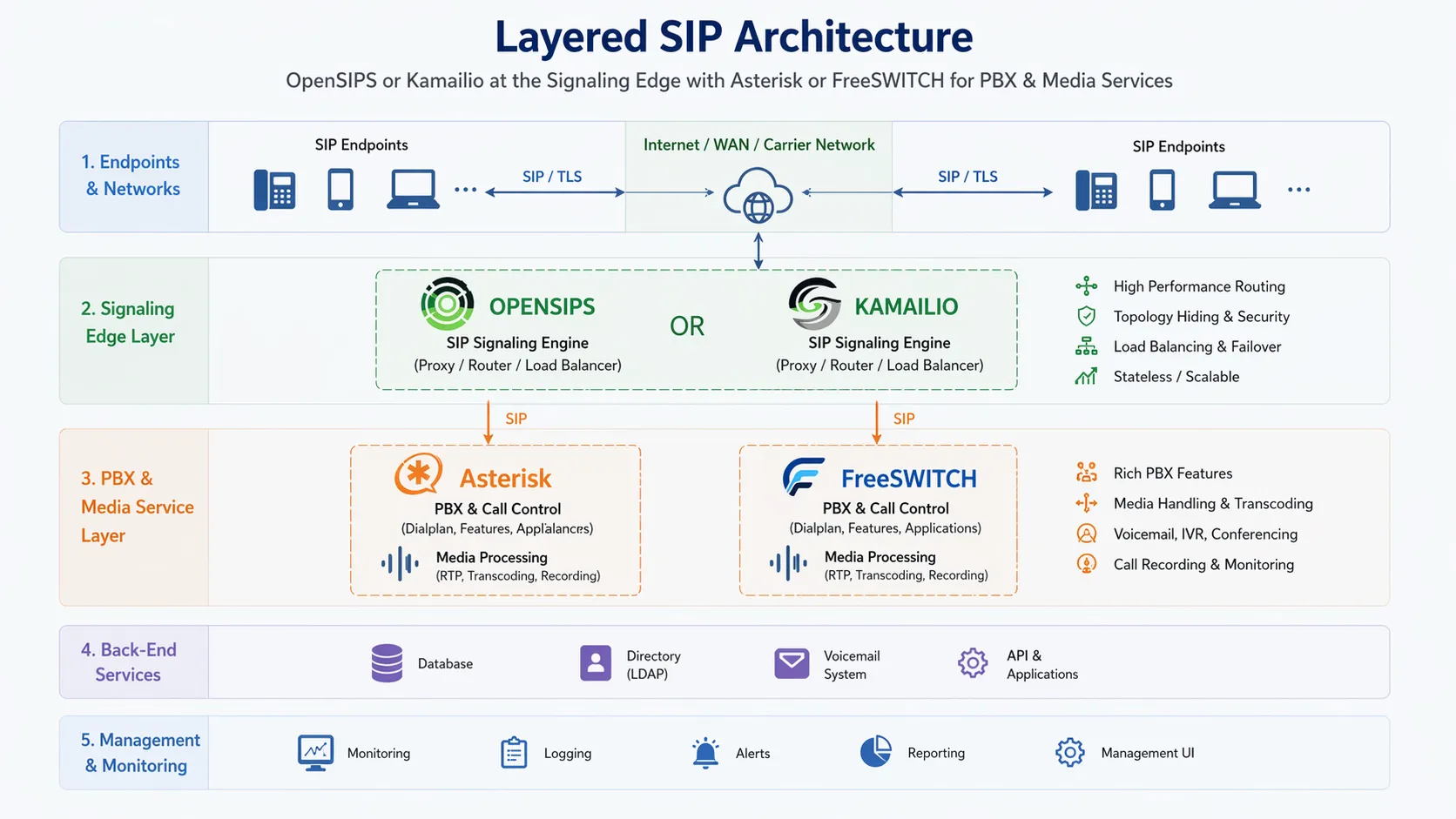
In many serious deployments, the best answer is a layered architecture. Kamailio or OpenSIPS can handle the signaling edge, registration, routing, load balancing, and traffic normalization. Behind that layer, Asterisk can provide PBX services, or FreeSWITCH can provide media-heavy application behavior.
This design reduces role conflict. The edge layer handles SIP policy and distribution. The service layer handles telephony features or media execution. Database, provisioning, monitoring, and billing layers can remain separate. Instead of forcing one platform to do everything, the architecture becomes easier to scale component by component.
A layered deployment often scales better because signaling and service execution can grow independently.
Best-Fit Scenarios
When Kamailio is a strong choice
Kamailio is a strong choice when the priority is high-performance SIP routing, registration handling, traffic dispatching, and policy control at the signaling edge. It fits service-provider infrastructure, SIP trunk aggregation, large registration services, WebRTC-to-SIP interconnection layers, and multi-node communication platforms.
It is also suitable when engineers want fine control over routing behavior without turning the front-end node into a full telephony application server. Its value comes from efficiency, flexibility, and clean separation of responsibilities.
When OpenSIPS is a strong choice
OpenSIPS is attractive when teams want a carrier-grade SIP server with strong clustering options, high-throughput signaling, and flexible service composition. It fits distributed registration, large-scale ingress control, clustered routing, and custom SIP platforms.
When comparing Kamailio and OpenSIPS, the decision often depends on scripting preference, module familiarity, clustering needs, ecosystem habits, and the operational model the team wants to maintain.
When Asterisk is a strong choice
Asterisk is usually the better fit when the goal is a working PBX or business communication application. It is practical for enterprise voice systems, internal office telephony, branch deployments, auto attendants, call queues, voicemail, IVR workflows, gateways, and call control logic.
It also makes sense for teams that want to build business telephony services quickly with mature call-flow patterns and broad community familiarity.
When FreeSWITCH is a strong choice
FreeSWITCH is especially compelling when conferencing, media control, programmable RTC behavior, and event-driven telecom applications are important. It fits media-intensive systems, multi-party communication services, conference platforms, and custom communication applications.
It can also be a strong option when the project needs a versatile software telecom stack rather than a conventional office PBX focus. In those environments, modularity and media-oriented design become major advantages.
How to Choose the Right Platform
The first selection criterion should be architectural role. If the project mainly needs SIP signaling, registration, routing, and front-end traffic control, Kamailio or OpenSIPS should be considered first. If the project mainly needs business call logic and PBX behavior, Asterisk is often the natural starting point. If the project is centered on conferencing, media services, or programmable event-driven communication, FreeSWITCH deserves close evaluation.
The second criterion is scaling strategy. Ask whether the system needs to scale mainly in signaling volume, media usage, conference capacity, or feature-rich call application logic. Each requirement points toward a different architecture.
The third criterion is operational readiness. The right platform is the one the team can deploy, monitor, troubleshoot, upgrade, and extend consistently over time. A technically strong platform still needs to fit the team’s real operating capability.
Teams should also avoid the false choice between single-platform simplicity and multi-platform complexity. In many projects, the best approach is phased architecture: start with the platform that solves the current requirement, then introduce layered separation as load, tenancy, geography, or service diversity increases.
Conclusion
There is no universal winner among open source SIP servers because Kamailio, OpenSIPS, Asterisk, and FreeSWITCH are not competing for exactly the same job. Kamailio and OpenSIPS are especially strong as SIP signaling infrastructure. Asterisk remains highly practical as a PBX and communications application framework. FreeSWITCH stands out for modular, media-centric, and event-driven communication services.
In small systems, one platform may cover most requirements well enough. In larger or more demanding systems, layered architecture is often more scalable and easier to maintain. A proxy-oriented platform can manage signaling at the edge, while PBX or media platforms handle service execution behind it.
The best choice comes from matching the platform to the architecture, not from choosing the most famous name. When responsibilities are separated clearly, open source SIP infrastructure becomes more resilient, observable, and ready for long-term growth.
FAQ
What is the difference between Kamailio and OpenSIPS?
Both are widely used for SIP signaling, routing, registration, and scalable edge behavior. The practical difference often depends on clustering approach, scripting preference, module familiarity, ecosystem habits, and the operating model that best fits the team.
Is Asterisk a SIP server or a PBX?
Asterisk can speak SIP, but it is better understood as a PBX-oriented communications framework. It is widely used for dialplan logic, IVR, voicemail, queues, gateways, and business telephony services.
Is FreeSWITCH better for conferencing?
FreeSWITCH is often a strong choice when conferencing and media control are major priorities. It is frequently used in projects where media programmability and event-driven integration matter more than pure SIP edge routing.
Should I use one platform or combine several?
Smaller deployments may use one platform successfully. Larger or more specialized systems often benefit from combining a signaling-focused platform with a PBX or media platform so each component handles the role it performs best.
Which open source SIP server scales best?
Scalability depends on what needs to scale. For signaling-heavy growth, Kamailio and OpenSIPS are strong choices. For PBX feature growth, Asterisk can be effective in the right architecture. For conference and media-heavy growth, FreeSWITCH is often a better fit.