Shipboard Video Access Gateway for Integrated Ship-to-Shore Communication
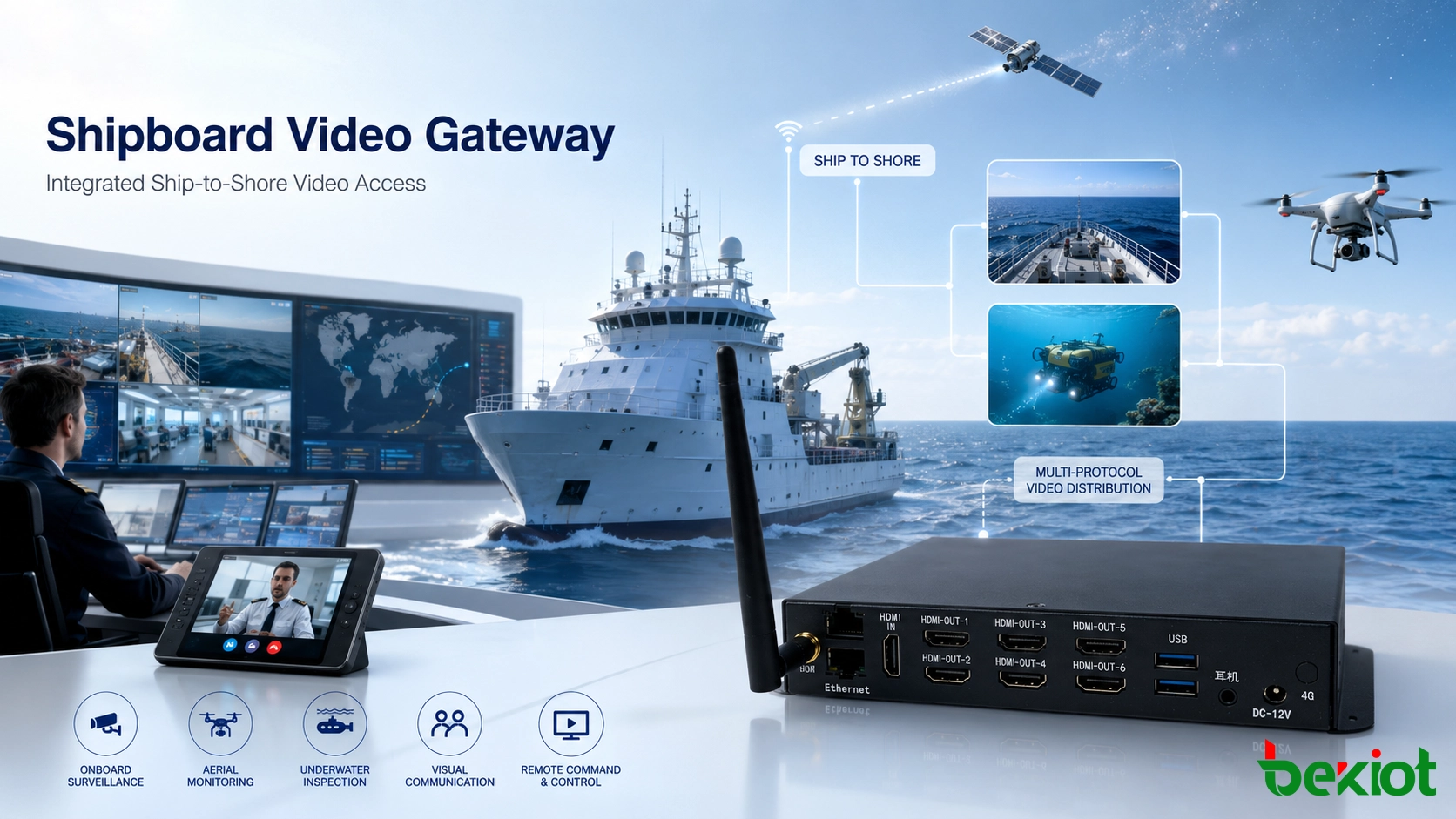
Shipboard video access gateways integrate onboard cameras, video terminals, drones, underwater robots, satellite links, SIP communication, and shore command platforms into one manageable ship-to-shore video workflow.
Becke Telcom
Modern ships are no longer isolated operating units. Cargo vessels, patrol boats, offshore engineering ships, research vessels, law-enforcement fleets, rescue ships, and special-purpose platforms are increasingly equipped with communication terminals, video systems, satellite links, onboard command applications, and digital operation tools. These systems support navigation assistance, dispatch coordination, safety management, remote consultation, and mission decision-making.
Among these onboard systems, video has become especially important. Traditional surveillance cameras are now used together with video conferencing terminals, video phones, unmanned aerial vehicles, underwater inspection robots, mobile inspection cameras, and shore-based command platforms. Through satellite networks or maritime broadband links, a shore command center may need to view deck cameras, join a video meeting with the crew, receive drone footage, or review underwater inspection images from the vessel.
The challenge is that shipboard video integration is not simply a matter of connecting one camera to one display. Different devices may use different ports, stream protocols, codecs, resolutions, and control methods. If every source needs a separate decoder, software client, or custom integration module, the whole system becomes costly, difficult to deploy, and hard to maintain. A shipboard video access gateway provides a more practical way to aggregate, convert, transmit, and distribute video resources across ship and shore systems.
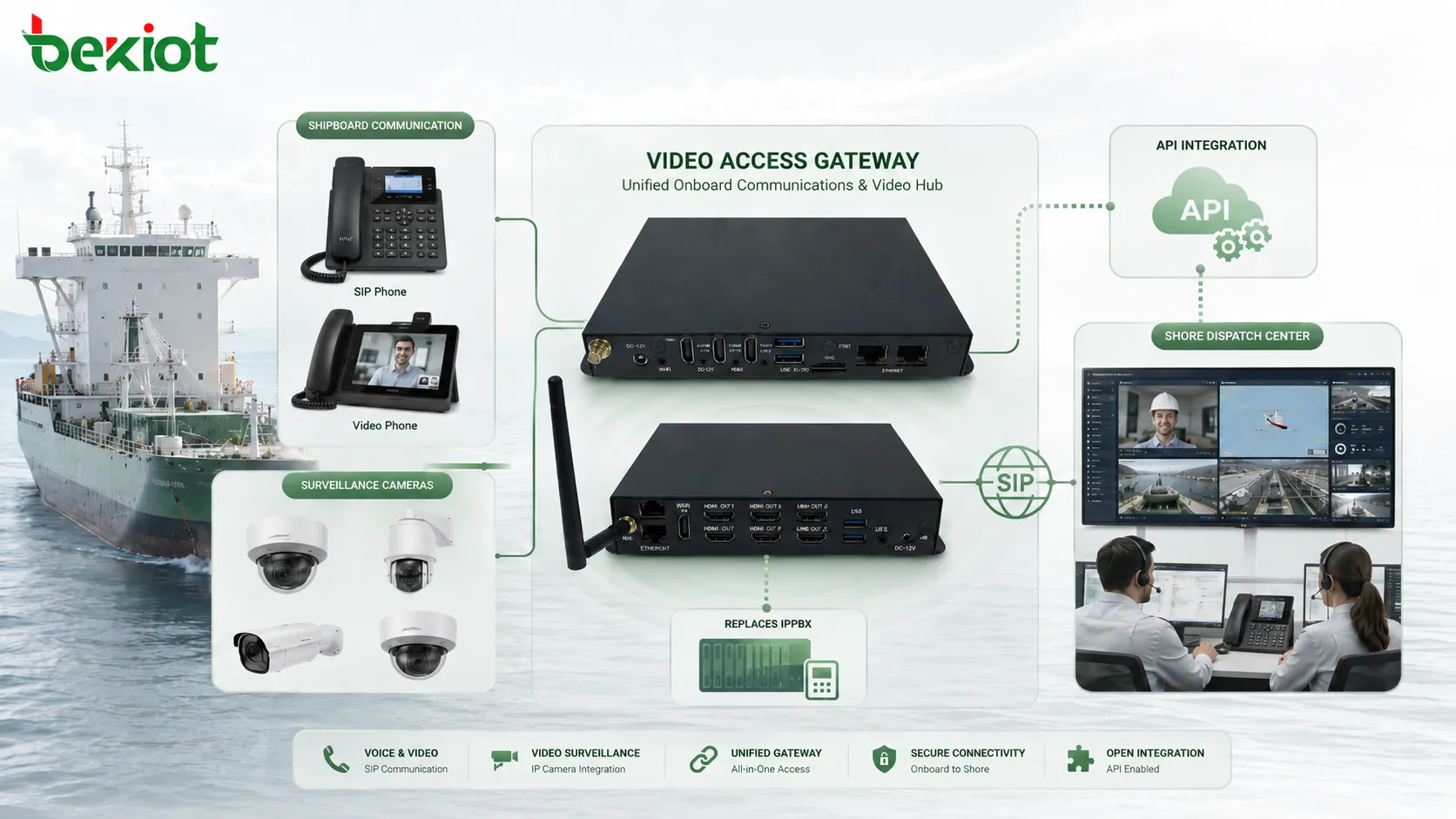
A shipboard video access gateway unifies onboard cameras, video terminals, drones, inspection robots, satellite backhaul, and shore command platforms.
Why ships need a unified video access layer
Modern vessels often carry many types of video sources. Fixed cameras may monitor the deck, bridge, engine room, cargo hold, machinery space, crane area, safety zone, and access points. Video conferencing systems may be used for remote consultation, technical support, or fleet coordination. Video phones can support internal visual communication and quick confirmation between crew members or command positions.
For special missions, more video resources may be added. Drones can provide aerial inspection, maritime patrol, emergency observation, or rescue assessment. Underwater robots can send visual data for hull inspection, underwater engineering, maintenance, salvage, or search operations. Mobile inspection cameras can be temporarily deployed when fixed coverage is not enough.
Each device may come from a different supplier and may output video differently. Some sources use HDMI, some provide RTSP streams, and others may depend on RTMP, FLV, HLS, GB/T28181, WebRTC, SIP video, or platform SDKs. Without a unified gateway layer, integrators may need to build separate video paths for each source. This increases wiring, hardware quantity, configuration work, and future maintenance pressure.
Shipboard environments make integration harder
Compared with land-based control rooms, vessels have stricter limits on space, power supply, wiring routes, heat dissipation, network stability, and maintenance access. A shipboard system should be compact, reliable, and easy for onboard personnel to manage. In many cases, the crew may not have the same IT maintenance resources as a shore-based command center.
A video access gateway can act as the central media layer. It receives video from onboard devices, adapts protocols, converts stream formats, and provides unified output to command systems, video conferencing platforms, AI analysis servers, business applications, dispatch platforms, and remote shore users.
Instead of creating many isolated video paths, the project can use one gateway architecture to organize the whole onboard video system. This is especially valuable when the vessel needs long-term operation, low maintenance burden, and flexible expansion for future digital maritime applications.
Aggregating cameras, drones, and inspection video
A key value of a shipboard video access gateway is unified video aggregation. Surveillance cameras, NVRs, video terminals, HDMI sources, drone receivers, underwater robot feeds, and temporary field cameras can be connected to the gateway and then made available to other systems.
For different vessel types, the value appears in different ways. A patrol vessel may need to send deck camera footage and drone video to a shore command center. An offshore engineering ship may need to transmit crane operation video, underwater inspection footage, and equipment status images. A research vessel may need to manage feeds from observation cameras and underwater devices. A rescue vessel may need to combine deck video, meeting room video, drone images, and remote expert consultation.
A practical gateway should support mainstream input and output methods, such as HDMI, RTSP, RTMP, GB/T28181, FLV, HLS, SIP, WebRTC, and other common streaming formats depending on project requirements. With a unified access layer, integrators do not need to design a separate conversion scheme for every camera, drone receiver, or video terminal.
Lightweight video transmission over satellite links
Many vessels rely on satellite communication to maintain contact with shore-based command centers. Satellite links are useful for remote sea areas, offshore engineering, maritime law enforcement, and emergency operations, but they still face practical limitations. Bandwidth may be limited, link quality may fluctuate, latency may be noticeable, and transmission cost may be high.
Video consumes far more bandwidth than ordinary voice or data. If several onboard cameras, drone feeds, or inspection streams are transmitted directly without optimization, the satellite channel can become overloaded. The result may be freezing, long delay, unstable preview, or high operating cost.
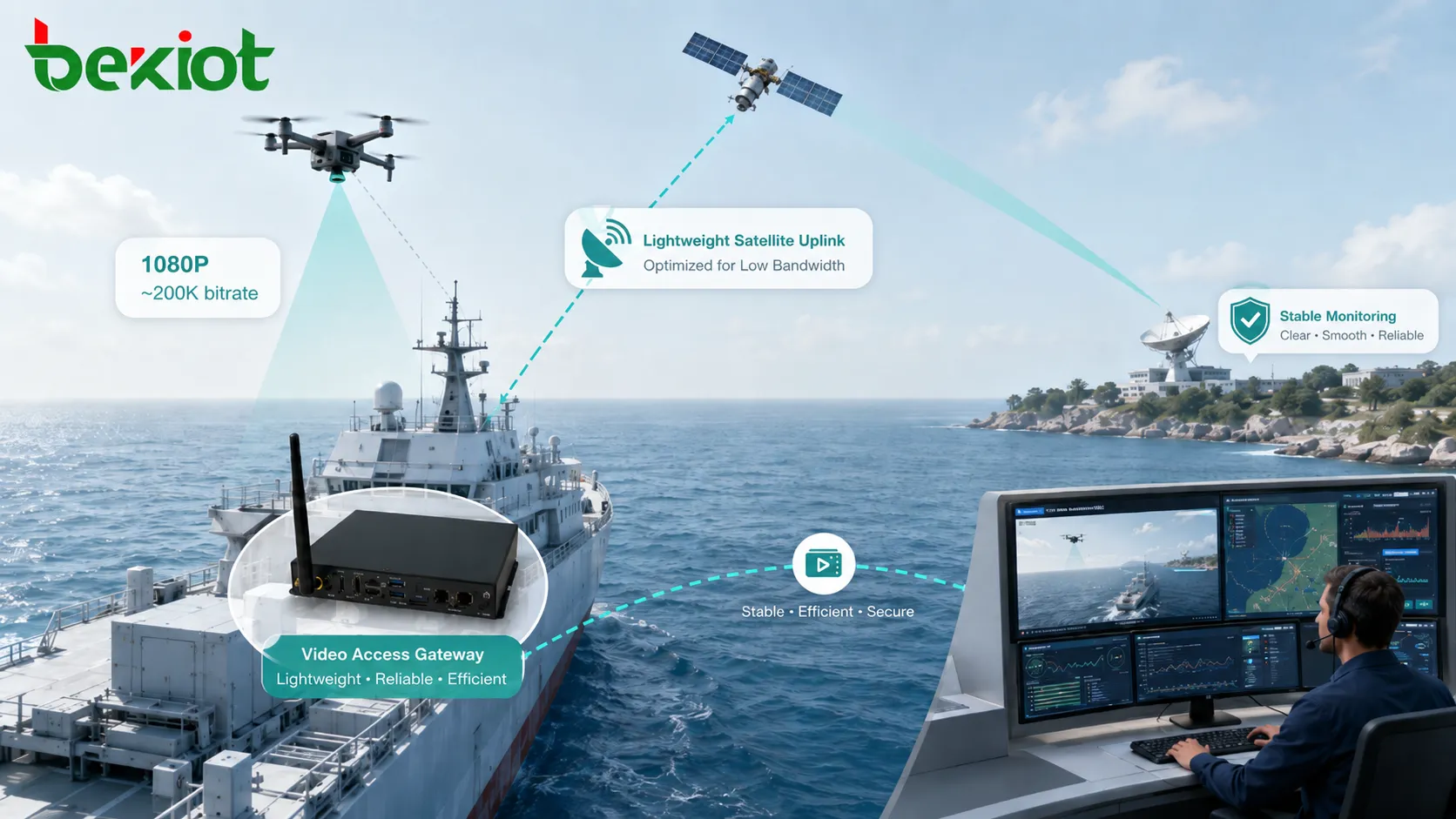
A shipboard video access gateway can reduce this burden by compressing, transcoding, and adapting streams according to the actual link condition. In some application scenarios, dynamic 1080P video can be transmitted at around 200K bitrate while still keeping the image clear enough for command observation. For maritime command, stable usable video is often more valuable than an oversized stream that frequently freezes.
Lightweight video processing helps vessels transmit clearer live video to shore command centers through limited satellite bandwidth.
One video source can serve multiple systems
On a modern vessel, video is no longer used by only one monitor or one recorder. A surveillance stream may need to enter a shipboard command application. Drone video may need to be shared into a video conference. An AI analysis server may require one stream format, while a browser-based management platform may require another. A dispatch platform may need SIP video linkage, while a superior platform may require GB/T28181.
If every upper-layer application requests video directly from the source device, the pressure stays on the terminal side. Multiple parallel calls may increase device load, network traffic, and system complexity. A gateway-based model changes this structure. The gateway receives one source stream and then distributes it to multiple systems in the format each system requires.
For example, one onboard surveillance camera can be received by the gateway and then converted into a GB/T28181 stream for a shore command platform, an RTSP stream for AI analysis, a SIP stream for a dispatch or video meeting system, and a WebRTC or FLV stream for a browser-based application. The same source can serve different systems without repeated device-side access.
SIP video communication inside the vessel
A shipboard video access gateway is not limited to media conversion. In a more integrated architecture, it can also connect SIP-based audio and video communication devices, including IP phones, video phones, intercom terminals, dispatch endpoints, and onboard command terminals.
For crew members, this means a video phone or dispatch terminal can support more than communication. It may also provide visual confirmation, selected camera preview, drone image access, or shore command interaction through a unified interface. In some projects, this can reduce the need for separate IPPBX modules, separate video access systems, and scattered configuration tools.
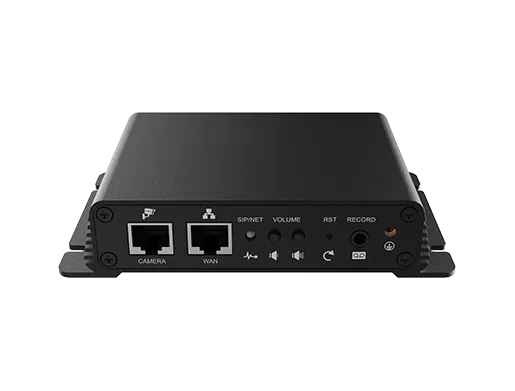
A gateway with SIP communication capability can combine internal calling, video access, stream conversion, and API integration in a compact device or 1U rack-mounted unit. This helps simplify shipboard architecture while keeping enough flexibility for future maritime command and communication upgrades.
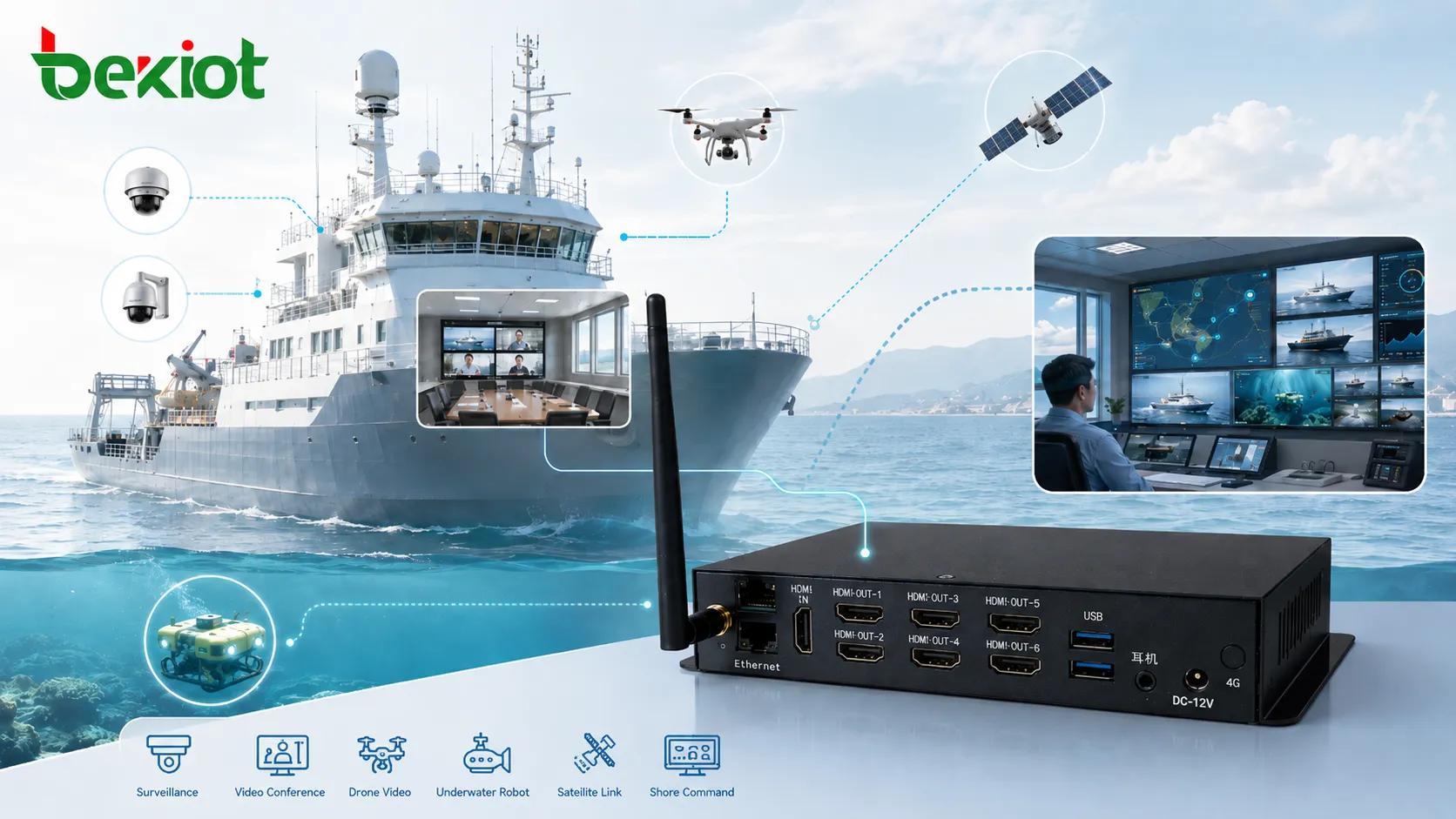
A unified gateway can combine video access, SIP communication, internal calling, API integration, and shore dispatch linkage in one shipboard architecture.
Practical value for maritime projects
The first value is lower hardware complexity. A unified gateway reduces the need for many independent decoders, converters, software clients, communication modules, and custom interfaces. On ships, this matters because rack space, installation space, power supply, and maintenance conditions are all limited.
The second value is simpler deployment. When the gateway supports mainstream video devices and protocols, integrators can connect cameras, video platforms, drone feeds, HDMI sources, SIP terminals, and shore systems through one central device instead of repeatedly developing separate interfaces for every subsystem.
The third value is better ship-shore collaboration. Shore command centers can receive onboard video, join visual communication, view drone or inspection robot footage, and support operational decisions more directly. In maritime law enforcement, offshore engineering, emergency rescue, fleet management, and special missions, this improves situational awareness and command continuity.
The fourth value is room for future expansion. A mature gateway should provide API interfaces so upper-layer systems can call streams, manage devices, trigger video linkage, connect GIS, receive alarm events, or combine video with dispatch records. This makes the video layer reusable for future maritime digitalization projects.
Implementation notes for integrators
Before deployment, the project team should check existing onboard equipment first. This includes surveillance cameras, NVRs, HDMI sources, video conferencing terminals, drone systems, underwater robot systems, satellite terminals, internal communication devices, network topology, and shore platform requirements. Only after this inventory is clear can the correct protocols, interfaces, and stream formats be selected.
Video quality should be matched with the transmission link. For satellite backhaul, the highest resolution is not always the best choice. The system should balance clarity, bitrate, latency, stability, and cost. In many command scenarios, continuous and stable video is more useful than a very high-resolution stream that cannot be maintained.
Access permission and security should also be planned early. Shipboard video may involve operational safety, cargo information, crew activity, law-enforcement evidence, or mission-sensitive data. The gateway should support account control, stream authorization, secure access policies, and network protection. Remote viewing should be limited to approved systems and authorized users.
Installation form also matters. Small vessels may prefer a compact gateway, while larger ships, offshore platforms, or integrated communication rooms may use a 1U rack-mounted device. The selected equipment should match available space, power conditions, heat dissipation, vibration environment, and long-term maintenance methods.
Shipboard video as a reusable command resource
Deploying a video access gateway on a ship is not only about converting formats. It is about creating a unified media and communication layer for onboard systems. The gateway can aggregate surveillance cameras, video conferencing equipment, drone feeds, underwater robot video, SIP terminals, and satellite backhaul into a more manageable architecture.
By supporting multi-protocol access, lightweight transmission, one-input-to-many-output distribution, SIP visual communication, and API integration, the gateway helps solve common shipboard problems such as device diversity, repeated protocol adaptation, satellite bandwidth pressure, fragmented communication, and difficult maintenance.
For maritime projects that need to combine video access, SIP voice, dispatch communication, paging, emergency notification, and shore-side coordination, Becke Telcom / 贝克通信 can be considered as a lightweight integration partner for building a more unified ship-shore communication workflow.
Summary
A shipboard video access gateway helps vessels integrate onboard cameras, video conferencing terminals, video phones, drones, underwater robots, HDMI sources, satellite links, and shore command platforms into one unified video workflow. It reduces isolated video paths, simplifies deployment, and makes onboard video easier to transmit, distribute, and manage.
For patrol vessels, offshore engineering ships, rescue ships, research vessels, cargo fleets, and special-purpose maritime platforms, this architecture supports better ship-shore collaboration, more efficient remote command, lighter satellite video transmission, and more scalable maritime digital systems.
FAQ
Can a video access gateway work when satellite bandwidth is poor?
Yes, but stream configuration must be planned carefully. The gateway should support bitrate control, resolution adjustment, codec optimization, and stream selection. For very limited links, only key video channels may be transmitted to shore while other streams remain available locally.
Does every onboard camera need to be replaced?
Usually no. The purpose of a gateway is to reuse existing video resources as much as possible. If cameras, recorders, or video platforms can provide supported interfaces or stream protocols, they can often be integrated into the gateway architecture.
How should drone video be handled on a vessel?
Drone video can be received onboard first, connected to the video gateway, processed into the required stream format, and then distributed to local displays, command terminals, AI platforms, or shore command centers. This avoids building separate drone video paths for every application.
Is SIP communication necessary for all shipboard video projects?
Not always. SIP is valuable when the project needs voice calls, video calls, dispatch terminals, visual intercom, or communication system integration. If the project only needs video viewing and recording, SIP support may be optional.
What should be checked before selecting a shipboard gateway?
Integrators should confirm input interfaces, protocol compatibility, satellite transmission requirements, concurrent stream capacity, transcoding performance, SIP support, API openness, device size, installation method, power conditions, and long-term maintenance requirements.