Modern Call Center System for Customer Service, Workflow Management and AI-Assisted Operations
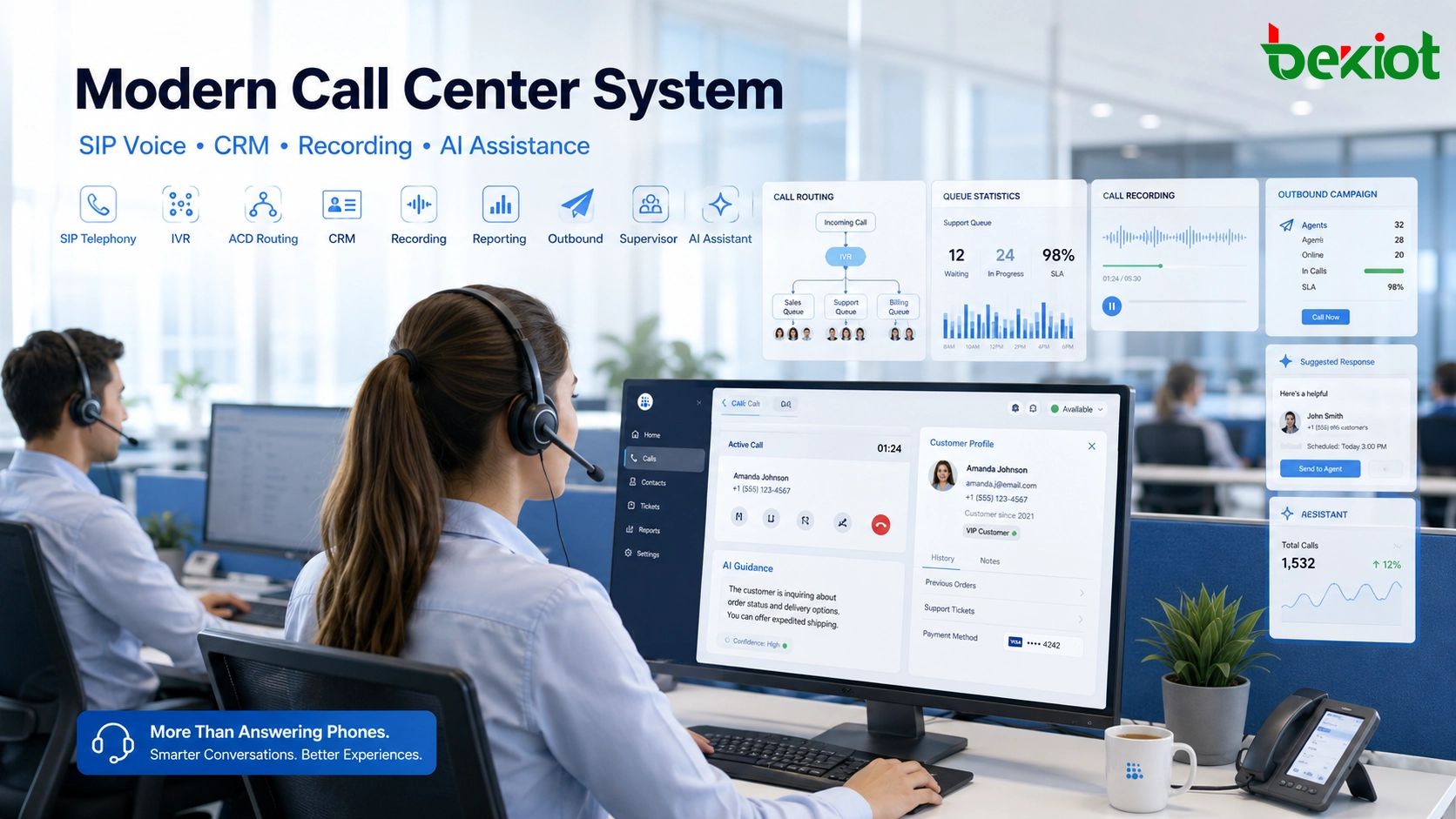
A modern call center system connects SIP telephony, CRM, IVR, ACD routing, recording, reporting, outbound tasks and AI assistance to improve customer service efficiency, traceability and quality control.
Becke Telcom
A call center is often understood as a team that answers customer phone calls. That description is no longer enough for modern service operations. Today, a call center system is a communication platform, customer service workspace, supervision tool, reporting center and workflow engine built around every customer interaction.
Whether a company has five service agents or hundreds of seats across several branches, the basic goal is the same: respond faster, keep service records complete, reduce repeated work and help managers understand what is really happening in daily communication. The difference is that modern platforms can now connect SIP telephony, CRM data, call recording, quality inspection, outbound campaigns, reporting dashboards and AI-assisted service tools into one operating environment.
A good call center system should not make service more complicated. It should help agents see the right customer information before speaking, help supervisors support difficult calls in real time, and help managers improve service quality with evidence instead of guesswork.
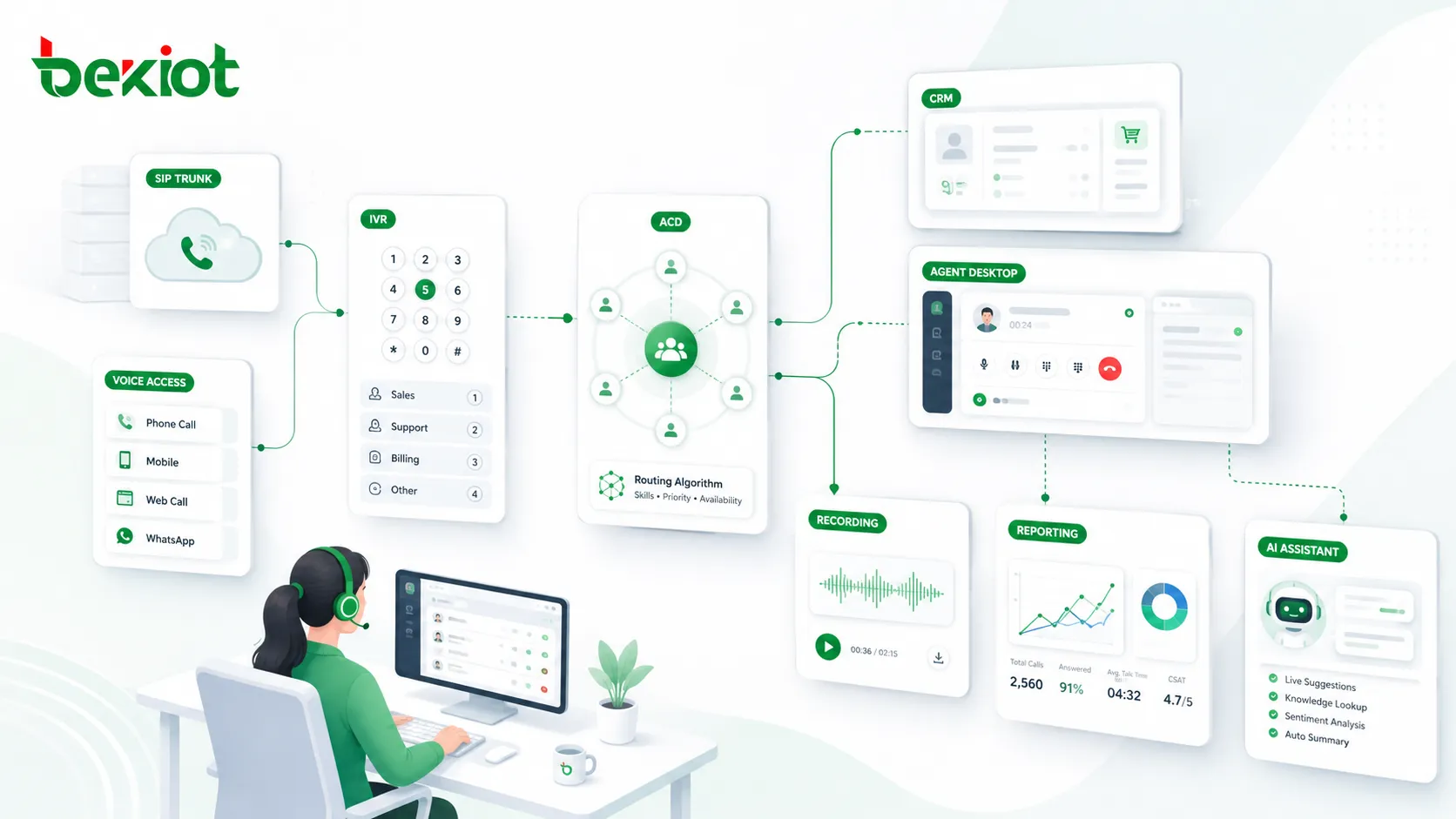
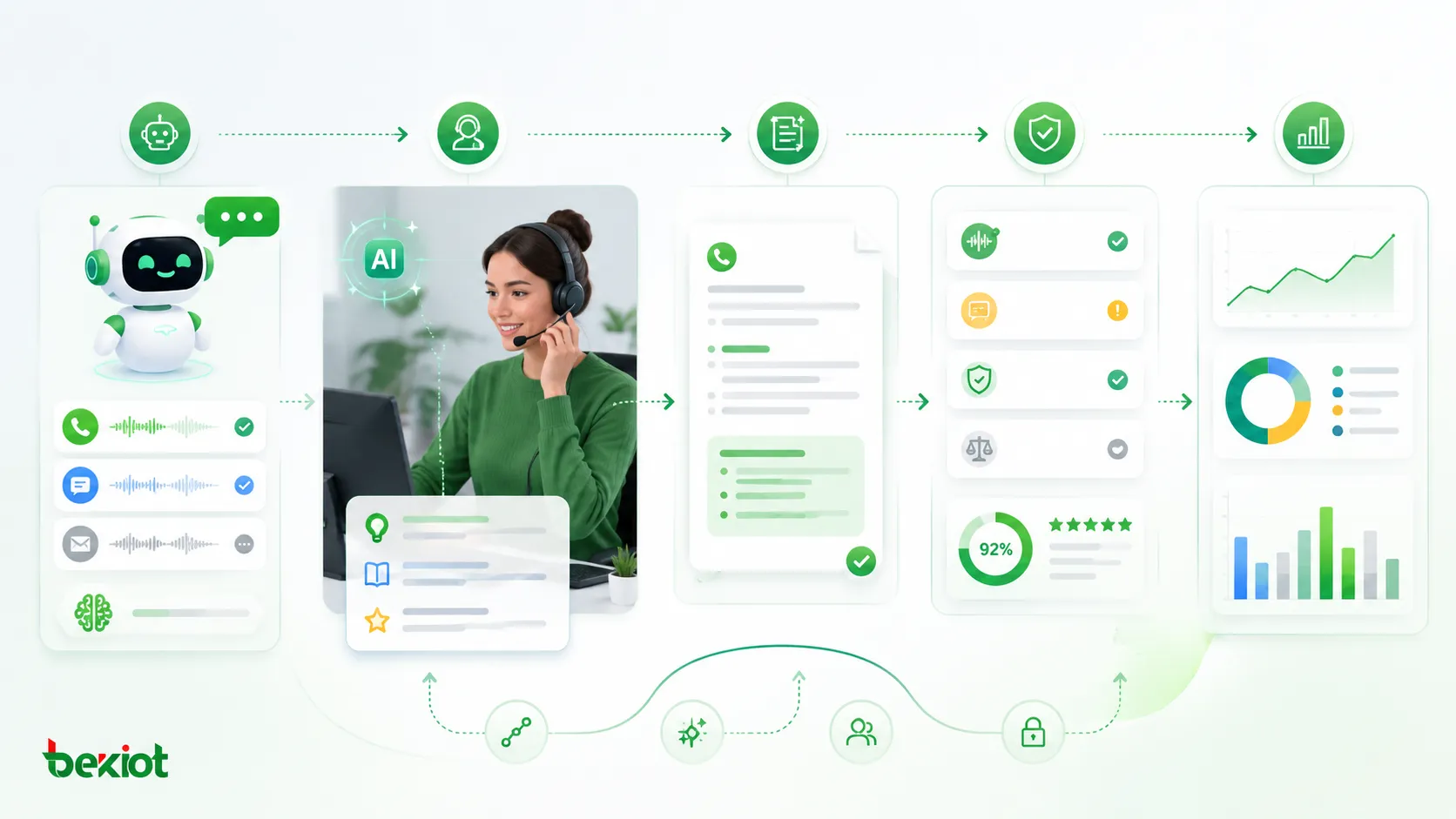
A modern call center platform connects voice access, routing, agent tools, customer records, recording, reporting and AI-assisted service workflows.
From Phone Answering to Service Operations
The role of the call center has changed
Traditional customer service teams often relied on phone lines, notebooks, spreadsheets and manual follow-up. This approach may work when call volume is low, but it quickly becomes difficult to manage when customers increase. Records are missed, customers repeat the same information, agents use different answers, and managers cannot clearly see where service delays happen.
A modern call center system changes phone communication into a structured service process. Incoming calls, outbound calls, agent actions, customer profiles, ticket updates, recordings, quality scores and follow-up tasks can all be connected to the same workflow.
The real value is before, during and after the call
The value of a call center is not only connecting a customer to an agent. Before the call starts, the system should identify the customer and prepare useful information. During the call, it should give the agent call controls, customer history and knowledge support. After the call, it should record what happened, help complete follow-up tasks and provide data for management.
This creates a better experience for both sides. Customers do not need to explain the same issue again and again. Agents do not need to search blindly. Managers can see service pressure, agent workload and recurring customer problems more clearly.
The central logic of a call center system is simple: reduce repetitive work, lower communication cost and make every customer interaction traceable.
Voice Controls That Keep Calls Moving
Agent login and device binding
In a professional call center, an agent does not simply pick up any random phone. The agent logs in to the platform, selects or binds a device, and becomes part of the routing, monitoring and reporting system. This allows the platform to know who is available, who is busy, who is in after-call work and who is temporarily offline.
Depending on the deployment model, agents may answer calls through softphones, headsets, desktop IP phones, mobile phones or other bound devices. This is useful for remote service, branch-office support, flexible staffing and hybrid work environments.
Hold, consultation, transfer and conference
Basic call handling functions are still essential. Agents need to place customers on hold, consult a colleague, transfer a call to a specialist or invite another person into a three-party conversation. These controls help agents solve real customer problems without forcing the customer to call again.
For example, an agent can briefly hold a customer while checking order status, consult a senior agent without exposing the internal conversation, or transfer the case to a technical support group when the issue requires specialist handling.
After-call work protects service quality
When a call ends, the system should not always push the next call to the agent immediately. Many service cases require notes, result codes, ticket updates, callback scheduling or complaint classification. After-call work gives the agent time to complete these records before taking the next interaction.
This wrap-up period may look short, but it is important. Without it, agents may handle more calls on paper, but records become incomplete and the next agent may not know what happened previously.
Customer Context Before the First Sentence
Screen pop and CRM integration
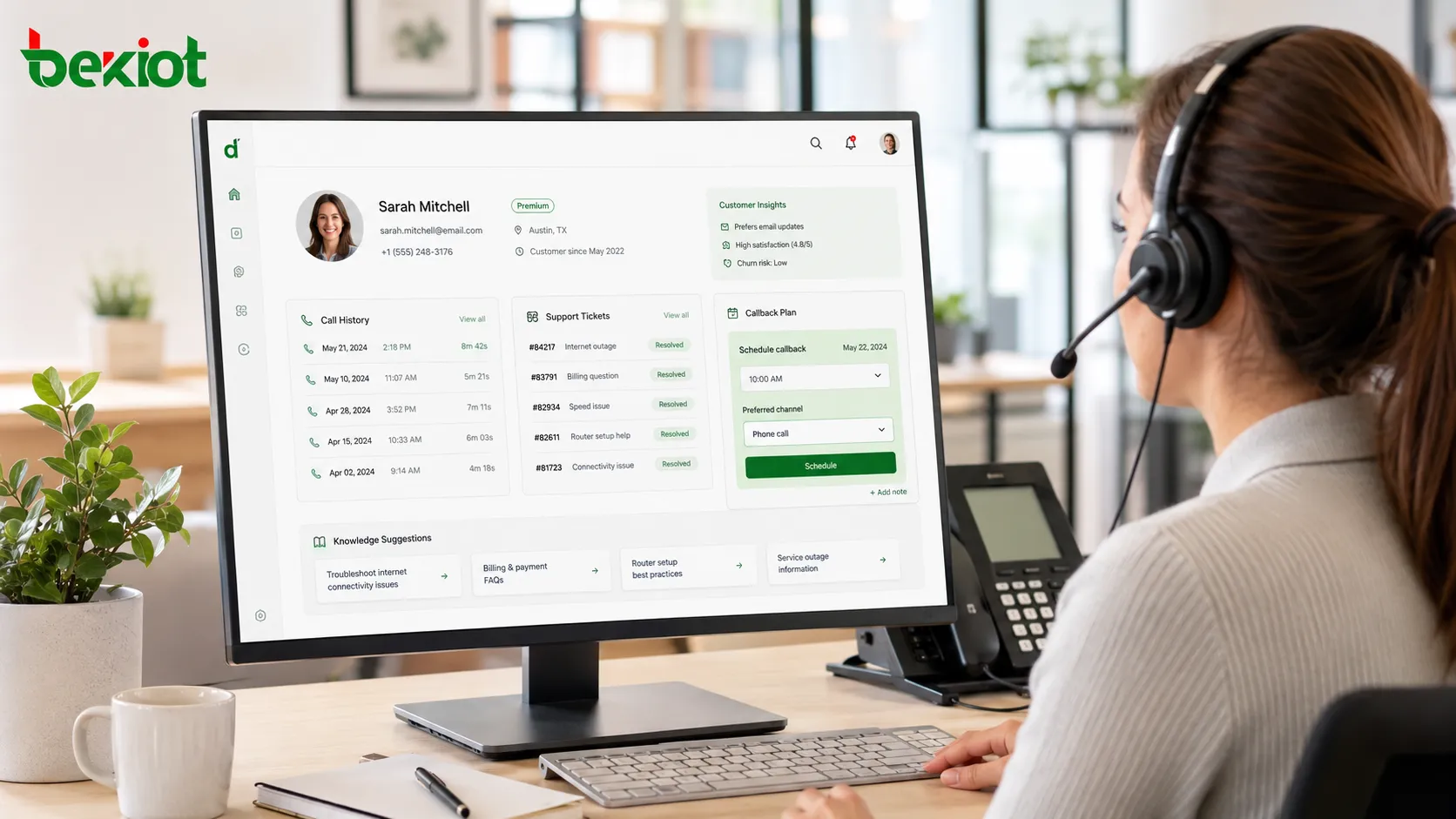
Customer screen pop is one of the most valuable call center features. When a customer calls in, the system can automatically display the customer profile, contact information, order history, previous tickets, complaint records, call notes and related recordings.
This allows the agent to start the conversation with context. Instead of asking the customer to repeat basic information, the agent can quickly confirm the identity and move to the actual issue. In practical service work, this can shorten call time while improving customer satisfaction.
The agent desktop becomes a service workspace
The agent desktop should be more than a call control panel. It should also support customer data updates, service notes, ticket creation, order lookup, callback scheduling, knowledge search and recording review. A well-designed workspace helps the agent complete the service process in one place.
For example, if a customer reports damaged delivery packaging, the agent can record the problem, create a reshipment task and schedule a follow-up reminder. If the customer changes a phone number, the agent can update the profile immediately during the call.
Customer screen pop helps agents view identity, history, tickets, recordings and follow-up tasks before and during the conversation.
Real-Time Supervision Instead of Delayed Guesswork
Queue and agent status monitoring
Supervisors need to know what is happening while the service operation is running. Real-time monitoring can show how many customers are waiting, how long they have waited, which agents are talking, which agents are idle, and which agents are in break or wrap-up status.
This visibility helps daily management. If the queue grows quickly, the supervisor can adjust staffing or reassign agents. If a call lasts unusually long, the supervisor can check whether the agent needs support.
Supervisor intervention tools
Advanced call center systems often provide silent monitoring, whisper coaching, barge-in and forced disconnect. Silent monitoring allows the supervisor to listen without joining the call. Whisper coaching lets the supervisor guide the agent while the customer cannot hear the supervisor.
Barge-in allows the supervisor to join a difficult or sensitive conversation directly. Forced disconnect may be used for malicious harassment calls or other abnormal situations. These tools should not be used only for control; their real purpose is to help teams handle risk in time.
Recording, Reports and Quality Management
Call recording as service evidence
Call recording is one of the most important parts of a call center system. It provides evidence when customers dispute what was said, when complaints need review or when service processes must be checked. Recordings also help businesses protect both customers and agents.
Recordings are also useful for training. New agents can review successful conversations and learn how experienced agents handle objections, emotional customers, product questions and complicated service requests.
Reports turn work into measurable data
Call center reports turn daily service work into measurable information. Managers can review inbound call volume, outbound call volume, answered calls, missed calls, waiting time, total talk time, average handling time, after-call work time and workload by time period.
These reports support decisions about staffing, training, process improvement and service strategy. Instead of relying on personal impressions, managers can see which time periods are under pressure, which agents need help and which customer issues appear most often.
Quality inspection makes improvement structured
Quality inspection helps service quality become measurable. A quality inspector can review recordings and score calls according to clear standards such as greeting, identity verification, politeness, problem diagnosis, compliance wording, solution accuracy and closing confirmation.
This makes coaching more specific. Instead of saying an agent “seems good” or “needs improvement,” the business can use structured scoring, review notes and repeated issue categories to improve training and service consistency.
Outbound Workflows for Proactive Customer Service
Task-based outbound calling
A call center is not limited to receiving calls. It can also support customer follow-up, satisfaction surveys, payment reminders, service notifications, appointment confirmation, membership care and outbound marketing campaigns.
Managers can import a customer list, create an outbound task and assign it to agents. The system can dial automatically, prevent repeated dialing, mark completed contacts and record the result of each call. This makes outbound work easier to manage than manual phone lists.
Callback appointment and follow-up reminders
Follow-up planning is important for after-sales service. An agent may need to call a customer in three days to confirm whether a replacement product has arrived, or call back at a specific time requested by the customer.
A callback workflow helps prevent missed promises. When the scheduled time arrives, the system reminds the agent or connects the call according to the task rule. This improves service reliability and reduces dependence on personal memory.
How AI Improves Call Center Operations
Real-time assistance during calls
AI is becoming useful in call center operations because it can support agents at the moment they need help. When a customer asks for a return, refund or configuration step, the system can identify the intent and display the related policy, process or suggested response.
AI can also help detect emotional changes. If a customer becomes angry or anxious, the system may remind the agent to slow down, acknowledge the concern and use a calmer response. This gives new and experienced agents a more consistent support layer.
Automatic summaries and knowledge access
After a call, AI can generate a service summary and extract key information for the ticket. The agent only needs to review and correct the result instead of writing the whole record manually. In many service teams, this can reduce after-call work and improve record completeness.
AI also changes how agents use knowledge bases. Traditional knowledge search depends heavily on keywords and long articles. An AI-assisted knowledge base can answer direct questions, such as warranty period, return conditions or setup steps, and provide a more precise response for the agent.
Bot triage and intelligent quality inspection
Before a human agent joins the call, a voice bot or chatbot can collect basic information, identify the problem and handle simple requests. When the case is transferred to a human agent, the bot can pass the issue description and customer context to the agent.
AI quality inspection can review far more calls than manual sampling. It can detect prohibited words, missing verification steps, required compliance wording and whether service rules were followed. Calls with potential problems can then be sent to human reviewers for final judgment.
AI can assist before, during and after calls through bot triage, live guidance, automatic summaries, sentiment alerts and intelligent quality inspection.
Business Value by Role
For managers and business owners
A call center system helps managers understand what agents are doing, why customers are calling, where waiting time is increasing and which problems appear most often. It also provides records and recordings when disputes need to be reviewed.
More importantly, it standardizes service. A company should not depend only on one experienced employee who remembers every process. The system helps turn service knowledge, workflows, follow-up rules and performance measurement into repeatable operations.
For agents
Agents benefit from customer context, integrated call controls, knowledge suggestions, AI summaries and supervisor support. They can see who the customer is, what happened before and what action should be taken next.
This reduces repetitive typing and unnecessary questioning. It also helps new agents become productive faster because the platform gives them guidance instead of forcing them to rely only on memory.
For customers
Customers benefit from shorter conversations, fewer repeated questions, faster problem resolution and more consistent answers. When records are complete, the customer does not need to explain the same issue again during the next contact.
This is why a call center system is not only an internal management tool. It directly affects customer trust, service speed and brand perception.
Deployment in Modern Communication Environments
SIP, CRM and enterprise system integration
A practical call center deployment usually connects SIP trunks, PBX or IP-PBX platforms, IVR, ACD routing, CRM, ticketing systems, agent desktops, recording storage and reporting dashboards. The exact architecture depends on team size, compliance needs, customer data structure and whether agents work on-site or remotely.
For organizations that also need SIP endpoints, voice gateways, dispatch communication or hybrid telephony access, Becke Telcom can be considered as a lightweight integration option within broader communication projects. The key is to design the call center as part of the complete service and communication network, not as an isolated phone tool.
Security and reliability
Call center systems handle customer information, recordings, tickets and service history, so security must be planned from the beginning. User permissions, recording access control, data retention rules, encrypted transmission, audit logs and backup strategy should be clearly defined before the system goes live.
Reliability is equally important. If customer service depends on the platform, the business should evaluate redundancy, failover, SIP trunk stability, storage capacity, network quality and disaster recovery requirements.
CRM fields, ticket history, screen pop logic and data update permission
Helps agents serve with context
Agent operation
Login mode, device binding, call controls, after-call work and callback tasks
Improves usability and record completeness
Supervisor control
Queue monitoring, silent monitoring, whisper coaching, barge-in and quality review
Supports real-time management
Security and records
Recording retention, access control, encryption, audit logs and backup policy
Protects customer data and service evidence
Measure What Actually Improves Service
A call center dashboard can show many numbers, but not every number deserves the same attention. Businesses should focus on metrics that reflect service pressure and customer experience, such as waiting time, missed calls, first contact resolution, average handling time, after-call work time, issue categories and quality inspection results.
When these metrics are connected with recordings, tickets and customer outcomes, managers can improve service with evidence. The goal is not only to make agents answer more calls. The goal is to make each interaction more effective, more traceable and easier to improve.
Final Notes
The function of a call center has expanded far beyond answering phones. A modern system combines customer data, call routing, agent desktops, supervisor tools, recording, reporting, outbound tasks, workflow automation and AI assistance.
Technology will continue to change, but the business logic remains stable: make communication more efficient, make service traceable, reduce repetitive work and let people focus on the parts of service that require judgment, empathy and problem-solving.
AI will not simply replace customer service agents. However, teams that know how to use AI-assisted tools will respond faster, record cases more completely and manage service quality more consistently than teams that still rely only on manual processes.
FAQ
How should a company choose between cloud and on-premises deployment?
Cloud deployment is often suitable for fast rollout, remote agents and lower maintenance workload. On-premises deployment may be preferred when the business has strict data control, private network requirements, local recording storage rules or integration needs with internal PBX and security systems.
What should be prepared before launching a call center project?
The business should prepare call flow rules, agent groups, customer data fields, CRM or ticketing integration requirements, recording retention policy, supervisor permission levels, reporting needs and training materials. Clear process design reduces later rework.
Can an existing PBX system connect to a new call center platform?
In many cases, yes. Existing PBX systems can often connect through SIP trunks, voice gateways or CTI integration. The final method depends on the PBX model, available interfaces, routing requirements and whether the business wants to keep legacy phones during migration.
How can businesses avoid poor AI results in customer service?
AI should be connected to reliable knowledge sources, reviewed by service managers and tested with real customer scenarios. It should assist agents, not replace process control. Human review is still important for sensitive cases, complaints, compliance issues and high-value customers.
What is the biggest mistake in call center implementation?
The biggest mistake is treating the system as only a phone platform. A successful call center project should connect communication, customer data, workflow, quality management, reporting and continuous service improvement.