What are the advantages and features of GSM mobile communication?
GSM mobile communication explained through its 2G network foundation, SIM-based identity, voice and SMS services, GPRS and EDGE evolution, network architecture, industrial uses, limitations and role in modern mobile communication history.
Becke Telcom
GSM mobile communication is one of the most important foundations in the history of digital cellular networks. Short for Global System for Mobile Communications, GSM was developed to provide standardized mobile voice service, subscriber authentication, roaming, short messaging, and later packet-data communication.
Many people simply describe GSM as “2G,” but that explanation is too narrow. GSM is not only a radio technology. It is a complete mobile communication framework that defines how a user device connects to a cellular network, how the subscriber is identified, how calls are routed, how messages are delivered, and how service continues when the user moves between coverage areas.
Although 3G, 4G, and 5G now dominate modern mobile networks, GSM still matters. It shaped the SIM-based subscriber model, international roaming, SMS services, mobile switching, and the early path from voice networks to mobile data. In many industrial, remote monitoring, machine-to-machine, and gateway applications, GSM concepts are still useful for understanding legacy devices and field communication systems.
GSM combines mobile devices, radio access, subscriber databases, switching systems, and service platforms into a standardized 2G cellular network.
Core Concept
GSM mobile communication is a second-generation digital cellular system designed for public land mobile networks. Its early purpose was to replace many incompatible analog systems with a more structured, secure, and interoperable digital standard.
In practical terms, GSM defines how a mobile phone identifies itself to the network, how radio channels are assigned, how voice calls are switched, how SMS messages are handled, and how users remain reachable while moving. This combination made GSM easier to deploy at scale across countries, operators, and equipment vendors.
One of GSM’s strongest ideas was separating the subscriber from the handset through the SIM card. This made subscriber management, device replacement, roaming, and authentication far more flexible than many earlier mobile systems.
Evolution Path
Early GSM was mainly built around digital voice and SMS. As mobile services expanded, operators needed a better way to handle data traffic without keeping a dedicated circuit open for the whole session. This need led to GPRS, or General Packet Radio Service.
GPRS added packet-switched data capability to GSM networks. It made services such as telemetry, simple internet access, device reporting, alarm transmission, and low-rate data communication more practical. Later, EDGE improved data rates by using more advanced modulation while still building on the GSM radio foundation.
This is why GSM is often discussed as a family of technologies. Classic GSM provided voice and SMS, GPRS added packet data, and EDGE improved data performance. Together, they formed the practical basis of many 2G and 2.5G mobile deployments.
GSM evolved from digital voice and SMS into a broader mobile platform with GPRS and EDGE packet-data capability.
Service Features
GSM introduced several service features that became familiar across the mobile industry. The first was standardized digital voice communication. Compared with analog systems, GSM provided better capacity planning, more predictable network control, and a stronger foundation for vendor interoperability.
The second major feature was SIM-based subscriber identity. The SIM allowed the subscriber profile to move between compatible devices, which simplified replacement, roaming, and account management. This design became one of the most recognizable parts of mobile communication.
GSM also made SMS widely available. Long before mobile apps became common, SMS gave users and systems a simple way to send short text information. It later became useful for alerts, one-time passwords, device notifications, and machine-generated messages.
With GPRS and EDGE, GSM also supported packet-data services. The performance was limited compared with modern broadband networks, but it was enough for many early mobile internet, telemetry, payment, tracking, and remote reporting tasks.
Network Layers
A GSM network is usually understood through several functional layers. The user side is the Mobile Station, which includes the mobile equipment and the SIM. This is the device that communicates with the cellular network over the radio interface.
The radio access layer is the Base Station Subsystem. It includes the BTS, or Base Transceiver Station, and the BSC, or Base Station Controller. The BTS handles radio transmission and reception inside a cell, while the BSC manages multiple base stations, radio resources, channel assignment, and handover control.
The circuit-switched core handles classic voice service. Important elements include the MSC for call control, the GMSC for connection to external networks, the HLR for permanent subscriber information, the VLR for temporary visitor information, the AuC for authentication, and the EIR for equipment identity control.
When GPRS and EDGE are added, the packet-data domain includes the SGSN and GGSN. These nodes support packet mobility, session handling, and connection to external packet networks. This architecture allowed GSM networks to support both traditional voice service and practical low-rate data communication.
Service Flow
A simplified GSM service process begins when the mobile device powers on and searches for a suitable network. The network checks subscriber identity through the SIM-related authentication framework, then registers the device location so that incoming calls, messages, or data services can be routed correctly.
When the user makes a call, sends an SMS, or starts a data session, the radio access network assigns the needed resources and passes signaling to the core network. The core network checks permissions, routes the service, and maintains subscriber mobility.
As the user moves, the network handles location updates and handovers. This ability to manage mobility across cells and operator domains is one of the reasons GSM became such a successful global standard.
Field Uses
The most familiar use of GSM was consumer mobile voice and SMS. For many years, GSM networks carried daily calls and text messages across large parts of the world, making mobile communication more affordable and consistent.
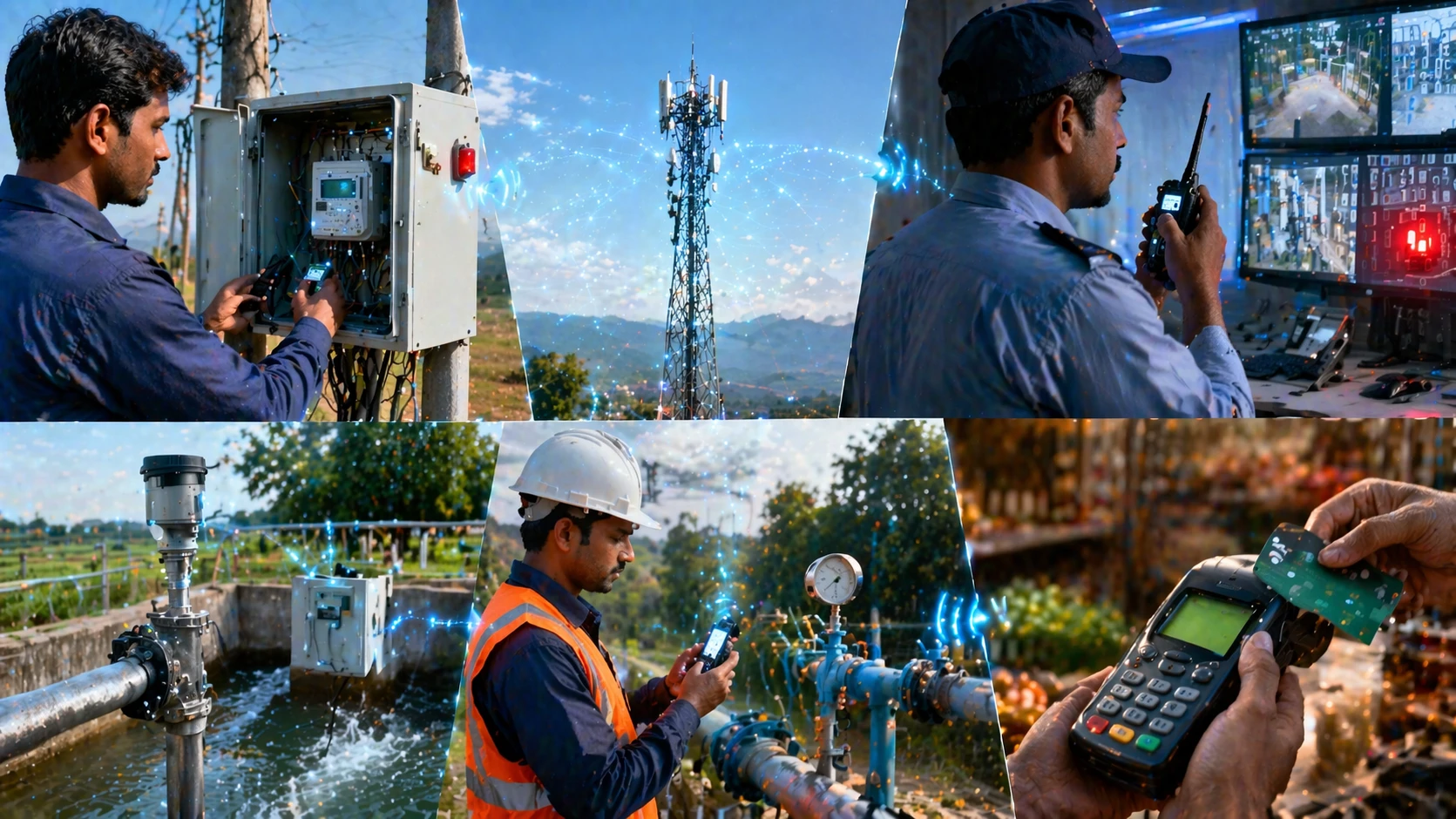
GSM also became widely used in machine-to-machine applications. Remote meters, telemetry modules, alarm panels, vehicle trackers, field terminals, and industrial monitoring devices often used GSM, SMS, GPRS, or EDGE because the modules were mature and the coverage was broad.
In industrial and utility environments, GSM-family connectivity supported alarm reporting, maintenance notification, remote cabinet status, pump station monitoring, and backup communication. For low-bandwidth field communication, GSM was often easier to deploy than building a private wide-area network.
Payment terminals, kiosks, vending machines, and service equipment also used GSM or GPRS where fixed broadband was unavailable or impractical. These applications did not need high bandwidth; they needed simple, stable, wide-area connectivity.
Beyond personal mobile service, GSM has been widely used in telemetry, alarm reporting, utility monitoring, payment terminals, and low-bandwidth field communication.
Practical Strengths
GSM’s success came from more than one technical feature. It offered global standardization, a strong roaming model, SIM-based flexibility, broad vendor support, mature infrastructure, and a useful mix of voice, SMS, and packet-data services.
For operators, GSM created a scalable ecosystem. For device makers, it created a predictable platform. For users, it made mobile service more consistent. For industrial integrators, it provided a practical wide-area communication option for devices that did not require broadband performance.
This combination explains why GSM remained relevant for such a long period, even after newer generations were introduced.
Modern Limits
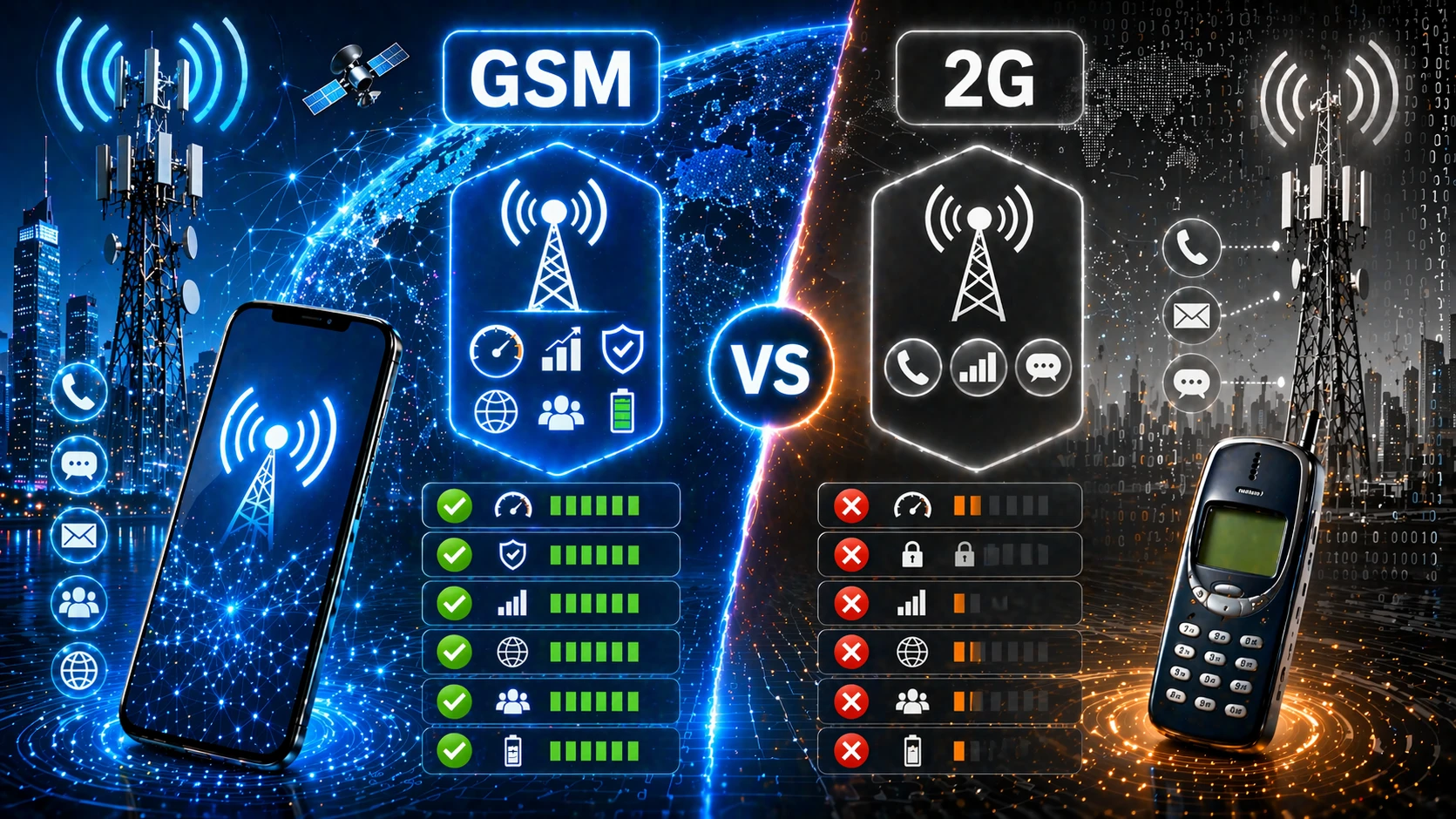
GSM is historically important, but it is not a modern broadband system. Its data performance is much lower than 3G, 4G, and 5G. It is also less efficient in spectrum use and not suitable for high-bandwidth applications such as HD video, cloud-native real-time services, or advanced mobile internet use.
Another limitation is network availability. In some regions, operators have reduced or retired older 2G layers to reuse spectrum for newer technologies. This means GSM-based devices may face service uncertainty if they are expected to operate for many more years.
For new projects, GSM should therefore be evaluated carefully. It may still be useful in legacy support, simple device replacement, and specific regional environments, but long-life deployments usually need a clear view of local operator plans.
Newer Systems
Compared with 3G, 4G, and 5G, GSM is simpler and narrower in capability. Newer systems provide higher data rates, lower latency, better spectral efficiency, richer multimedia support, and stronger integration with cloud services.
GSM, however, remains important because it explains the foundation of mobile identity, roaming, switching, and wide-area service control. Many later mobile systems evolved from concepts that GSM helped standardize and popularize.
In engineering training, gateway integration, legacy device replacement, and industrial communication planning, understanding GSM still helps explain how older field devices behave and why certain network design choices were made.
Planning Notes
When GSM is involved in a project, the first question should be service availability. Engineers should confirm whether the local operator still supports GSM, SMS, GPRS, or EDGE, and whether there are public plans for 2G shutdown or spectrum refarming.
The second question is application bandwidth. GSM-family communication is suitable for voice, SMS, status reporting, alarm transmission, simple telemetry, and low-rate data. It is not suitable for modern broadband-heavy use.
The third question is lifecycle. A device that only needs short-term legacy support may be acceptable on GSM. A new system expected to run for many years may need 4G, LTE-M, NB-IoT, 5G, or multi-network fallback depending on the application.
Final View
GSM mobile communication is more than a historical label for 2G. It is a complete digital mobile framework that introduced standardized subscriber identity, structured radio access, international roaming, circuit-switched voice, SMS, and practical packet data through GPRS and EDGE.
For engineers, integrators, and technical buyers, GSM remains useful because it explains legacy device behavior, SIM-based subscriber control, field gateway design, and the evolution from early digital mobile networks to today’s multi-generation communication environment. Even where GSM is no longer the primary mobile service, its architecture and service ideas continue to influence how mobile communication is understood.
FAQ
How should a legacy GSM device be evaluated before reuse?
Check local 2G service availability, SIM support, module band compatibility, antenna condition, data requirement, power supply, and the expected service life of the application.
Why do some old alarm systems still use GSM?
Many alarm systems were designed when GSM modules were inexpensive, widely available, and suitable for SMS or low-rate reporting. Replacement depends on network support and upgrade cost.
Can a GSM gateway connect old systems to newer networks?
In some cases, a gateway can help bridge legacy voice or alarm interfaces, but the design must consider local cellular support, SIP integration, number routing, and long-term operator policy.
What should replace GSM in long-life IoT projects?
Common options include LTE, LTE-M, NB-IoT, and sometimes 5G, depending on coverage, power consumption, bandwidth, latency, and device lifetime requirements.
Why does GSM still appear in technical discussions?
GSM remains a reference point because many legacy networks, SIM-based devices, field terminals, and early M2M systems were built around its service model and architecture.