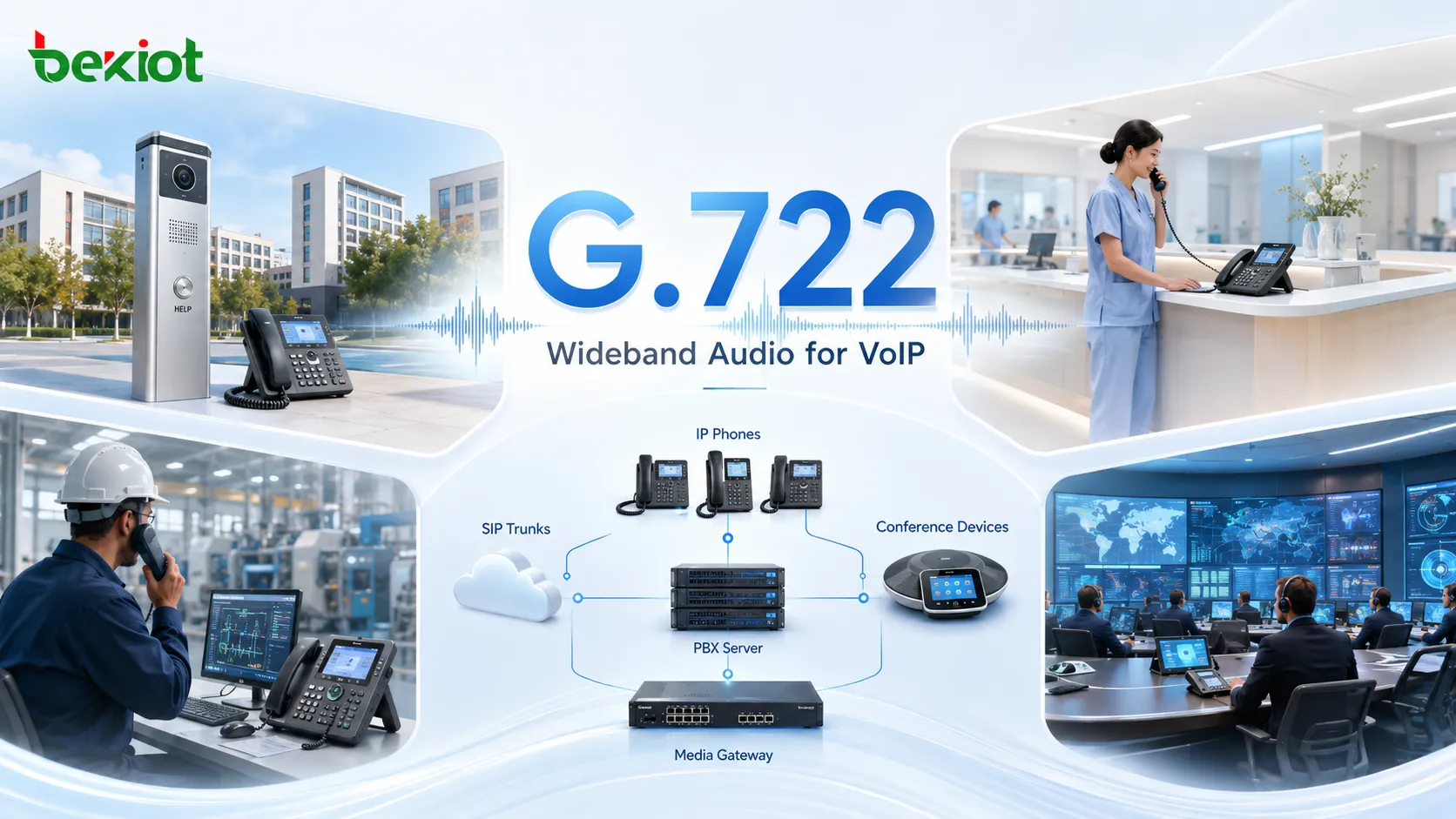
G.722 wideband voice codec explained for business VoIP, IP phones, PBX platforms, conference systems and SIP endpoints, covering HD voice quality, RTP clock behavior, G.711 comparison, codec policy, deployment checks and selection advice.
Becke Telcom
G.722 is a wideband voice codec used in business VoIP systems, IP phones, conference devices, DECT handsets, SIP platforms, and PBX environments. It is not a new codec, but it remains useful because it improves speech clarity without making enterprise voice design overly complicated.
In many office and managed communication networks, the goal is not only to connect a call. Users also need to hear names, numbers, instructions, product terms, and meeting discussions clearly. Compared with traditional narrowband telephone audio, G.722 carries more useful voice detail, so conversations sound more open and natural.
The codec is most valuable when both endpoints support wideband audio and the network can carry RTP media reliably. It is commonly used for internal calls, conference rooms, executive phones, reception teams, support desks, DECT mobility, unified communications platforms, and SIP endpoints where better listening quality matters.
Wideband voice improves call clarity in enterprise VoIP systems when compatible endpoints and stable network conditions are available.
Why wideband audio matters
Traditional telephone calls are narrowband. They are clear enough for basic speech, but they remove part of the voice spectrum that helps speech sound natural. This is why older calls can feel thin, muffled, or tiring during long conversations.
Wideband audio carries more of the human voice range. The result is not only “better sound” in a general sense. It can make speech easier to recognize, reduce repeated questions, improve meeting-room communication, and make speakerphone calls more comfortable.
This matters in real business environments. A receptionist confirming names, a support engineer explaining a procedure, a manager joining a conference call, or an operator speaking through a SIP endpoint all benefit when speech is easier to understand.
How the codec carries speech
G.722 is an ITU-T wideband audio codec based on sub-band ADPCM, or sub-band adaptive differential pulse code modulation. Instead of treating the whole audio signal as one simple stream, it separates the signal into frequency bands and processes them in a way that preserves more speech detail.
The codec is commonly associated with 16 kHz audio sampling. This allows it to carry a wider speech range than classic narrowband telephony. In practice, this is why calls can sound clearer on compatible IP phones, softphones, conference phones, and unified communications clients.
G.722 is often discussed as a 64 kb/s class codec in enterprise VoIP. It can also support 48 and 56 kb/s modes, but 64 kb/s is commonly seen in SIP phone and PBX discussions. Its value is voice quality and predictable behavior, not bandwidth saving.
Technical Item
Typical Meaning
Practical Impact
Codec type
Wideband sub-band ADPCM voice codec
Improves speech clarity compared with narrowband telephone audio.
Common rate
Often used at 64 kb/s in VoIP systems
Similar planning class to G.711, but with wider speech quality.
Sampling association
16 kHz audio sampling
Supports a wider voice range than traditional narrowband calls.
Common use
Internal VoIP, IP phones, conference devices, UC platforms
Best when both endpoints and the media path support wideband audio.
Main limitation
Not universal across all trunks and legacy systems
May need G.711 fallback for PSTN, gateways, or older endpoints.
The 8 kHz RTP clock detail
One detail often confuses engineers during SIP troubleshooting. In RTP signaling, G.722 is usually shown with an 8,000 Hz clock rate for historical compatibility reasons. This does not mean the call is actually narrowband.
A packet capture or SDP message may show an 8 kHz RTP clock, while the audio experience is still wideband. This is normal behavior for G.722 and should not be mistaken for a codec downgrade.
When troubleshooting HD voice, engineers should check more than the clock value. Endpoint codec negotiation, PBX media policy, SBC configuration, recording platforms, conferencing bridges, and gateway behavior all affect whether wideband audio is preserved end to end.
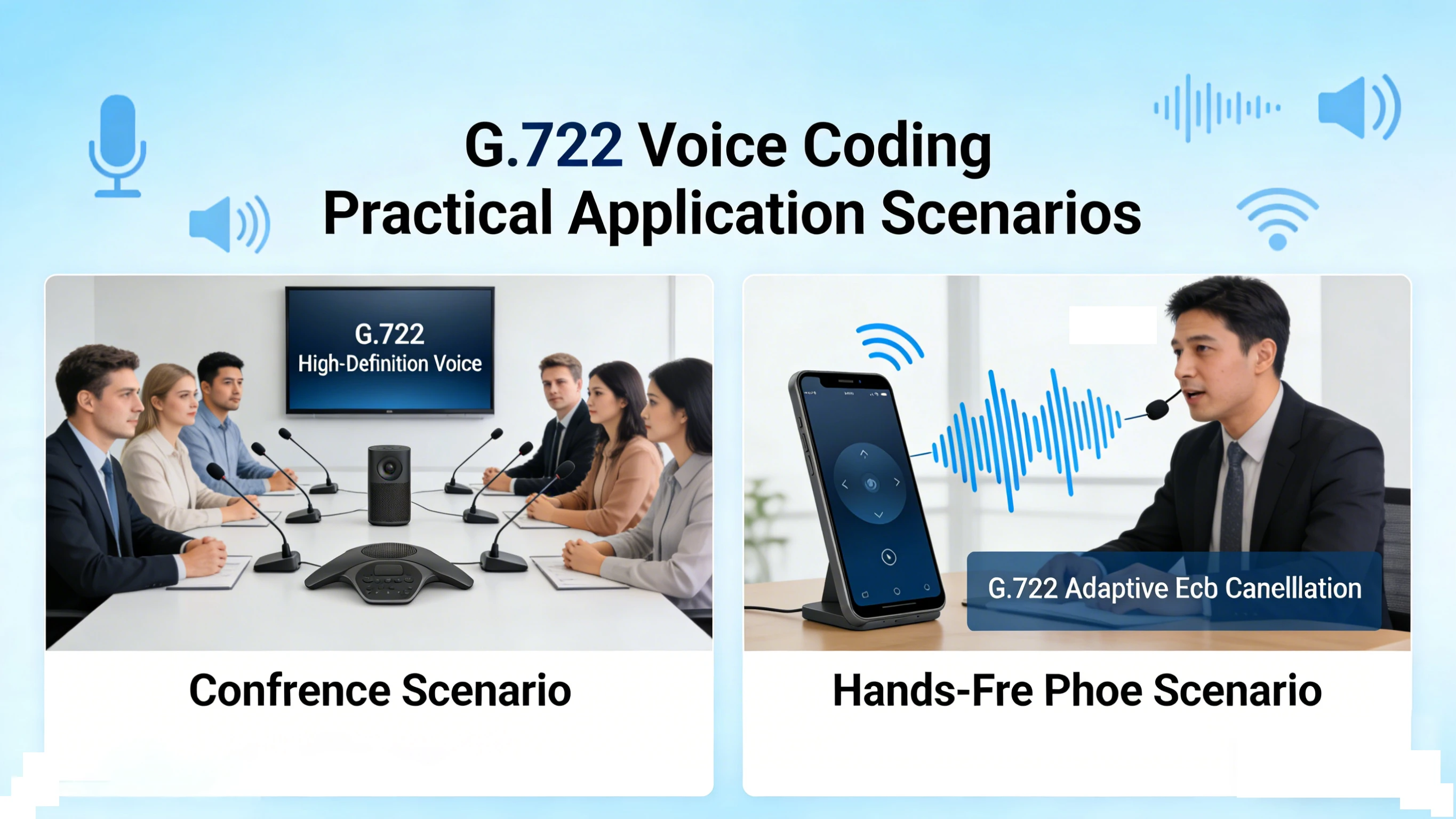
Meeting rooms and speakerphone calls benefit from clearer speech because multiple voices and room acoustics can make narrowband audio harder to follow.
How it compares with narrowband calling
G.711 remains one of the safest baseline codecs in telephony because it is widely supported by IP phones, PBX systems, SIP trunks, analog gateways, carriers, and legacy voice platforms. It is often the better choice when compatibility is the top priority.
G.722 takes a different role. It keeps the simplicity that enterprise systems need while delivering clearer speech when both sides of the call support wideband audio. This makes it strong for internal VoIP calls, office communication, conference phones, and managed SIP environments.
In many real systems, the best policy is not to force one codec everywhere. A PBX may prefer wideband audio for internal calls while keeping G.711 available for SIP trunks, PSTN gateways, analog interfaces, recording systems, or older endpoints.
Selection Point
G.711
G.722
Voice range
Narrowband telephone voice
Wideband speech for clearer audio
Main strength
Maximum legacy compatibility
Better internal call clarity
Typical use
PSTN, SIP trunks, gateways, older endpoints
IP phones, conference devices, UC platforms, internal SIP calls
Best policy
Keep as fallback and trunk codec
Prefer for compatible internal calls
Where it fits best
The codec is most useful in environments where voice quality matters and the network is managed well enough to support stable RTP media. Office LANs, headquarters networks, managed WANs, private PBX systems, and unified communications platforms are common examples.
Business desk phones
Many enterprise IP phones support wideband voice for extension-to-extension calling. This is useful for reception teams, sales departments, managers, support staff, and users who spend a lot of time on internal calls.
Conference rooms
Meeting rooms benefit from clearer audio because multiple speakers, distance from the microphone, room echo, and speakerphone playback can make speech harder to understand. Wideband audio helps conversations feel more natural.
DECT and cordless systems
Compatible DECT handsets and base stations can use wideband audio for internal mobility. This gives office users clearer voice quality while they move around the building.
Unified communications platforms
UC systems often include this codec in their negotiation list because it improves voice quality without requiring a complicated media strategy. It is especially useful when the platform controls both endpoints.
SIP intercom and operational endpoints
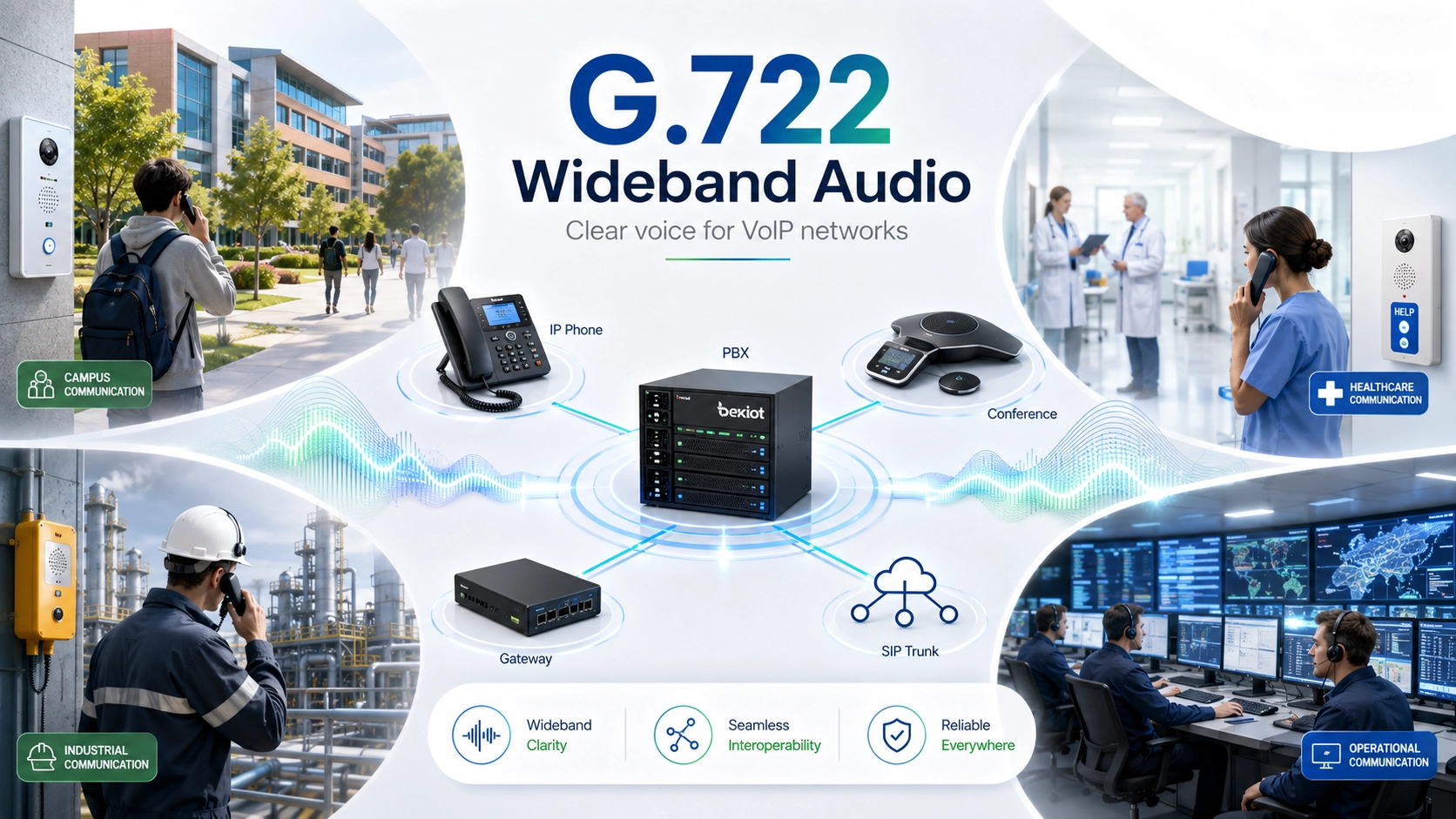
In campus, healthcare, industrial, and operational communication projects, wideband audio can improve clarity for intercom, help point, paging, and voice response use cases. However, endpoint microphone quality and acoustic environment still matter.
Many VoIP networks use wideband audio for internal calls while keeping other codecs available for trunks, gateways, and legacy interoperability.
What can reduce the expected clarity
Enabling the codec on a phone does not guarantee that every call becomes HD voice. The full media path has to support it. If a PBX, SBC, recording system, media relay, trunk provider, conference bridge, or endpoint forces a downgrade, the call may return to narrowband audio.
Endpoint quality also matters. A good codec cannot fix a poor microphone, weak speaker, bad echo control, noisy room, or unsuitable handset design. In meeting rooms and industrial environments, acoustic conditions can be just as important as codec selection.
Network quality remains important as well. Packet loss, jitter, delay, congestion, and unstable Wi-Fi can damage call quality even when the selected codec is suitable. Voice QoS, stable switching, proper VLAN design, and careful wireless planning are still needed.
Problem
Likely Cause
Better Fix
Call does not sound wideband
One endpoint or media device does not support the codec.
Check both endpoints, PBX codec policy, SBC profiles, and recording systems.
SDP shows 8 kHz and looks confusing
Historical RTP clock behavior for this payload format.
Do not treat the 8 kHz clock alone as proof of narrowband audio.
Audio is still unclear
Poor microphone, weak speaker, echo, noise, or bad room acoustics.
Review endpoint hardware and acoustic environment, not only codec settings.
Calls downgrade unexpectedly
Codec priority, trunk profile, SBC rule, or media relay forces another codec.
Document codec order and test the complete call path.
Wideband calls break on external routes
PSTN gateway or carrier trunk does not support the codec end to end.
Use G.711 fallback for external or legacy interconnection.
Codec policy in a mixed voice system
Most business networks are mixed environments. A company may have new IP phones, older SIP phones, conference devices, DECT handsets, analog gateways, SIP trunks, recording servers, and cloud applications. Not all of them support the same codec behavior.
A practical policy usually prefers wideband audio for internal calls between compatible endpoints. It then keeps G.711 available for carrier trunks, PSTN access, analog gateways, older phones, or third-party systems. This avoids forcing wideband audio into parts of the network that cannot support it properly.
Codec policy should also consider call recording, conferencing, IVR, SBC traversal, and contact center platforms. If one media component transcodes every call, the system may lose the benefit of wideband audio even when phones are configured correctly.
Selection and deployment checklist
A good deployment is less about turning on a checkbox and more about confirming the complete path. Engineers should test real calls between the endpoints and services that users actually rely on.
Confirm endpoint support: both sides of the call must support the codec for wideband audio to work.
Review codec priority: PBX, SBC, phones, UC clients, and trunks should have a clear negotiation order.
Check media services: recording, voicemail, IVR, conferencing, and call center systems may affect codec selection.
Keep fallback options: G.711 should remain available for PSTN, gateways, older endpoints, and broad compatibility.
Test network quality: packet loss, jitter, delay, Wi-Fi instability, and congestion can still damage call quality.
Evaluate endpoint hardware: microphones, speakers, echo cancellation, and acoustic design strongly affect the user experience.
Validate real call paths: test internal calls, trunk calls, conference calls, recorded calls, and mobile or DECT calls separately.
When another codec may be better
G.722 is a strong choice for many internal and managed VoIP networks, but it is not automatically the best option for every situation. If the call must pass through legacy PSTN equipment, a carrier route, or a gateway that prefers narrowband audio, G.711 may be more reliable.
If the network is bandwidth-limited or unstable, an adaptive codec may perform better in some cases. If the application requires very high-quality audio, music, browser-based communication, or dynamic network adaptation, Opus may be more suitable where the platform supports it.
The best choice depends on the full call path, not only the endpoint datasheet. A codec that works well for internal desk-phone calls may not be ideal for SIP trunking, public internet softphones, contact center recording, or mixed legacy integration.
How to judge whether the design is suitable
A suitable design begins with the user experience target. If users need clearer internal calls, better speakerphone meetings, and more natural office communication, wideband audio is worth enabling where compatible endpoints exist.
The second check is interoperability. Phones, PBX platforms, SBCs, conferencing systems, recording platforms, and SIP services should negotiate the codec as intended. If the call path silently downgrades to narrowband audio, the configuration needs review.
The third check is network and endpoint quality. Good codec policy cannot compensate for poor microphones, bad speakers, echo, packet loss, jitter, congested uplinks, or unstable Wi-Fi. A real test call is more useful than assuming HD voice from a feature list.
Final view
G.722 remains a practical wideband codec for business communication because it improves speech clarity without making voice system design overly complex. It is especially useful for IP phones, conference devices, DECT handsets, SIP PBX platforms, unified communications systems, and managed internal VoIP networks.
The best results come from using it where both endpoints and the full media path support wideband audio, while keeping G.711 or other codecs available for trunks, gateways, older devices, and external interoperability. When codec policy, network quality, and endpoint hardware are aligned, G.722 can make everyday VoIP calls noticeably clearer.
FAQ
Is G.722 better than G.711?
For voice clarity, it is usually better because it supports wideband speech. For legacy compatibility, G.711 is still often safer. The better choice depends on whether the priority is clearer internal audio or broader interconnection support.
Is it the same as HD voice?
Not exactly. HD voice is a general term for clearer wideband calling. G.722 is one of the common codecs used to deliver that experience in enterprise telephony.
Does it use more bandwidth than G.711?
In many VoIP discussions, both are treated as 64 kb/s class codecs. Total network bandwidth still depends on packetization, RTP, UDP, IP headers, VLAN tags, VPN overhead, and other transport factors.
Why does the RTP clock show 8 kHz?
This is a historical RTP payload-format detail kept for compatibility. It does not mean the call is narrowband. The codec can still provide wideband speech even when the RTP clock appears as 8,000 Hz.
Where is it commonly used?
It is commonly used in enterprise IP phones, conference phones, DECT office systems, SIP PBX platforms, unified communications systems, and managed internal VoIP environments where better speech clarity is needed.
Should every business voice system prefer it?
Not always. It is a strong choice for many internal calls, but codec selection should also consider SIP trunk support, recording systems, conferencing platforms, WAN quality, endpoint compatibility, and legacy devices.