G.729 voice codec explained for bandwidth-sensitive VoIP, SIP trunks, IP PBX networks, gateways and branch offices, covering 8 kb/s compression, RTP behavior, Annex B, codec comparison, deployment checks and selection advice.
Becke Telcom
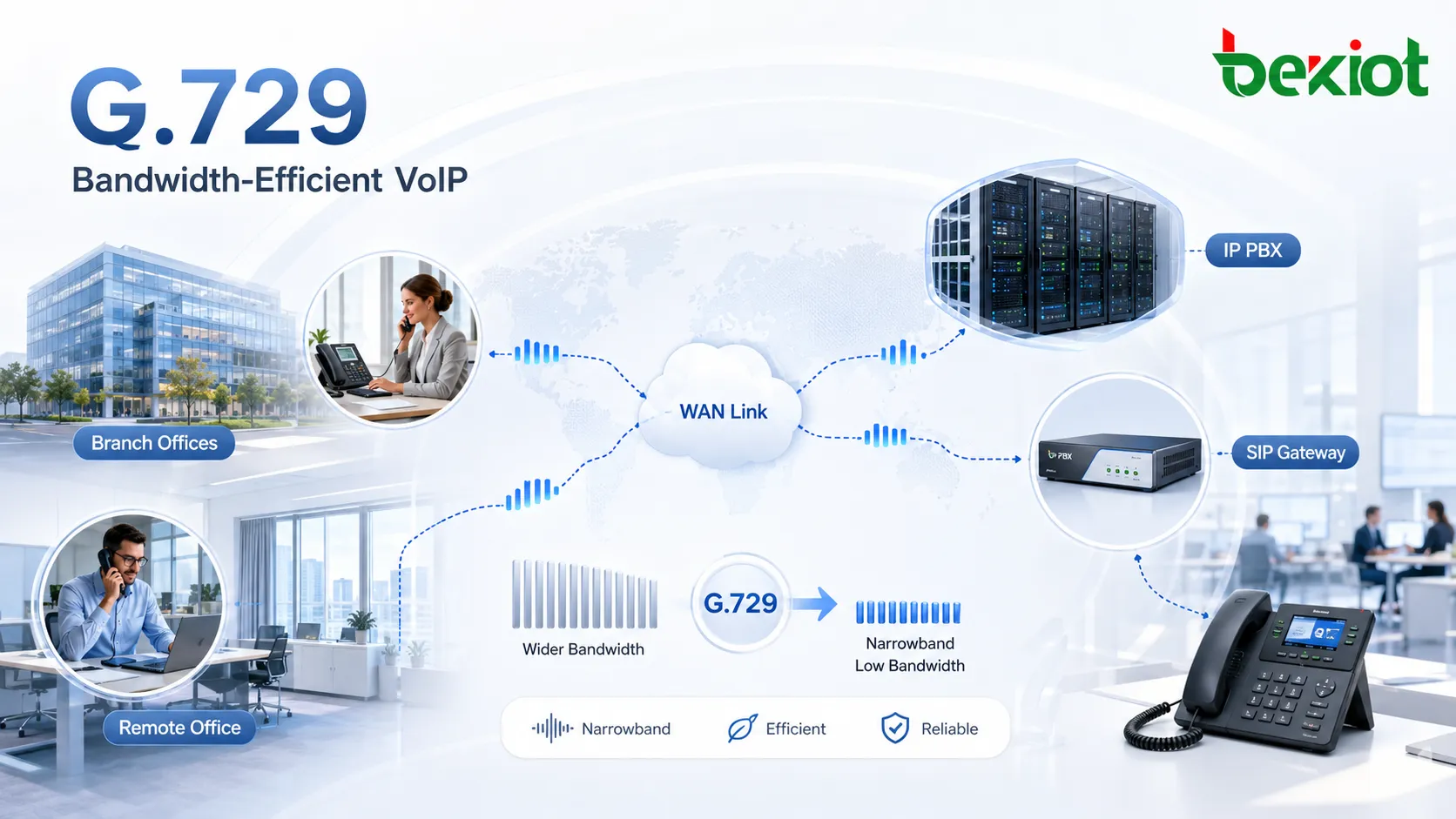
G.729 is a narrowband voice codec used in IP telephony when bandwidth efficiency is more important than wideband audio quality. It became popular because it can carry understandable speech at a much lower codec bit rate than G.711, making it useful for branch offices, WAN voice links, SIP gateways, IP PBX interconnection, and long-lived enterprise voice systems.
The codec is not designed for HD voice or a rich meeting-room audio experience. Its purpose is more practical: reduce voice payload size while keeping speech clear enough for normal business communication. That trade-off explains why it still appears in many VoIP deployments, especially where older equipment, limited network links, or established SIP trunk profiles are still in use.
A good codec policy should not choose G.729 only because it saves bandwidth. The full call path also matters: endpoint support, SBC settings, DSP resources, trunk policy, Annex B behavior, packet loss, jitter, fax needs, recording systems, and transcoding rules can all affect the final result.
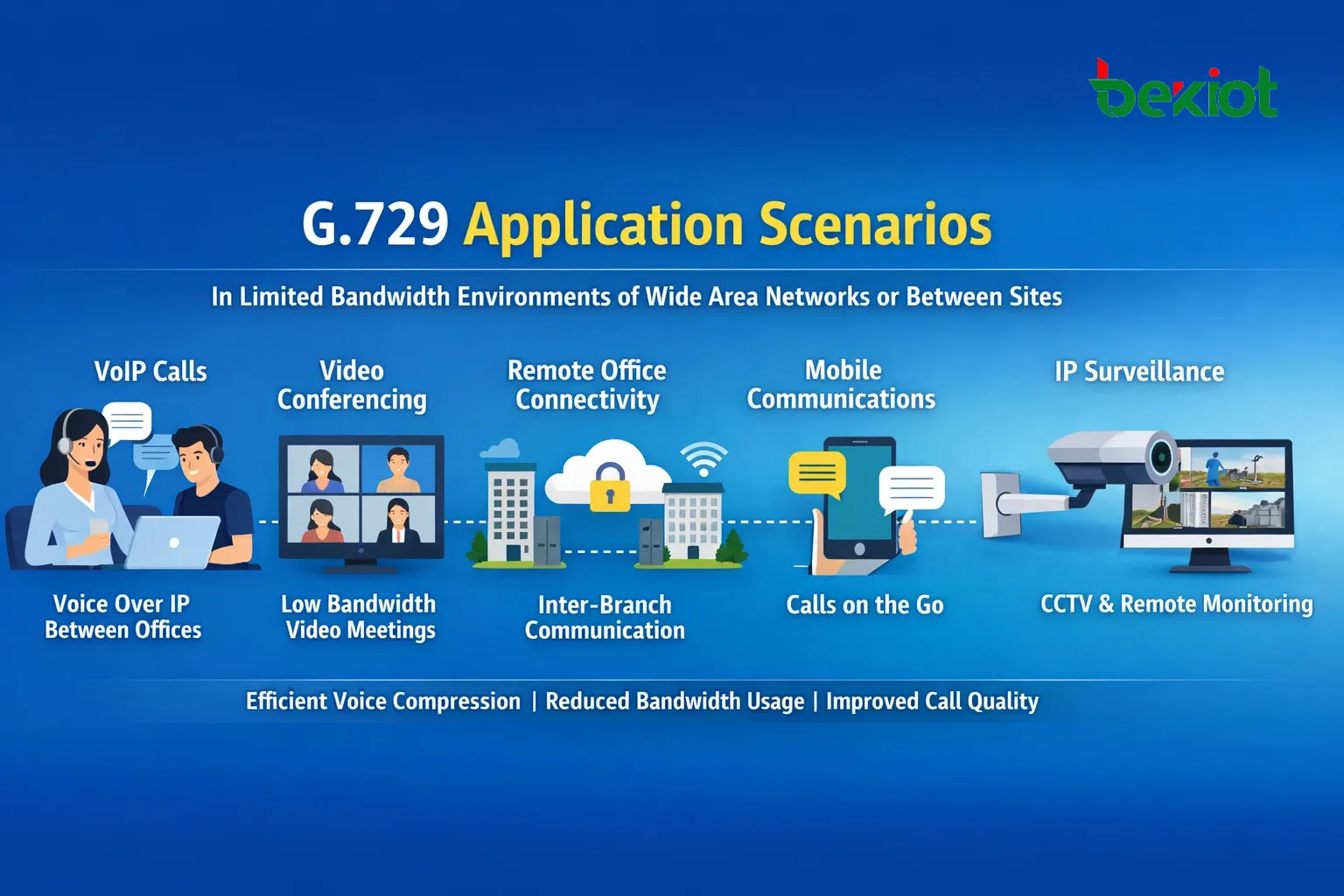
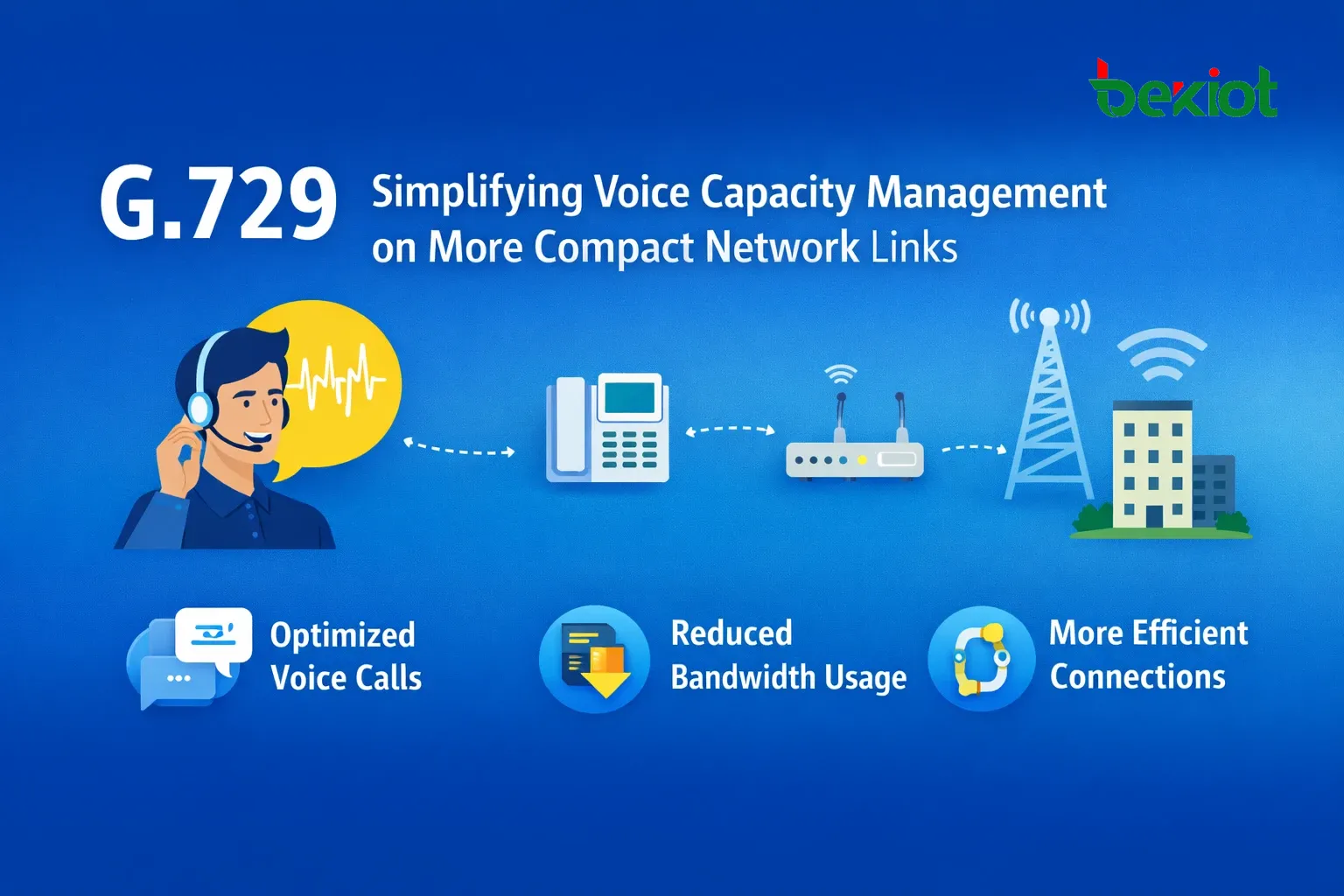
G.729 is often used where voice traffic must remain compact across WAN links, remote sites, gateways, or older VoIP infrastructure.
Why bandwidth efficiency still matters
Many modern office LANs can easily carry G.711 or wideband codecs. In those environments, voice quality and interoperability may matter more than saving a small amount of bandwidth. The situation changes when calls cross limited WAN links, VPN tunnels, remote branch circuits, wireless backhaul, satellite links, or older inter-site networks.
In those cases, several simultaneous calls can compete with business data, video, file transfer, cloud applications, and monitoring traffic. Reducing the per-call voice payload can help keep service usable when the link is modest or expensive to upgrade.
This is the practical reason G.729 remains relevant. It is not selected because it sounds better than newer codecs. It is selected because it can make voice deployment possible on constrained paths where a higher-bit-rate codec may reduce call capacity or increase congestion risk.
How the compression works
G.729 is an ITU-T speech codec for compressing narrowband voice in packet-based and digital voice networks. In its basic form, it encodes speech at 8 kb/s using CS-ACELP, short for conjugate-structure algebraic-code-excited linear prediction.
Instead of sending a more direct high-bit-rate waveform, the codec models speech and creates a compact representation of the voice signal. This keeps the codec rate low while preserving enough information for normal conversation.
The trade-off is audible. Speech can remain understandable, but it usually sounds more processed than G.711 and less open than wideband codecs such as G.722 or Opus. For normal business calls this may be acceptable; for conference rooms, high-clarity internal calling, or HD voice, it may not be the best first choice.
Technical profile
In common VoIP use, G.729 operates with 10 ms speech frames. A single encoded frame is 10 octets, and two frames are often placed into one 20 ms RTP payload. This packetization pattern is common in SIP, H.323, gateway, and enterprise PBX environments.
In RTP, the codec uses an 8,000 Hz clock rate and is commonly associated with static payload type 18. This long-established mapping makes it familiar to engineers who work with packet captures, SIP SDP negotiation, gateways, and SBC troubleshooting.
Technical Item
Typical Value or Behavior
Practical Meaning
Codec type
Narrowband speech compression
Designed for intelligible voice, not HD audio.
Base codec rate
8 kb/s
Much lower payload rate than G.711.
Speech frame
10 ms
Often combined into 20 ms RTP packets.
RTP clock
8,000 Hz
Matches narrowband telephony operation.
Common payload type
Static payload type 18
Frequently seen in SIP and H.323 packet analysis.
Main value
Bandwidth reduction
Useful for WAN, VPN, branch, and gateway scenarios.
Annex A and Annex B details
Several variants appear in real systems. G.729A is a reduced-complexity version that is widely supported in VoIP platforms. It is commonly treated as interoperable with the main G.729 payload in many SIP and RTP environments.
G.729B adds voice activity detection and comfort noise behavior, often described as silence suppression. This can reduce transmitted media during silent periods, but it can also create compatibility issues when endpoints, trunks, gateways, or SBCs do not agree on Annex B behavior.
This is one of the details that should be checked during deployment. A call may negotiate the codec name but still behave poorly if Annex B expectations differ. Some systems expose this as a separate parameter, while others hide it inside a trunk, endpoint, or DSP profile.
The codec is valued mainly for bandwidth control, not for wideband or high-definition voice quality.
Bandwidth is not only codec rate
The 8 kb/s figure describes the codec payload, not the full network bandwidth. A real VoIP call also includes RTP, UDP, IP, Ethernet, VLAN, VPN, or other transport overhead. Packetization interval also changes the packet rate and the amount of overhead per second.
Even after overhead is included, G.729 usually consumes much less bandwidth than G.711 under common packetization settings. That is why it became a useful tool for WAN voice design. However, engineers should still calculate real call capacity instead of comparing only codec bit rates.
A voice design should include concurrent calls, signaling traffic, both directions of RTP media, QoS policy, failover behavior, and any encapsulation used by VPN or tunneling. If the link is already congested, a low-bit-rate codec alone will not solve packet loss or jitter.
Comparison with familiar alternatives
Codec selection is always a trade-off. G.711, G.722, Opus, and G.729 solve different problems. A design that works well for a remote branch may not be the best design for a headquarters LAN, a conference room, or a public internet softphone.
Codec
Typical Strength
Typical Limitation
Good Fit
G.729
Low payload rate and mature support in older VoIP systems.
Compressed narrowband audio; not ideal for HD voice or fax passthrough.
WAN calls, remote sites, gateway interconnection, older PBX networks.
G.711
Simple, low-delay, widely supported, and easier to troubleshoot.
Higher bandwidth use than compressed codecs.
LAN calls, SIP trunks, media gateways, PSTN interconnection.
G.722
Wideband voice with clearer internal call quality.
Requires compatible endpoints and media path.
IP phones, conference phones, managed internal VoIP networks.
Opus
Flexible wideband and adaptive behavior for modern applications.
May require transcoding when connecting to traditional SIP or PSTN systems.
WebRTC, modern UC platforms, app-based voice and conferencing.
A simple rule is useful: choose G.711 when the network can comfortably carry the traffic and broad compatibility is important; choose G.722 when clearer internal audio is the goal; consider G.729 when link capacity is limited and compressed narrowband speech is acceptable.
Best-fit scenarios
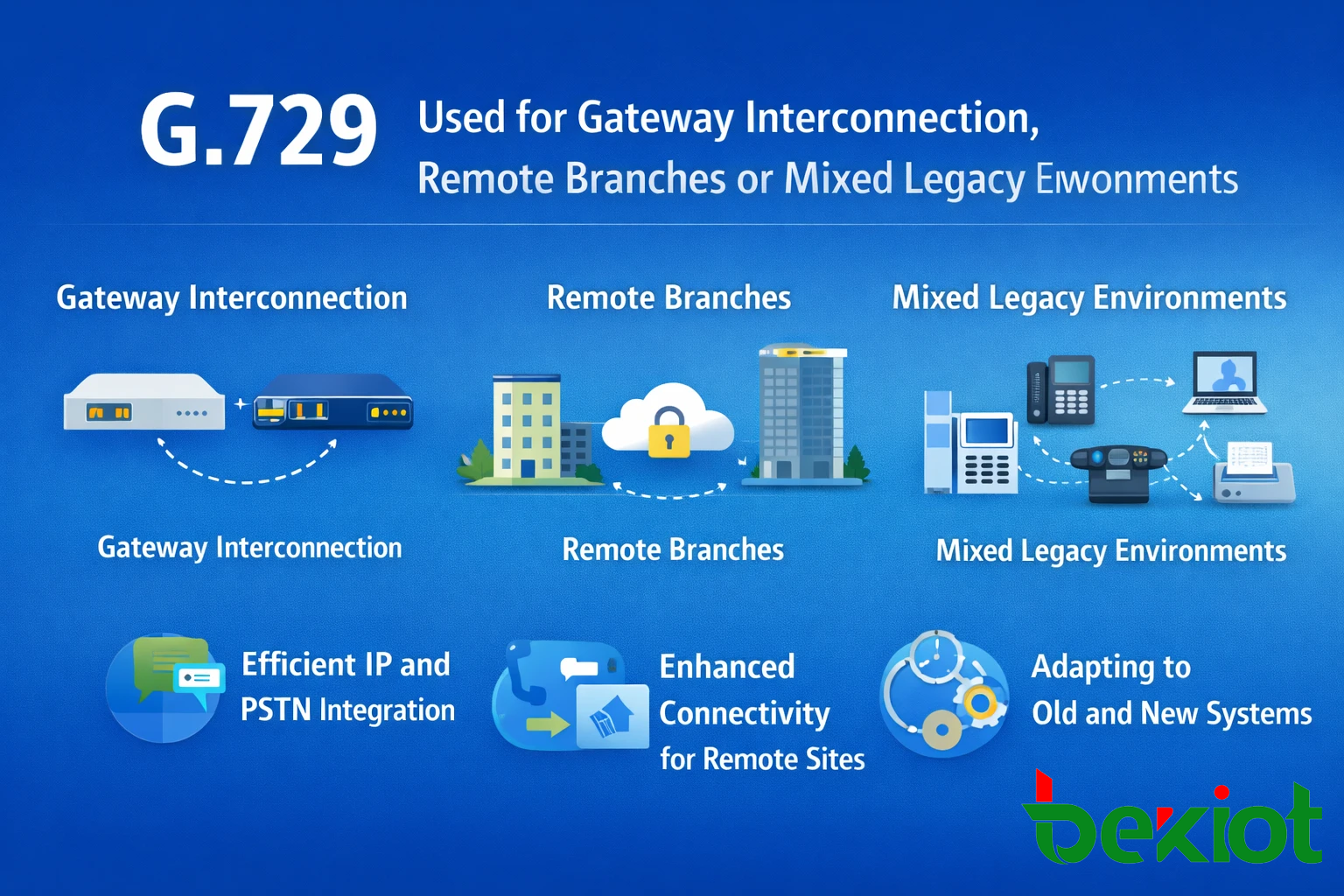
G.729 works best where bandwidth remains a real design constraint or where existing equipment already depends on it. It is especially common in long-lived VoIP networks, older enterprise systems, and gateway-based deployments.
Branch office voice
Remote branches may have modest WAN, VPN, or inter-site bandwidth. When several calls share the same path, a compact codec can help increase practical call capacity and reduce pressure on the link.
Gateway and PBX interconnection
SIP gateways, legacy PBX systems, SBCs, and multi-site voice platforms may already support the codec. In these environments, it can provide a familiar compressed voice option without introducing a newer codec that older equipment cannot handle.
Older enterprise networks
Some organizations still operate older handsets, trunks, media gateways, or DSP-based platforms. If the infrastructure already supports G.729 reliably, keeping it in the policy may be practical for selected routes.
Carrier and service-provider profiles
Some trunk profiles or interconnection policies may include G.729 for compatibility or bandwidth reasons. Before enabling it, the enterprise side should confirm codec order, Annex B behavior, transcoding rules, and billing or service limitations where relevant.
Bandwidth-aware dispatch and office calls
In some dispatch, office, or operational voice networks, the requirement is not HD audio but clear enough speech across limited links. In those cases, it can be useful if the network is stable and users accept the narrower sound.
Common uses include branch VoIP, gateway interconnection, multi-site PBX networks, and legacy voice environments.
Where it is not the best default
G.729 should not be enabled everywhere simply because it saves bandwidth. In a modern LAN with enough capacity, G.711 or G.722 may provide better clarity and simpler troubleshooting. In conference rooms, wideband codecs often deliver a more natural listening experience.
It is also not a fax-first codec. Fax passthrough is usually handled with G.711, while T.38 is used when dedicated fax relay is required. A heavily compressed voice codec can make fax tones less reliable, especially if packet loss or jitter is present.
Public internet softphone scenarios may also require a different strategy. Where network conditions change quickly, an adaptive codec may be more suitable if the platform supports it. The best codec choice depends on the actual call path, not on one universal default.
Deployment checks
Before enabling the codec across a network, engineers should verify endpoint support, trunk policy, DSP resources, Annex B settings, QoS, recording behavior, and transcoding paths. The goal is to save bandwidth without creating avoidable call-quality or compatibility problems.
Endpoint support: confirm that phones, gateways, PBX systems, SBCs, and trunks support the selected mode.
Codec order: define when this codec should be preferred and when G.711 or G.722 should take priority.
Annex B behavior: align silence suppression and comfort noise settings across endpoints and trunks.
DSP capacity: check transcoding resources if calls must move between G.729, G.711, G.722, or other codecs.
QoS policy: protect RTP media from packet loss, jitter, delay, and congestion.
Recording systems: confirm that call recording or media relay platforms can handle the codec or transcode correctly.
Fax routing: avoid using it as the primary fax codec; test T.38 or G.711 passthrough where fax is required.
Common mistakes and better fixes
Mistake
Typical Problem
Better Fix
Using it as a universal default
Internal calls may sound more compressed than necessary.
Use it only where bandwidth saving is actually needed.
Ignoring Annex B
Silence suppression mismatch may affect negotiation or comfort noise behavior.
Align Annex B settings across phones, gateways, SBCs, and trunks.
Assuming low bit rate fixes poor networks
Packet loss, jitter, and delay can still damage compressed speech.
Apply QoS and measure real link performance.
Forcing transcoding on every call
DSP load increases and voice quality may decline.
Keep codec paths consistent and transcode only where necessary.
Using it for fax passthrough
Fax tones may fail or become unstable.
Use T.38 or G.711 passthrough where fax is required.
Ignoring recording or IVR platforms
Media services may not support the codec cleanly.
Test recording, voicemail, IVR, and conferencing paths before rollout.
How to judge whether the choice is suitable
A suitable codec choice begins with the network path. If calls cross a constrained WAN, VPN, remote branch link, or bandwidth-sensitive inter-site route, G.729 may be useful. If the calls stay inside a high-capacity LAN, the benefit may be small compared with the loss in naturalness.
The second check is user expectation. For normal office calls, compressed narrowband speech may be acceptable. For conference rooms, executive calls, training, support sessions, or long conversations, clearer audio may be more important than saving bandwidth.
The third check is platform compatibility. Phones, PBXs, SBCs, gateways, trunks, recording systems, voicemail, and IVR services should all support the chosen media policy. If the call path requires repeated transcoding, the design may become harder to maintain than expected.
The final check is operations. Engineers should be able to confirm codec negotiation in SIP SDP, inspect RTP payloads, measure jitter and packet loss, and adjust QoS or routing when quality problems appear.
Final view
G.729 is best understood as a practical bandwidth-saving codec. It is not the richest-sounding option, and it is not an HD voice codec, but it remains valuable when a voice network needs compact, predictable, and widely recognized narrowband speech compression.
The best results come from using it selectively. It fits branch links, gateway interconnection, older PBX systems, and bandwidth-aware routes. For modern LAN calling, conference audio, fax, or wideband user experience, other codecs may be better. A strong VoIP design usually keeps G.729 as one tool in the codec policy rather than treating it as the default answer for every call.
FAQ
Is G.729 better than G.711?
It is better when bandwidth efficiency is the main priority. G.711 is usually better when the network has enough capacity and the goal is simpler, less compressed voice quality.
Is it an HD voice codec?
No. It is a narrowband speech codec. It is designed for efficient voice compression, not for HD voice or wideband audio.
What is the main advantage?
The main advantage is the low codec bit rate. This makes it useful for bandwidth-sensitive VoIP, SIP trunking, remote branch connections, and gateway interconnection.
What is the difference between G.729 and G.729A?
G.729A is a reduced-complexity version. In many RTP and SIP environments, G.729 and G.729A are treated as interoperable at the basic payload level.
Does it support silence suppression?
Silence suppression is associated with Annex B. It uses voice activity detection and comfort noise behavior, but whether it is used depends on endpoint support and system policy.
Is it suitable for fax?
It is usually not the preferred choice for fax. Many VoIP designs use G.711 for fax passthrough or T.38 when dedicated fax relay is required.
Is it still useful today?
Yes, but its role is selective. It is still useful in bandwidth-aware networks, SIP gateways, older PBX environments, carrier interconnection, and remote sites. For modern LAN calling or HD voice, other codecs may be a better first choice.