LLDP-MED explained for IP phone deployments, covering voice VLAN discovery, QoS policy, PoE awareness, DHCP provisioning flow, CDP comparison, deployment tips and troubleshooting for mixed-vendor VoIP networks.
Becke Telcom
In an IP phone deployment, the first few seconds after a phone is connected can decide whether the device joins the right network or creates another support ticket. The phone needs power, a voice VLAN, traffic priority, an IP address, access to a provisioning server, and finally a successful registration to the IP PBX or hosted voice platform.
LLDP-MED helps with the earliest part of that process. It allows a media endpoint such as an IP phone to learn important access-layer information from the managed switch it connects to. This information may include voice VLAN policy, Layer 2 and Layer 3 priority settings, power-related details, inventory data, and sometimes location information.
It is important to describe the role accurately. LLDP-MED does not normally deliver the complete SIP account, firmware package, PBX server list, or every device parameter. It helps the phone enter the correct network context so that DHCP, configuration download, and SIP registration can continue properly.
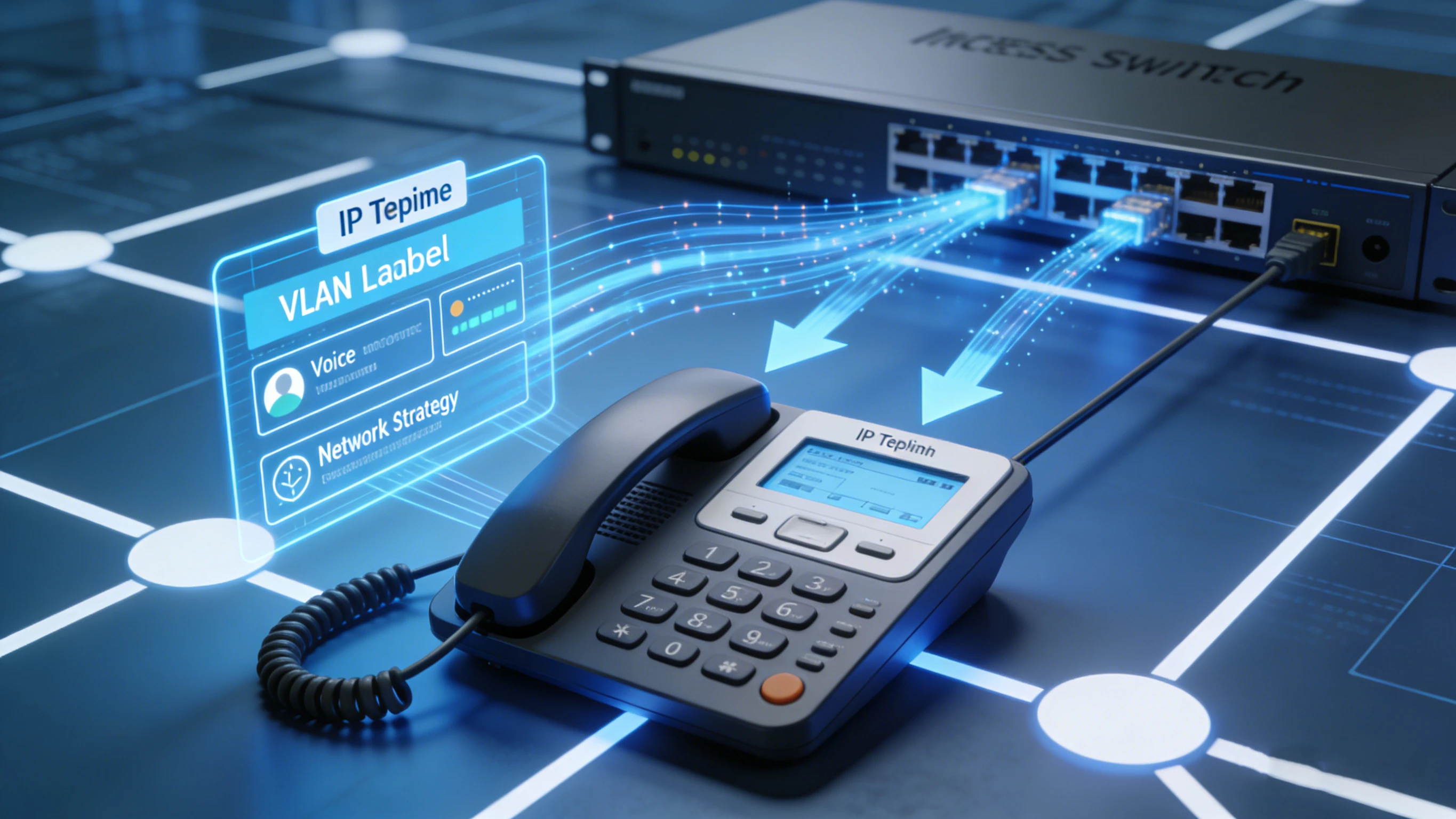
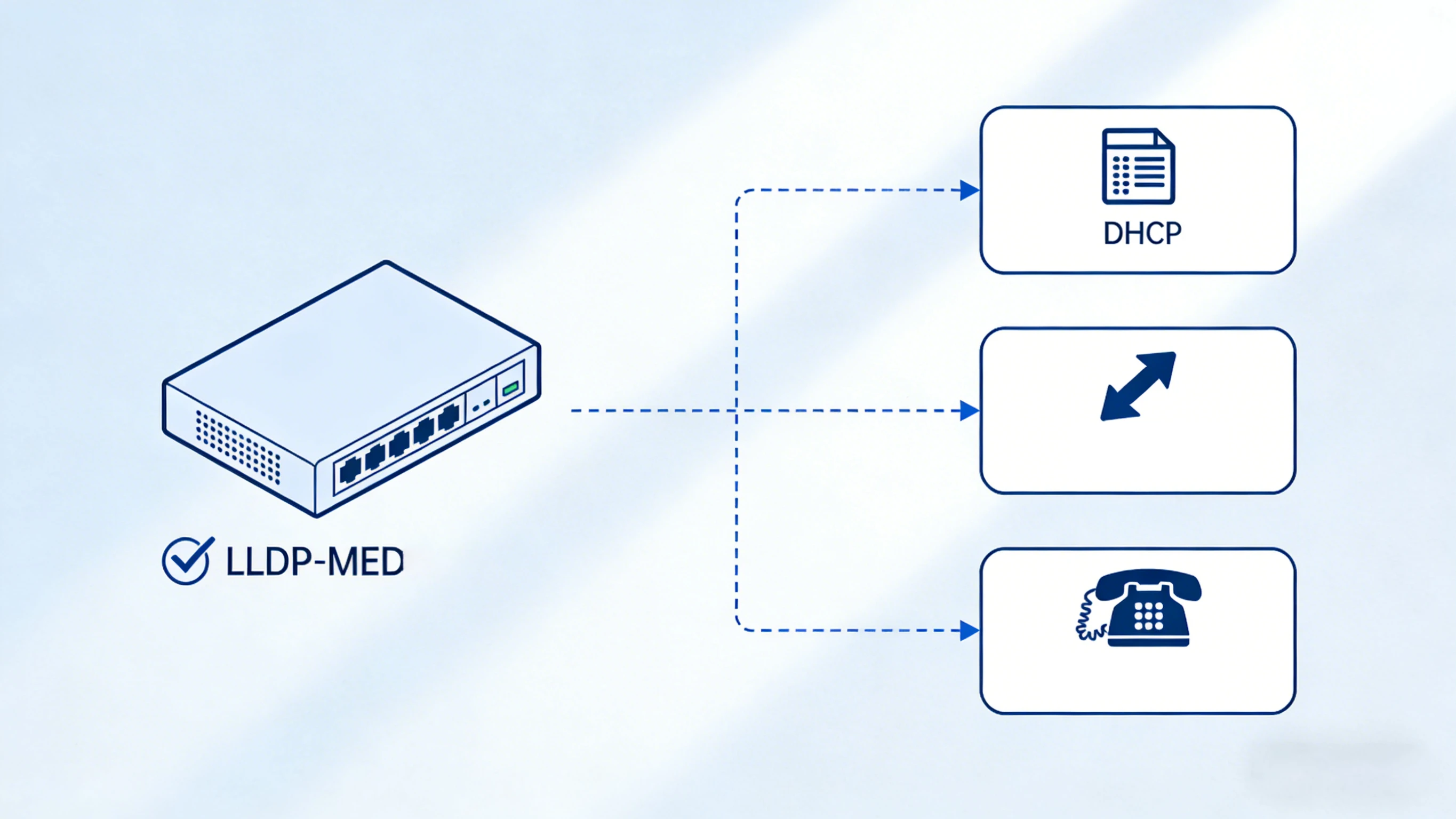
LLDP-MED helps an IP phone learn voice VLAN and network policy information from the access switch as soon as the Ethernet link comes up.
What LLDP-MED Means
LLDP-MED stands for Link Layer Discovery Protocol for Media Endpoint Devices. It is an extension of LLDP, the Layer 2 discovery protocol used by network devices to exchange identity and capability information with directly connected neighbors.
Standard LLDP is useful for general network discovery. LLDP-MED adds information that matters specifically to media endpoints, especially VoIP phones. This is why it is commonly used together with managed PoE switches, voice VLANs, QoS policy, and enterprise IP telephony networks.
Why It Matters
The practical role of LLDP-MED is to make phone onboarding more predictable. When a new phone is plugged into a switch port, the switch can advertise the correct voice network policy. The phone can then move to the voice VLAN and apply the expected priority markings before the rest of its provisioning process begins.
This reduces manual work for administrators. Instead of configuring VLAN details on every phone, the network can provide the policy automatically. This is especially useful in offices, hospitals, campuses, hotels, warehouses, transport hubs, and industrial sites where many phones may be installed, replaced, or moved over time.
How Startup Works
A typical startup process begins when the phone receives power, often through PoE. After the Ethernet link becomes active, the phone and the switch exchange LLDP information. If both sides support LLDP-MED and the correct TLVs are enabled, the switch can advertise voice-related network policy.
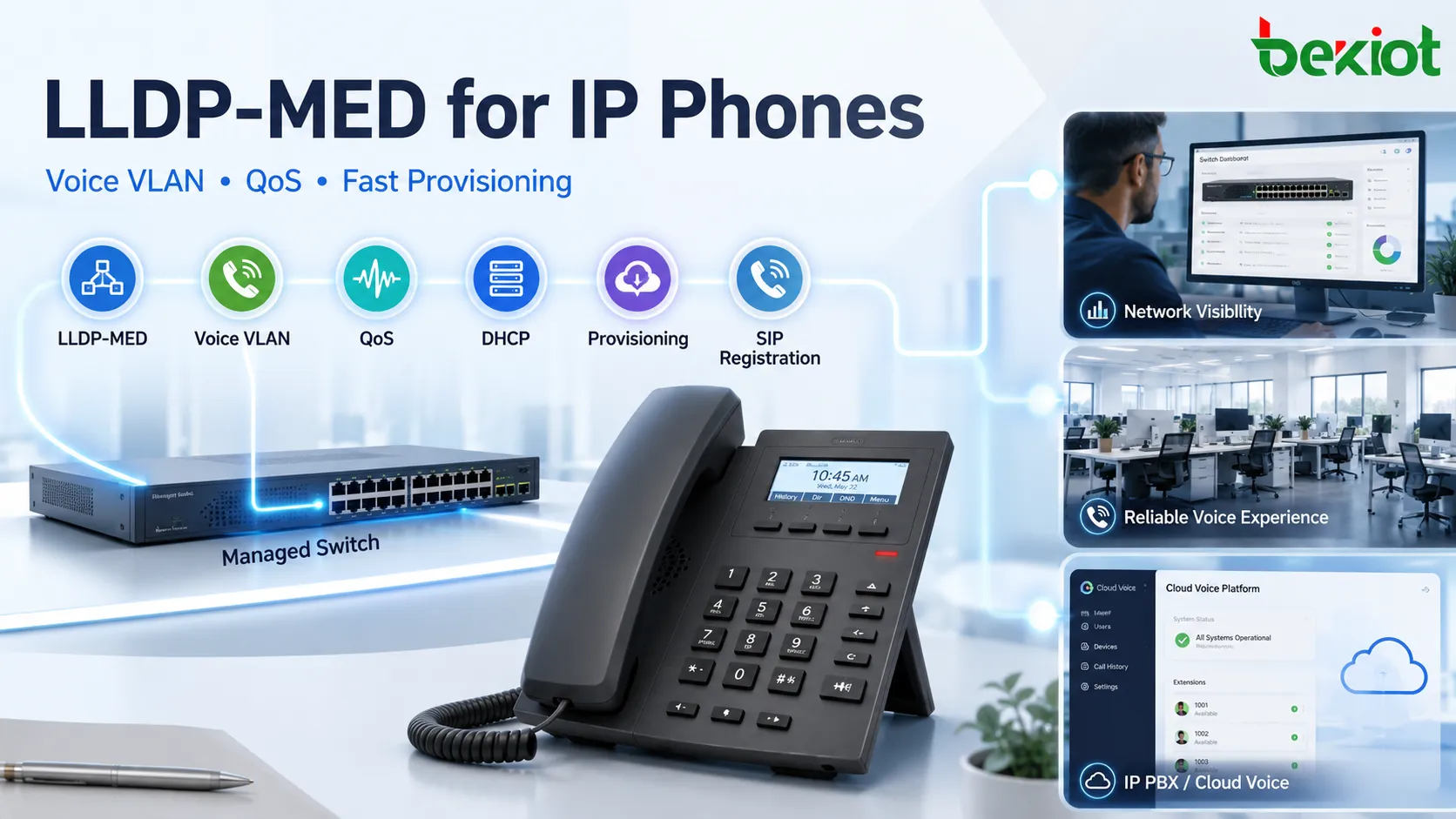
The phone may then apply the advertised voice VLAN and priority settings. After joining the correct network, it requests IP configuration through DHCP. From there, it discovers or reaches its provisioning server, downloads configuration files if needed, checks firmware policy, and registers to the SIP server or IP PBX.
This sequence explains why LLDP-MED is helpful but not complete by itself. It is early-stage network discovery, not the entire auto-provisioning system.
In a typical IP phone boot process, LLDP-MED comes before DHCP, configuration download, firmware checking, and SIP registration.
Voice Policy Role
The most widely used LLDP-MED function in VoIP networks is the network policy TLV. This allows the switch to tell the phone which VLAN should be used for voice traffic and what priority treatment should apply.
Voice quality depends on predictable traffic handling. Bandwidth is only one part of the design. Delay, jitter, packet loss, congestion, and queue behavior also matter. LLDP-MED does not replace a complete QoS plan, but it helps align the phone and access switch at the edge of the network.
Power Data Use
LLDP-MED can also support power-related communication between the switch and the endpoint. This matters because not all phones require the same power level. A basic desk phone, a color-screen phone, a video phone, and a phone with an expansion module may have different PoE requirements.
In larger deployments, power awareness helps administrators understand endpoint behavior and switch capacity more clearly. It also supports better planning when many PoE devices are connected to the same access layer.
Asset Visibility
Inventory information is often overlooked, but it can be useful for support teams. LLDP-MED can help expose endpoint details such as device type, model, manufacturer, firmware version, or serial information depending on device support.
This makes troubleshooting and lifecycle management easier. When a user reports a problem, the support team can identify which device is connected to which switch port, what model is in use, and whether the device may require firmware or configuration review.
What It Cannot Do
LLDP-MED should not be confused with full phone provisioning. A phone still needs IP addressing, DNS, gateway information, time synchronization, provisioning server access, certificates if used, configuration files, firmware logic, SIP account details, and call-control settings.
These functions are normally handled through DHCP, vendor-specific DHCP options, HTTP, HTTPS, TFTP, TR-069 in some environments, provisioning platforms, or the phone’s own management system. LLDP-MED helps the phone get onto the right network path first, but the rest of the process must still be designed correctly.
Auto Setup Role
In everyday engineering language, administrators often say that a phone is auto-provisioned when it can be plugged in and brought online with little manual work. LLDP-MED supports that experience indirectly.
It automates the access-layer discovery stage. It does not automatically complete every SIP or provisioning task. A better description is this: LLDP-MED makes zero-touch deployment smoother by helping the phone find the correct voice network before it continues with DHCP and provisioning.
CDP Comparison
In Cisco-focused environments, engineers may also use Cisco Discovery Protocol to advertise voice VLAN information. CDP can work well inside a Cisco ecosystem, and many older VoIP deployments used it heavily.
LLDP-MED is the more vendor-neutral option. It is usually the better choice when switches and phones come from different vendors. For mixed networks, open discovery matters because it reduces dependency on one proprietary mechanism.
Where It Helps
LLDP-MED is useful in many IP telephony environments. In enterprise offices, it helps desk phones join the correct voice VLAN without manual editing. In hospitals and campuses, it reduces work across many access switches and endpoint locations. In hotels and public-service locations, it helps maintain consistent access policy across different phone types.
It is also useful in warehouses, factories, transport hubs, and industrial facilities where endpoints may be replaced quickly. If the switch policy is already correct, a replacement phone can often be connected and guided into the correct network with fewer manual steps.
Deployment Tips
Before relying on LLDP-MED, confirm that both the switch and the IP phone support it. Then check whether the required TLVs are enabled. Some environments may have LLDP, LLDP-MED, and CDP active at the same time, so administrators should understand which mechanism the phone will prefer.
The access layer must also match the provisioning layer. A phone that correctly learns the voice VLAN still needs DHCP services, reachable provisioning URLs, correct time settings, firewall access, certificates if required, and valid SIP registration details.
Troubleshooting should follow the boot sequence. If the phone does not enter the voice VLAN, check LLDP-MED policy. If it enters the correct VLAN but does not receive an IP address, check DHCP. If it receives an IP address but does not download configuration, check provisioning discovery. If configuration is downloaded but registration fails, check SIP credentials, transport, DNS, NAT, TLS, or PBX policy.
Main Benefits
Reduces manual voice VLAN configuration on phones.
Improves consistency across many access switch ports.
Supports faster moves, adds, replacements, and site rollouts.
Helps align voice traffic priority at the access layer.
Improves visibility for support and lifecycle management.
Works well in mixed-vendor VoIP networks when properly supported.
Final Summary
LLDP-MED is one of the most practical access-layer tools in IP phone deployment. It helps phones learn voice VLAN and network policy information automatically, reducing manual configuration and improving rollout consistency across multi-site VoIP networks.
Its value is strongest when it is used as part of a complete provisioning design. LLDP-MED prepares the phone for the correct network environment, while DHCP, provisioning servers, firmware policy, security settings, and SIP registration complete the full phone deployment process.
FAQ
Is LLDP-MED the same as LLDP?
No. LLDP is the base Layer 2 discovery protocol. LLDP-MED is an extension designed for media endpoint devices such as IP phones.
Can LLDP-MED assign a voice VLAN?
Yes. A managed switch can advertise voice VLAN policy through LLDP-MED so the IP phone learns which VLAN should carry voice traffic.
Does LLDP-MED replace DHCP?
No. LLDP-MED and DHCP serve different roles. LLDP-MED provides access-layer policy discovery, while DHCP provides IP configuration and may help the phone discover provisioning resources.
Does LLDP-MED provide SIP account settings?
Usually not. SIP account details, PBX server addresses, firmware policy, and device configuration are normally delivered through provisioning platforms, DHCP options, or configuration files.
Is LLDP-MED useful in mixed-vendor networks?
Yes. One of its main advantages is vendor-neutral interoperability, making it useful when switches and IP phones come from different manufacturers.