Many network teams discover the value of prioritization the hard way. A link that worked fine during normal office hours suddenly produces choppy calls, frozen video conferences, and delayed paging messages during a software rollout or large backup window. The underlying problem is rarely a total lack of bandwidth. More often, different types of traffic are competing for the same queues, and nothing tells the network which packets should move first.
That is where QoS prioritization comes in. It is not a way to create more capacity, but a way to make smarter decisions when capacity is contested. A network that can identify voice, video, operational traffic, and background data can behave far more predictably than one that treats every packet as equally urgent. For organizations running IP telephony, intercoms, cameras, or industrial systems alongside ordinary office traffic, that predictability is often the difference between a stable service and a recurring complaint.
What QoS Prioritization Actually Does
A common misconception is that QoS somehow expands a slow link. It does not. A congested 10 Mbps WAN remains a 10 Mbps WAN. What changes is how the network handles the queue that forms when more traffic needs to leave than the interface can immediately transmit. Without explicit policy, packets are usually forwarded in a fairly generic order. With prioritization, certain classes can be served ahead of others, given reserved capacity, or deliberately held back.
This matters because different services fail in different ways. A phone call requires steady delivery of small packets. A video meeting can tolerate some variation but suffers if large file transfers consume too much bandwidth. A background backup can usually wait. By assigning each type of traffic to a different service class, the network can protect what needs to stay responsive without treating every application as if it were equally urgent.
The result is not a speed upgrade. It is a more graceful form of congestion. Real-time audio remains intelligible, interactive sessions stay usable, and bulk transfers continue in the background at a controlled pace. Once this distinction is understood, QoS stops looking like a mysterious performance feature and becomes a practical traffic management tool.
How Classification, Queuing, and Shaping Fit Together
Before any prioritization can happen, the network has to know what a packet is. Classification is the step that identifies traffic by source, destination, port, application signature, VLAN, or marking. Once identified, packets can be marked so downstream devices along the path apply the same policy. In IP networks, DSCP values are commonly used to carry that treatment intent.
Marking alone does not change forwarding behavior, however. The real work happens when packets reach a congested interface and must wait in queues. A priority queue can be reserved for the most delay-sensitive traffic, while weighted scheduling ensures that other important classes still receive a fair share. Without such controls, a burst of large file transfers can push voice or control packets deep into a queue, where the added delay destroys their usefulness.
Shaping and policing add another layer of control. Shaping smooths traffic bursts by releasing packets at a controlled rate, while policing can cap a flow and drop or remark excess traffic. These mechanisms are especially valuable where a fast campus network feeds into a slower WAN or internet connection. By managing how traffic enters the constrained segment, the network prevents a few aggressive sources from dominating the path.

QoS prioritization separates traffic into service classes so real-time and mission-critical data can receive more predictable treatment during congestion.
Where Prioritization Delivers the Most Value
Voice has long been the most familiar use case. A SIP call or intercom session needs very little bandwidth, but it reacts badly to jitter, packet loss, and excessive delay. When voice packets arrive too late or in uneven bursts, users hear clipped words, robotic audio, or call instability. Prioritizing RTP media and signaling traffic therefore remains one of the clearest wins in enterprise QoS design.
Video is different. Conferencing streams consume far more bandwidth than voice, and a surveillance feed does not need the same treatment as a live two-way conversation. Treating every video flow as top priority can crowd out more sensitive traffic. Mature policies often separate conversational video from high-volume streaming or recorded media, giving each class a more appropriate level of protection.
Industrial and operational networks add another dimension. SCADA polling, PLC communications, HMI traffic, alarm events, dispatch audio, and IP paging may share the same infrastructure as routine office applications. In those environments, a delayed emergency announcement or a slow alarm path can have operational consequences that go far beyond user frustration. QoS helps reduce that risk by keeping background activity from overrunning more critical services.
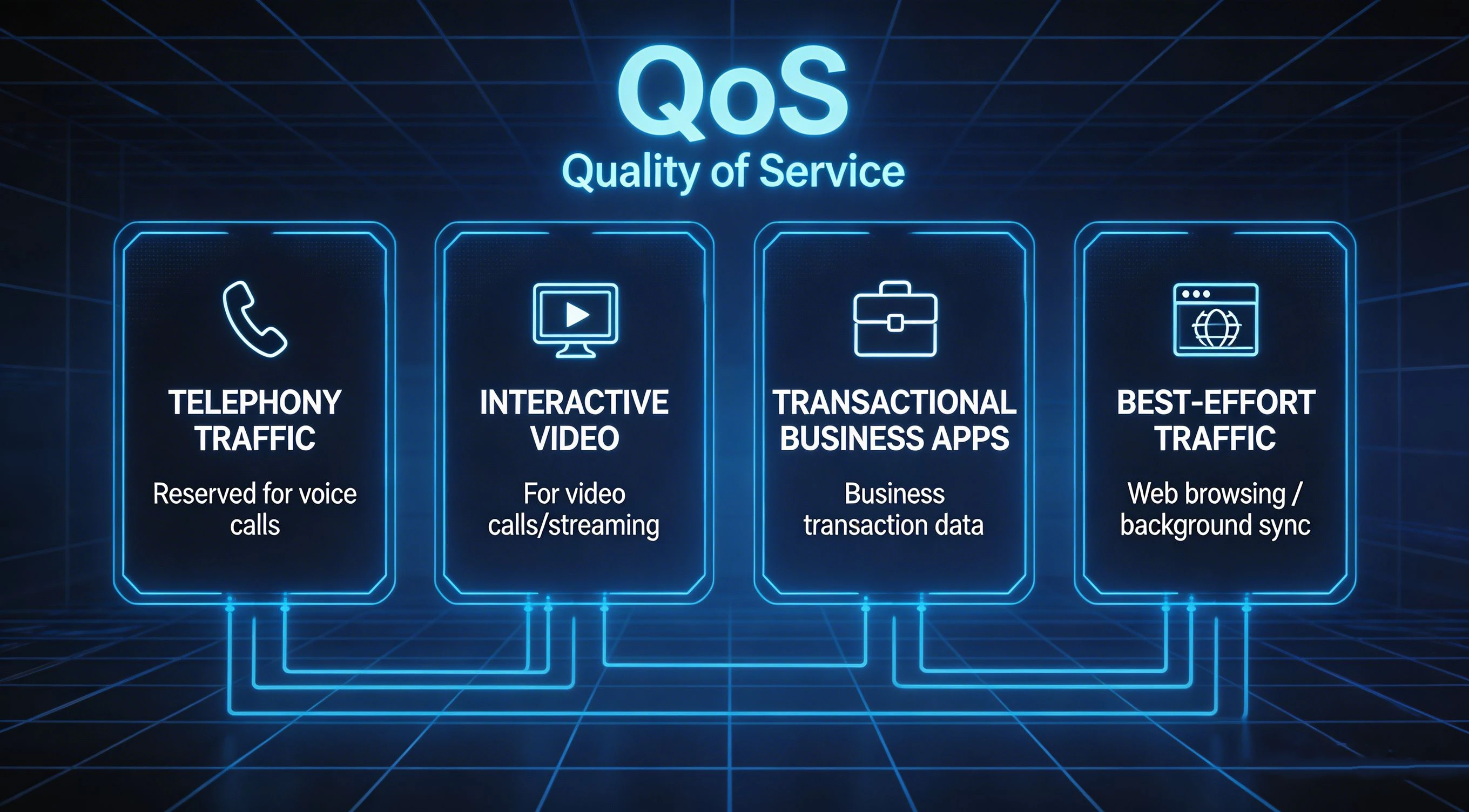
QoS policy often protects different critical services in different ways, rather than trying to place everything into a single high-priority queue.
Practical Policy Decisions for Real Networks
One of the most common design errors is creating too many traffic classes. A policy that looks precise on paper often becomes difficult to maintain, troubleshoot, and apply consistently across different devices. In practice, a smaller set of well-understood classes usually works better. A reasonable starting point is to separate real-time voice, interactive video, critical business or operational traffic, best-effort data, and background transfers.
Another frequent mistake is marking too many applications as high priority. If every packet receives priority treatment, the concept loses its meaning. Worse, overly broad priority queues can starve other services and create instability under sustained load. Priority should be reserved for the traffic that is most sensitive to delay and most important to preserve, such as voice, emergency audio, or a narrow class of real-time control messages.
Finally, QoS should be treated as an ongoing operational practice rather than a one-time configuration. Traffic patterns change, new applications appear, codecs evolve, and business priorities shift. Monitoring jitter, packet loss, queue drops, and DSCP distribution helps teams refine policies over time. A network that reviews its prioritization periodically is far more likely to keep real-time services stable than one that simply enables QoS and forgets it.
FAQ
How do you decide which traffic should receive strict priority?
Strict priority is usually reserved for traffic that becomes unusable under even small amounts of extra delay or jitter. Voice media, emergency paging, and certain real-time control exchanges are typical candidates. Video meetings and business applications often need assured bandwidth, but they generally do not belong in the strict priority queue.
Does QoS need to be configured on every switch in the network?
Not necessarily. The most important places are where congestion is likely to occur, such as WAN edges, VPN tunnels, internet exits, and shared uplinks. Access switches can be configured to mark or trust traffic early, while core devices with abundant capacity may need only a simpler policy. The key is consistency at the constrained points, not uniform complexity everywhere.
Can QoS help if the real problem is an unstable wireless link?
It can help manage queuing and prioritization once packets enter the wired network, but it cannot correct radio interference, poor signal quality, or severe packet loss on the wireless medium. QoS works best when the bottleneck is contention between traffic types, not when the physical link itself is unreliable.
What is a realistic first step for teams that have never used QoS?
Start by identifying the traffic that needs protection most. Usually that means voice, paging, or real-time control. Then define a small number of classes, apply them at the busiest interfaces, and monitor the results. A simple, observable policy is easier to improve than a highly detailed one that nobody fully understands.