Open Architecture explained for software, industrial, communication and enterprise systems, covering modular design, APIs, data models, protocols, security, governance, interoperability testing and scalability.
Becke Telcom
In software platforms, industrial systems, communication networks, automation projects, enterprise applications, and digital infrastructure, system value is no longer judged only by what the platform can do on the delivery day. A useful system also needs to connect with other platforms, accept new modules, support future upgrades, exchange data, and adapt to changing workflows.
Open Architecture is built around this need for long-term adaptability. It separates a system into independent but cooperative parts, then lets those parts communicate through defined interfaces, standard protocols, shared data models, and controlled integration rules.
The goal is not openness without control. A strong open architecture allows modules, devices, applications, services, and third-party systems to interoperate while still following security, governance, compatibility, and lifecycle requirements.
The problem it is designed to solve
Many traditional systems were built as closed structures. Hardware, software, database formats, interface logic, communication protocols, and upgrade paths were tightly bound together. This can work in a stable and limited environment, but it becomes difficult when the organization needs to add functions, connect external systems, replace old components, or support different vendors.
A closed system often creates dependency. If one module changes, other functions may be affected. If a vendor stops supporting a component, the whole platform may become hard to maintain. If data cannot be exported through a standard interface, other systems must rely on manual entry, file import, or custom conversion.
Open Architecture reduces these risks by separating system capabilities into manageable layers and defining how those layers interact. A module does not need to understand every internal detail of another module. It only needs to follow the agreed interface, protocol, data format, and permission rule.
This matters most in long-life systems. Industrial facilities, transport networks, public infrastructure, healthcare platforms, enterprise systems, communication platforms, and government projects may operate for many years. During that time, requirements change. Open Architecture gives the system room to evolve instead of forcing a complete rebuild.
Modular design is the foundation
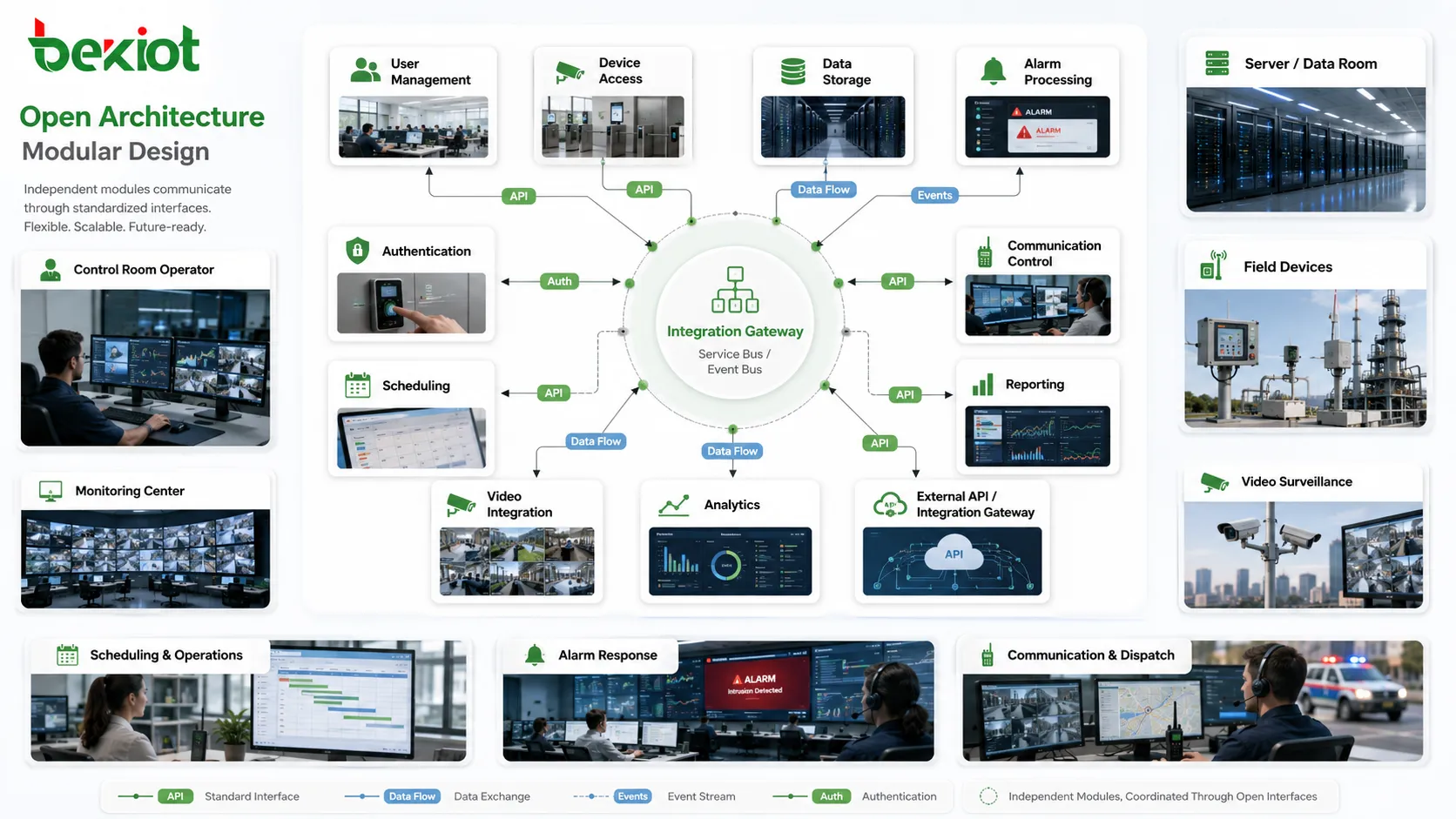
The first working principle is modular design. A system is divided into functional parts rather than built as one inseparable block. Each module has a defined purpose, such as user management, device access, alarm processing, communication control, reporting, scheduling, authentication, analytics, or external interface service.
Modularity improves maintainability. A reporting module can be upgraded without changing the device access layer. A notification service can be replaced without rewriting the core database. A new analytics module can be added without changing the login mechanism.
It also supports specialization. Different teams or vendors can develop different modules as long as they follow the required interface rules. This is one reason Open Architecture is valuable in large projects that combine software, hardware, services, and third-party systems.
Modular design still needs discipline. If modules are too large, the system remains inflexible. If modules are too small, integration becomes complicated and performance may suffer. Good architecture places module boundaries around real business functions, technical responsibilities, and lifecycle needs.
Open Architecture begins by dividing the system into independent functional modules that communicate through defined interfaces.
Interfaces make cooperation possible
A module is useful only when it can cooperate with other modules. An interface defines how one part of the system communicates with another part. It may describe request format, response format, commands, data fields, authentication method, event notification, error code, file exchange method, or protocol behavior.
Standardized interfaces are the practical working channel of Open Architecture. A software platform may expose REST APIs, WebSocket channels, message queues, SDKs, database views, or file interfaces. A hardware or industrial system may use drivers, fieldbus interfaces, network ports, digital input and output, or standardized device protocols.
The interface acts as a contract. If the caller sends data according to the contract, the service returns a predictable result. If the service changes internally but keeps the contract stable, external integrations can continue working.
Good interface design should be clear, documented, stable, and versioned. It should define required fields, optional fields, data types, response codes, timeout behavior, permission requirements, and compatibility rules. A vague interface may create more confusion than a closed system.
Interfaces should also avoid exposing unnecessary internal details. If an API directly mirrors internal database tables, every database change may break outside systems. A better design exposes business-oriented actions, such as creating a work order, querying device status, subscribing to alarm events, or updating user permissions.
Layered abstraction reduces dependency
Open Architecture relies on abstraction. Abstraction means hiding unnecessary implementation details behind a stable access layer. A user application does not need to know which database engine stores records. A dispatch system does not need to understand every internal algorithm of an alarm platform. It only needs a reliable way to request or receive the required information.
A typical system may separate the presentation layer, service layer, data layer, integration layer, device layer, and infrastructure layer. Each layer has a defined responsibility. The presentation layer handles user interaction. The service layer handles business logic. The data layer stores information. The integration layer connects external systems. The device layer communicates with physical endpoints.
This separation allows change to happen in one layer without forcing unnecessary change elsewhere. A front-end interface can be redesigned while the backend API remains stable. A new device protocol can be added through a gateway without changing the whole application.
The risk is over-abstraction. Too many layers without a clear purpose can make the system hard to understand and may reduce performance. Good Open Architecture uses abstraction to reduce dependency, not to hide every detail behind unnecessary complexity.
Protocols provide common language
Protocols define how devices, services, or applications exchange information. They may define message structure, connection behavior, addressing, session control, error handling, security, timing, and data representation.
In software and cloud systems, common methods include HTTP, HTTPS, REST, WebSocket, MQTT, AMQP, SOAP, GraphQL, gRPC, and message queues. In industrial and device environments, systems may use Modbus, OPC UA, BACnet, CAN, PROFIBUS, PROFINET, EtherNet/IP, serial protocols, or vendor-defined interfaces. In communication systems, SIP, RTP, SNMP, LDAP, and related protocols may appear.
The role of protocols is to reduce custom dependency. If two systems support a common protocol correctly, integration becomes easier. This does not mean integration is automatic. Data mapping, permission, timing, command behavior, and workflow logic still need engineering design.
Protocol selection should match the use case. Real-time telemetry may need lightweight publish-subscribe messaging. Business data exchange may use REST APIs. A high-performance internal service may use gRPC. A building automation project may use field-specific protocols. An open architecture should support appropriate communication methods instead of forcing every connection into one pattern.
Data models keep information meaningful
Open Architecture is not only about connecting endpoints. It also requires understandable data. Different systems may use different field names, identifiers, units, status values, time formats, language settings, and classification methods. If data is not mapped correctly, the systems may connect technically but still produce wrong business results.
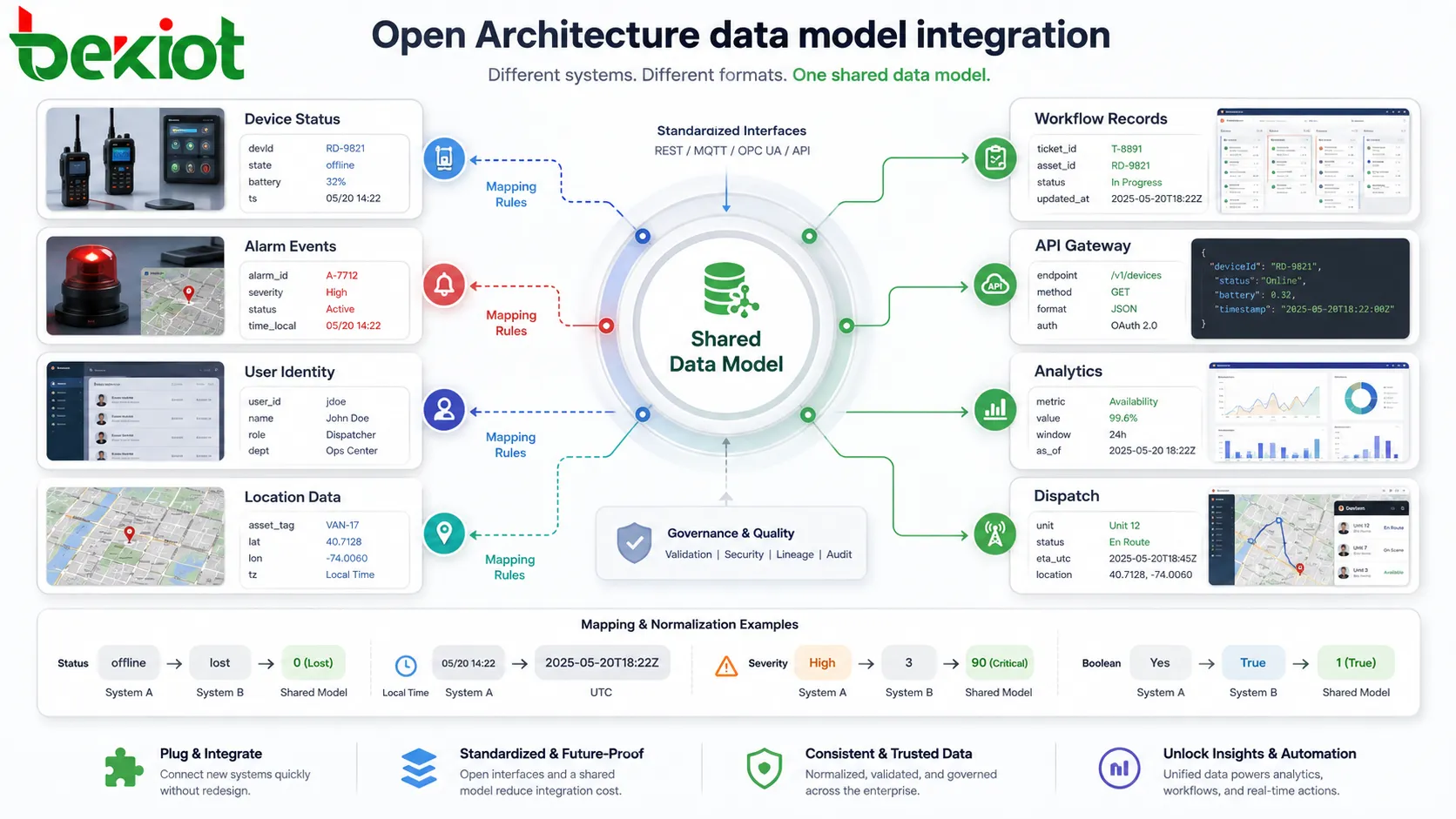
A data model defines how information is structured. It may describe users, devices, alarms, events, locations, permissions, work orders, messages, media records, schedules, assets, departments, or process states. Shared models or transformation rules allow different modules to understand the same information.
For example, one system may call a device state “offline,” another may use “lost,” and another may use a numeric code. One system may store timestamps in local time, while another uses UTC. One system may identify a location by building and floor, while another uses a zone ID. These differences must be mapped carefully.
Data ownership should also be defined. A device management platform may own device status. A user directory may own user identity. A dispatch platform may own incident records. Clear ownership prevents several systems from overwriting the same field in conflicting ways.
Shared data models and mapping rules allow different systems to exchange information without losing meaning.
Loose coupling protects future change
Loose coupling means modules depend on each other as little as reasonably possible. They communicate through interfaces and contracts rather than direct internal dependency. This principle allows each part of the system to evolve with less risk.
In a tightly coupled system, one change can create many hidden effects. If a database field changes, several applications may fail. If a device protocol changes, the control platform may require large modification. If a service moves to another server, all clients may need reconfiguration.
Loose coupling reduces this problem. A module can change its internal code, storage method, or deployment environment as long as the external interface remains compatible. New modules can be added without rewriting old ones, and one subsystem can be replaced without abandoning the entire platform.
Loose coupling is often implemented through APIs, service buses, message brokers, event-driven architecture, adapter layers, drivers, plug-ins, and configuration-based integration. The dependencies still exist, but they are visible, documented, and manageable.
Extension mechanisms support new functions
Open Architecture often includes plug-in or extension mechanisms. These allow new functions to be added without changing the core system. A plug-in may add a device driver, report type, alarm rule, authentication method, protocol connector, workflow adapter, visualization widget, or third-party service integration.
The core system provides extension points. These define what the plug-in can access, what events it can receive, what APIs it can call, what data it can read or write, and how it should be installed or updated.
This is useful because real projects often need local customization. One customer may need a special alarm report. Another may need a custom device protocol. A third may need integration with a regional platform. Extension points allow customization while protecting the core architecture.
Plug-ins still require governance. A poorly written extension can affect performance, security, or stability. The system should control permissions, resource usage, compatibility versions, logging, error isolation, and update methods.
Orchestration coordinates distributed services
Open Architecture often connects services such as user management, alarm processing, device access, notification, video linkage, scheduling, reporting, analytics, storage, and external APIs. Service orchestration defines how these capabilities work together to complete a process.
For example, when an alarm occurs, the system may receive the event, verify its type, store the record, notify the operator, open a related video view, trigger a paging message, create a work order, and update an incident timeline. Each step may belong to a different module or service.
Orchestration may use workflow engines, business process systems, event buses, rules engines, middleware, or service choreography. The key is that the process should be configurable and observable, not hidden inside scattered custom code.
Failure handling should be included. If one service fails, the system should define whether to retry, skip, roll back, notify an operator, or continue in a degraded mode. Open Architecture does not remove failure; it makes failure paths easier to manage.
Security is part of openness
Open Architecture does not mean open access without control. A system can be open in interfaces and extensibility while still being strict in security. In fact, the more integration points a system provides, the more important security governance becomes.
Security begins with identity. Every external system, user, device, or service should be identified through credentials, certificates, tokens, keys, accounts, or other trusted methods. Anonymous access is not suitable for sensitive data, device control, operational commands, or emergency workflows.
Authorization defines what each caller can do. A third-party application may read status but not change configuration. A device gateway may report telemetry but not access user records. A local administrator may manage one site but not another.
Security also includes encryption, audit logs, rate limiting, input validation, secure coding, vulnerability testing, secret management, network segmentation, and lifecycle review. The principle is controlled openness: open enough to integrate, but controlled enough to protect data, operations, users, and infrastructure.
Governance keeps openness manageable
Flexibility without governance can create disorder. If every team creates its own interface, data model, permission rule, and integration logic, the system may become more fragmented than a closed platform.
Architecture governance includes interface standards, naming rules, version management, data ownership, security policy, integration review, documentation requirements, testing procedures, lifecycle management, and change approval. These rules keep new modules and integrations compatible with the larger system.
Version management is especially important. Interfaces change over time. New fields may be added, old fields may be deprecated, authentication methods may improve, and response structures may evolve. Without versioning, an upgrade can break existing integrations.
Documentation is also part of governance. Interface documents, data dictionaries, workflow descriptions, sample requests, error codes, event definitions, and deployment guides reduce integration cost and make the architecture usable by other teams.
Interoperability must be tested
Many products claim to be open, compatible, or interoperable. These claims are useful only when verified in real integration conditions. Open Architecture provides the possibility of interoperability, but engineering testing confirms whether it works in the actual project.
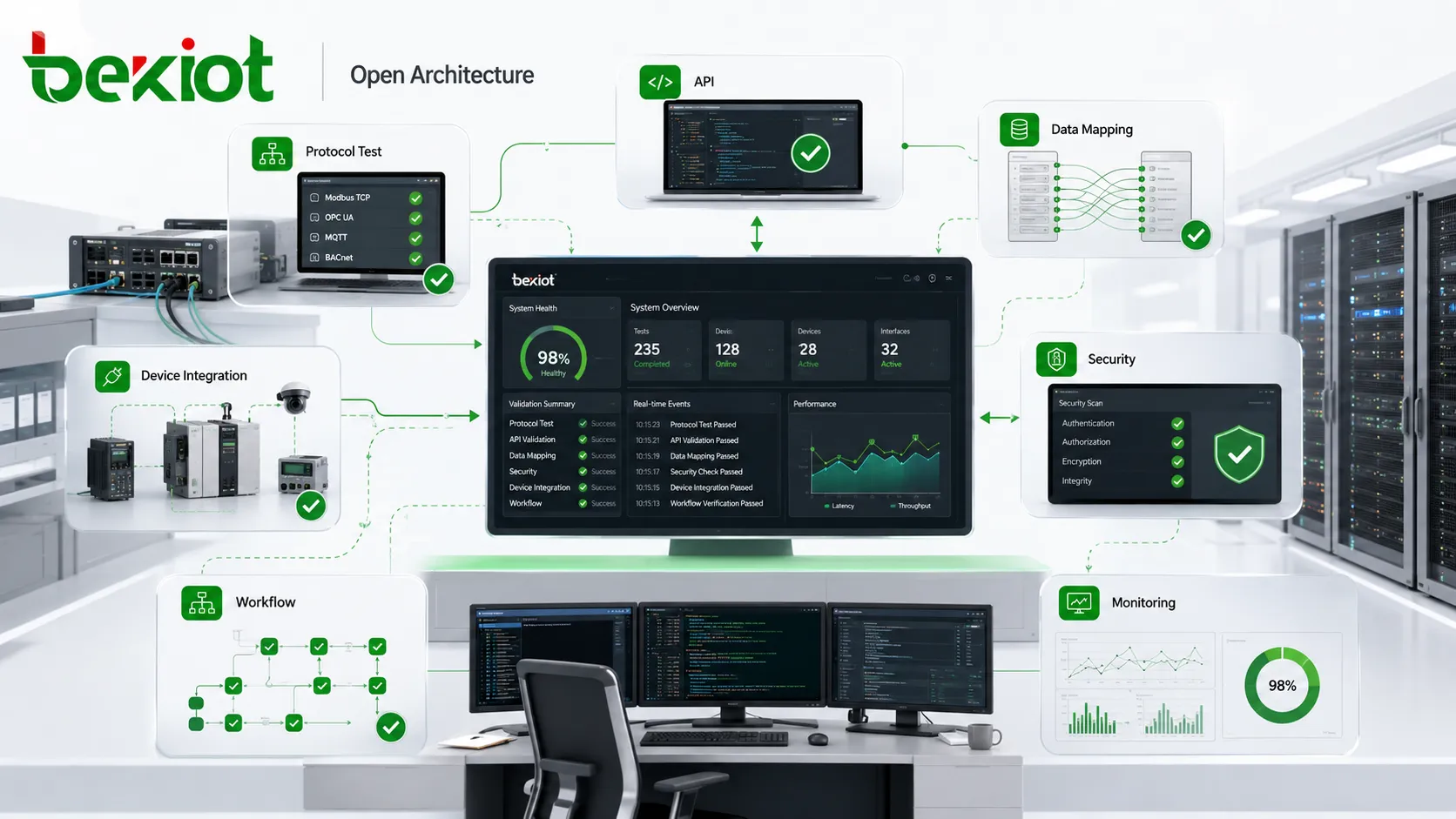
Testing should check protocol behavior, data fields, authentication, error handling, timeout behavior, event delivery, performance, security, and version compatibility. It should also include abnormal conditions such as missing data, duplicate events, network delay, expired tokens, service restart, and partial failure.
Device integration needs field testing. A protocol document may say that a device supports a command, but the device may respond differently under load, after restart, or during network interruption. Application integration also needs workflow testing. A record may synchronize correctly, but the business process may still fail if the status mapping or time zone is wrong.
Interoperability is not a one-time label. It is a verification process that should include real equipment, real data, real networks, and real operating workflows.
Interoperability requires testing of protocols, APIs, data mapping, security rules, devices, workflows, and monitoring behavior.
Where Open Architecture is used
Enterprise platforms
Enterprise platforms use Open Architecture to connect CRM, ERP, HR, finance, document management, customer service, workflow, analytics, and reporting systems. Each system may own a different part of the business process, and the architecture allows them to exchange data without repeated manual entry.
For example, a customer order may start in an e-commerce platform, move into ERP, generate a finance record, create a logistics task, and update a customer service dashboard. Open interfaces make this process more continuous.
Industrial and automation systems
Industrial facilities often include old PLCs, new sensors, SCADA systems, device gateways, energy meters, safety systems, maintenance platforms, alarm systems, and management dashboards. These systems may come from different generations and vendors.
Open Architecture connects them through device drivers, protocol gateways, data platforms, alarm services, and application modules. Legacy equipment can be integrated through adapters, while new devices can be added through supported protocols.
Communication and dispatch systems
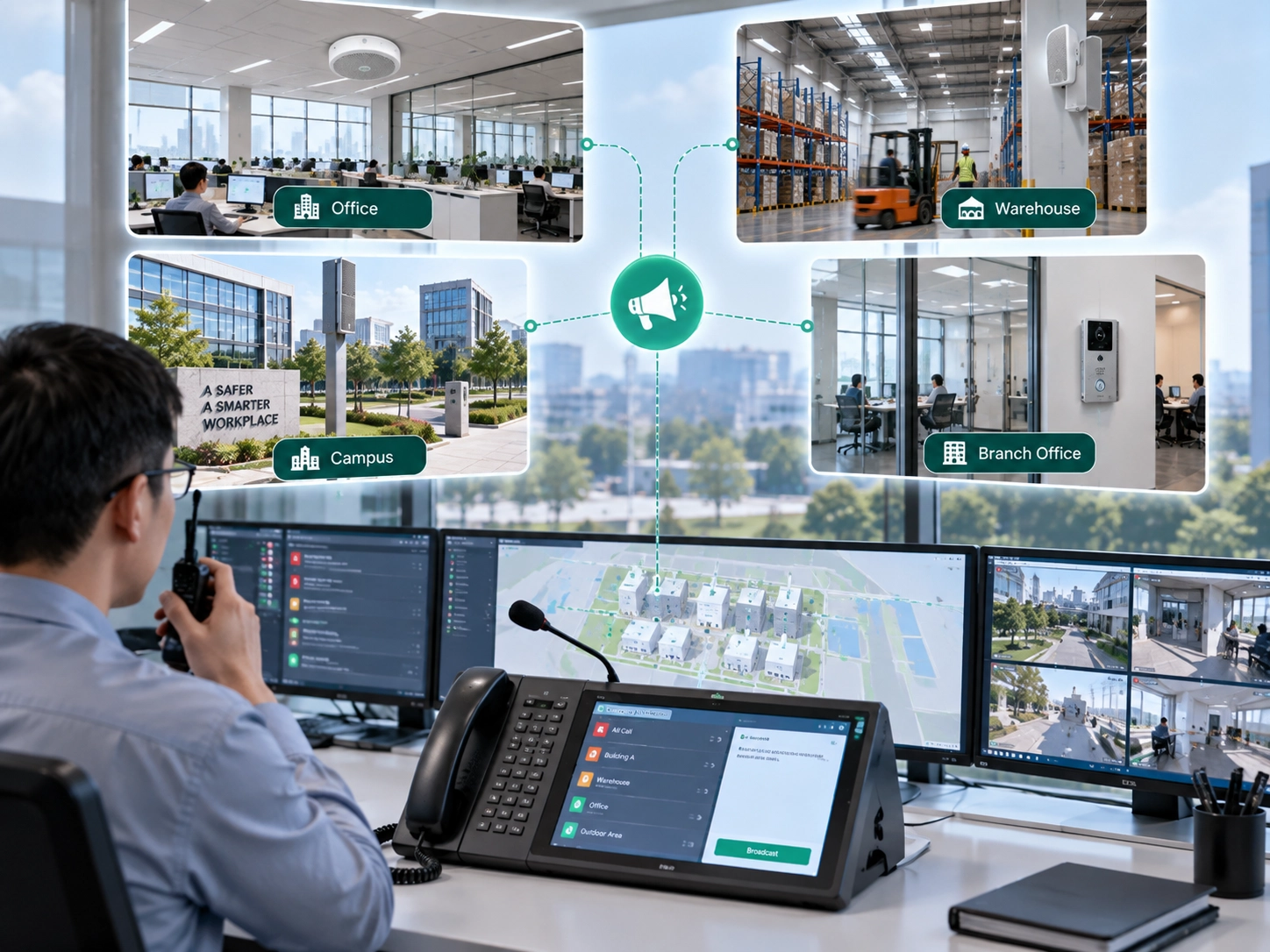
Communication and dispatch systems often need to connect voice, video, alarms, public address, intercom, access control, GIS, recording, mobile terminals, and command platforms. Open Architecture allows these functions to cooperate as part of one operational workflow.
An emergency call may trigger a dispatch pop-up, show location data, open a nearby camera, start recording, notify a response group, and create an event record. These actions may come from different modules, but the architecture makes them work together.
Cloud, IoT, and edge computing
Cloud, IoT, and edge computing also depend on Open Architecture. Devices collect data at the edge, gateways preprocess information, cloud platforms store and analyze data, and business systems use the results.
Open interfaces between edge and cloud allow the system to balance local response, centralized management, analytics, and long-term storage. This is important because IoT ecosystems change quickly and need room for new devices, networks, analytics tools, and AI services.
Benefits and risks
Aspect
System Value
Risk to Manage
Adaptability
New modules, devices, and workflows can be added more easily
Poor planning may create unnecessary complexity
Vendor flexibility
Projects are less dependent on one closed supplier
Compatibility still requires mapping, testing, and support
Data sharing
Information can move automatically between systems
Unclear data ownership can create conflicting records
Security control
Interfaces can be protected by identity, permission, logs, and encryption
More integration points can increase the attack surface
Lifecycle value
Upgrades and replacements can be handled in stages
Weak governance can turn openness into fragmentation
How to judge whether it is truly open
A truly open architecture should provide documented interfaces, clear data models, supported protocols, version management, security controls, and practical integration methods. It should not depend on undocumented internal access or one-off customization that only the original vendor understands.
It should support modular expansion. Certain functions should be added or replaced without rewriting the entire system. Extension points, APIs, adapters, drivers, and service interfaces should be stable enough for long-term use.
It should also support real interoperability testing. Documentation alone is not enough. External systems, devices, data sources, or applications should be able to connect and operate according to the intended workflow.
Security and governance should be visible. If a system is open but has no permission control, audit log, version policy, or integration review process, it may be unsafe for serious use.
The final test is lifecycle value. If every change still requires deep custom modification, the practical openness is limited even if the system claims to support open interfaces.
Implementation principles for real projects
Real projects should begin by defining integration goals. The team should identify which systems need to connect, what data must be exchanged, which functions must be triggered, who owns each data source, which operations are read-only, and which operations can change system state.
The next step is selecting the right integration method. Some use cases need synchronous APIs. Some need webhooks. Some need message queues. Some need protocol gateways. Some need file exchange for batch data. The method should match the business need instead of following one fashionable pattern.
Security should be designed early. Authentication, authorization, encryption, network segmentation, audit logs, and key management should not be added as an afterthought. Each interface should have a defined risk level and access policy.
Documentation and testing should be part of delivery. Interface documents, data dictionaries, sample calls, error definitions, version notes, and integration test cases help future teams maintain the architecture.
Long-term operation should include monitoring and review. API usage, device integration status, module health, error rates, performance, security events, and deprecated interfaces should be monitored because Open Architecture is a living structure, not a one-time diagram.
Final view
Open Architecture works by combining modular design, standardized interfaces, layered abstraction, common protocols, shared data models, loose coupling, extension mechanisms, service orchestration, security control, governance, and interoperability testing.
Its logic is based on separation and cooperation. Functions are separated into manageable modules, while cooperation is achieved through defined contracts. Internal implementation can change, but external behavior remains stable enough for integration.
The value of Open Architecture appears when it is applied with discipline. It should not mean disorder, insecure access, or uncontrolled customization. A strong open architecture is documented, governed, secure, testable, extensible, and aligned with real operational needs.
FAQ
Is Open Architecture the same as open source?
No. Open Architecture means the system is designed with accessible interfaces, modular structure, and integration capability. Open source means the source code is made available under a license. A system can use Open Architecture without being open source.
What is the core working principle of Open Architecture?
The core principle is controlled modular cooperation. The system separates functions into modules and allows them to communicate through standardized interfaces, protocols, and data models while maintaining security and governance.
Why are standardized interfaces important?
Standardized interfaces allow different modules, systems, or devices to exchange information in a predictable way. They reduce dependency on internal code and make integration, upgrade, and replacement easier.
Does Open Architecture guarantee compatibility?
No. It improves the possibility of compatibility, but real interoperability still requires protocol matching, data mapping, configuration, security alignment, and testing under actual project conditions.
What risks should be considered when using Open Architecture?
Risks include weak security, poor governance, unclear data ownership, version conflicts, interface instability, excessive complexity, performance bottlenecks, and untested compatibility.