MTBF and protection level explained for industrial and communication equipment, covering failure definition, calculation methods, field data, IP and IK ratings, environmental matching, procurement review and maintenance.
Becke Telcom
In engineering procurement, industrial equipment design, communication system planning, and long-term maintenance, MTBF and protection level are often used together to judge whether a device is suitable for its operating environment. A high MTBF value may suggest lower expected failure frequency, while a suitable protection level shows whether the product structure can resist dust, water, impact, corrosion, electrical stress, or other site conditions.
These two indicators are useful, but they are often misunderstood. MTBF is not a guaranteed lifetime, and protection level is not a complete reliability promise. A product with an impressive MTBF may still fail early if it is installed in the wrong environment. A product with a high protection rating may still be unreliable if internal components, thermal design, firmware stability, power quality, or maintenance practices are weak.
A practical engineering decision should read MTBF and protection level together, but not confuse them. MTBF answers how often a device may fail under defined assumptions. Protection level answers what external hazards the product can resist under verified test conditions. Real field reliability depends on both.
Start with the failure boundary
Before MTBF can be calculated or compared, the project team must define what counts as a failure. A device may stop completely, restart unexpectedly, lose communication, produce incorrect output, display wrong status, fail to meet response time, or require manual reset. Some of these events may be counted as failures in one project but treated as temporary anomalies in another.
For repairable equipment, MTBF usually refers to the average operating time between failures that require repair or corrective action. If a system runs for a long period and experiences several valid failures, MTBF can be calculated by dividing total operating time by the number of valid failures. In early design, MTBF may also be predicted from component failure-rate models before enough field data exists.
The failure boundary should match the product purpose. For a monitoring terminal, screen failure, communication loss, or power module failure may be counted. For a network device, packet forwarding failure, port failure, reboot, configuration corruption, or management loss may be counted. For safety-related equipment, failure to alarm, failure to communicate, wrong indication, or delayed response may be more serious than minor cosmetic defects.
The project should also define what is not counted as a product failure. External power loss, wrong installation, cable damage, incorrect configuration, unauthorized modification, lightning without surge protection, water entry through poor cable glands, or operation outside rated conditions may be excluded from product MTBF calculation. They still affect real project availability, but they should be classified correctly.
Use the right reliability indicator
MTBF is mainly meaningful for repairable systems or equipment that can return to service after repair, replacement, or restoration. Servers, communication devices, industrial controllers, monitoring terminals, network switches, gateways, and field devices usually fit this category.
For non-repairable items, MTTF, or mean time to failure, may be more appropriate. A sealed module, lamp, sensor element, small electronic component, or single-use device may be replaced rather than repaired. Using MTBF carelessly for non-repairable items can create confusion.
MTBF should also be separated from service life. A product may have an MTBF value much longer than its warranty period or expected service life because MTBF is a statistical reliability indicator, not a promise that one unit will operate for that exact number of hours.
Availability is another related but different concept. Availability depends on how often failures occur and how quickly the system can be restored. A device with moderate MTBF and very short repair time may provide better practical availability than a device with higher MTBF but difficult maintenance. MTTR, spare parts, modular replacement, remote diagnosis, and service access should be reviewed together.
Prediction and field data are different sources
During design or early procurement, complete field data may not exist. MTBF is then often estimated through reliability prediction methods. These methods use component failure rates, stress factors, temperature, electrical load, quality level, environment, duty cycle, and operating profile to estimate the expected failure rate of the whole product.
Prediction is useful because it helps engineers compare design options before long-term operation records are available. It can show which components contribute most to expected failures, whether temperature reduction improves reliability, whether derating is needed, or whether a fan or power module is a weak point.
However, prediction is still an engineering estimate. Different methods may use different component classifications, quality factors, environmental assumptions, stress models, and confidence approaches. A reported MTBF value should therefore state the calculation method and key assumptions. Without the method, the number is incomplete.
Field data gives a different kind of evidence. If many units operate for a long time and valid failures are recorded accurately, observed MTBF can be more meaningful than early prediction. It reflects real temperature, humidity, power quality, user behavior, workload, maintenance, and installation conditions.
Field data also needs scale. A small sample or short observation period can be misleading. No failure during a short test does not prove extremely high reliability. Good field reliability analysis combines operating hours, installed quantity, failure logs, repair records, root cause classification, environment notes, firmware version, production batch, and maintenance history.
MTBF determination depends on failure definition, component data, operating conditions, reliability model selection, calculation, and validation.
Operating conditions decide whether MTBF is meaningful
MTBF values should always be read together with operating conditions. Temperature is one of the most important factors for electronic equipment. High temperature can accelerate component aging, reduce capacitor life, affect power modules, increase solder stress, and shorten the life of fans or batteries.
Electrical stress also matters. Components operated near maximum voltage, current, power, or thermal limits may fail sooner than components with proper margins. Power surges, unstable input voltage, poor grounding, and electromagnetic interference can all affect reliability.
Mechanical and environmental stress should not be ignored. Vibration, shock, dust, moisture, salt spray, chemical vapor, UV exposure, repeated button operation, cable pulling, and connector corrosion may create failures that are not fully represented by a general electronic reliability calculation.
Duty cycle also changes reliability. A device operating continuously at high load may not have the same failure rate as one used intermittently. A paging amplifier, industrial phone, gateway, display terminal, or network device may experience different thermal and electrical stress depending on how often it transmits, rings, displays, records, drives audio, or handles traffic.
A responsible MTBF statement should include or reference the calculation standard, environment, temperature, duty cycle, failure definition, and data source. A bare statement such as “MTBF 100,000 hours” is less useful than a value tied to clear engineering conditions.
Component quality and derating shape reliability
Many MTBF predictions begin at component level. Resistors, capacitors, integrated circuits, transistors, diodes, connectors, relays, switches, fans, displays, batteries, power supplies, and other parts may each contribute to the total failure rate.
Some components deserve special attention. Electrolytic capacitors, fans, batteries, relays, connectors, and mechanical switches may have wear-out mechanisms or higher sensitivity to temperature, vibration, moisture, or repeated operation. Even if the overall predicted MTBF looks acceptable, one weak component can dominate field failures.
Derating is a common reliability design method. Instead of operating components close to their maximum ratings, engineers select parts with voltage, current, temperature, or power margins. Proper derating can reduce stress and improve long-term reliability.
Component quality and supplier control also matter. Two components with the same nominal rating may not perform equally under industrial conditions. Manufacturing quality, material stability, supplier consistency, incoming inspection, PCB layout, grounding, thermal design, conformal coating, connector strain relief, and firmware stability all influence real reliability.
Confidence and standards affect interpretation
Reliability numbers should be read with statistical caution. When MTBF is based on test or field data, confidence level is important. A claim based on limited data may have a wide uncertainty range. A stronger confidence requirement usually needs more samples, more test time, or more observed operating hours.
Zero failures during a short test does not mean infinite reliability. It only means no failures were observed during that test duration and condition. The statistical meaning depends on sample size, operating time, and confidence method.
The selected standard should match the product type and industry. Military, aerospace, telecom, industrial automation, commercial electronics, transportation, medical, and utility applications may use different reliability prediction methods. A standard familiar in one sector may not fit another.
Cross-comparison should be cautious. A product predicted using one standard cannot always be compared directly with another product predicted using a different method. The difference may come from the model rather than the design. Reliable comparison requires consistent assumptions.
Determination Source
Main Use
Strength
Limitation
Reliability prediction
Design-stage estimation and comparison
Finds high-risk components before field data exists
Depends on assumptions, models, and input data quality
Laboratory test data
Verification under controlled conditions
Provides measured evidence under known stress
May not represent all field environments or long-term use
Field operation data
Real-use reliability evaluation
Reflects actual installation, usage, and maintenance
Needs large sample size and clear failure classification
Supplier component data
Part-level reliability input
Useful for prediction and component comparison
May be based on different environments or assumptions
Customer requirement
Contract and procurement compliance
Creates a common evaluation basis
Can mislead if the method does not fit the application
Protection level starts with hazard matching
Protection level is different from MTBF. It does not describe how long a device will run between failures. It describes how well the device or enclosure resists specific external conditions. These may include dust ingress, water ingress, mechanical impact, corrosion, temperature, vibration, flame exposure, electrical stress, surge, electromagnetic interference, or hazardous-area requirements.
The first step is identifying real site hazards. A device in a clean office does not need the same protection as a device installed outdoors near a coastline. A control terminal inside a cabinet does not face the same impact risk as a public emergency call point in a transport station. A wash-down food processing area has different risks from a dry warehouse.
Protection judgment should therefore begin with the environment, not the product label. Is there dust? Is it conductive? Is water dripping, spraying, jetting, or immersing the device? Is there sunlight, salt fog, chemical vapor, vibration, shock, public misuse, or temperature extreme? Is the device installed indoors, outdoors, under a roof, inside a cabinet, or directly on a machine?
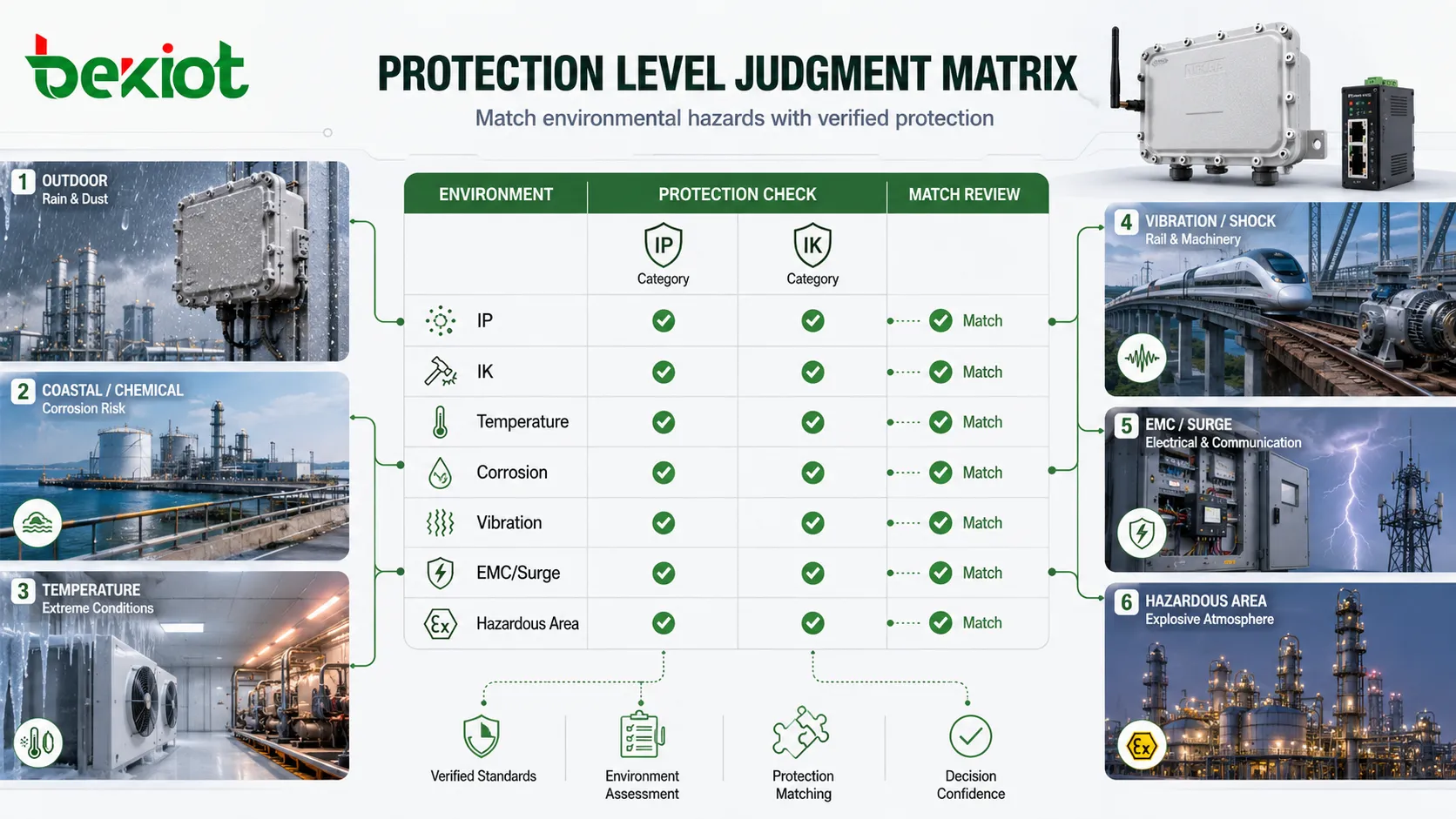
Once hazards are identified, the right protection ratings or tests can be selected. IP ratings are common for solid and liquid ingress protection. IK ratings are used for mechanical impact. Other sites may require corrosion tests, vibration tests, EMC tests, insulation tests, flame tests, surge tests, or hazardous-area certification.
IP rating is only one part of protection
IP rating is one of the most familiar protection indicators. It describes the degree of protection provided by an enclosure against solid objects and water. The first digit relates to solid particle or access protection, while the second digit relates to liquid ingress protection.
It should not be simplified into “waterproof” or “dustproof” without reading the specific digits. Dripping water, spraying water, water jets, powerful jets, temporary immersion, and high-pressure high-temperature water exposure are different test conditions. A device suitable for rain may not be suitable for immersion or wash-down cleaning.
Installation affects ingress protection. Cable glands, conduit entries, mounting orientation, gasket compression, screw torque, maintenance access, and unused holes can all affect whether dust or water enters. A high-rated enclosure can lose protection if installed with poor cable sealing or damaged gaskets.
IP rating also does not judge internal reliability directly. A sealed enclosure may resist water but still overheat if thermal design is weak. It may also trap condensation if temperature changes are not considered. Ingress protection should be balanced with heat and moisture management.
Impact and environmental resistance need separate review
Mechanical protection is usually judged separately from ingress protection. A device may be hit by tools, carts, luggage, public misuse, vehicles, falling objects, or repeated operation. IK rating is commonly used to classify enclosure resistance to external mechanical impact under defined test energy levels.
Impact resistance should match the installation location. A device in a quiet office corridor does not need the same impact level as one installed at a public platform, outdoor gate, warehouse dock, school corridor, parking area, or industrial passage.
Additional environmental conditions may also matter. Temperature range, corrosion resistance, salt spray performance, UV exposure, chemical resistance, vibration, shock, EMC immunity, surge protection, and hazardous-area certification may be relevant depending on the application.
A high rating in one category does not automatically mean high protection in another. A product may resist water but not strong impact. It may resist impact but not corrosion. It may be dust-tight but not suitable for explosive atmospheres. Protection level must be judged category by category.
Protection level should be judged by matching environmental hazards with verified test categories and installation conditions.
Test evidence matters more than vague claims
Terms such as rugged, waterproof, weatherproof, industrial grade, heavy duty, outdoor rated, shock resistant, and high reliability are not enough for engineering judgment. They may describe intention, but they do not replace test evidence.
A useful test report should identify the tested model, sample condition, standard, test level, method, duration, mounting orientation, cable entry condition, acceptance criteria, and result. If the report does not match the final product version or installation method, its relevance may be limited.
Project teams should also check whether the rating applies to normal operation, storage, transportation, or a specific configuration. Some ratings apply only when covers are closed, unused ports are sealed, or specified cable glands are installed.
For critical applications, third-party testing or certification may be required. Internal tests may support design verification, but external certificates can provide stronger acceptance evidence where contracts, regulations, or safety requirements demand it.
Evaluate MTBF and protection level together
MTBF and protection level describe different things, but both affect whether equipment remains usable in the field. MTBF focuses on expected failure frequency under defined assumptions. Protection level focuses on resistance to external conditions. If either side is weak, the real system may become unreliable.
An electronic device with a strong predicted MTBF may fail in a dusty outdoor site if moisture or particles enter the enclosure. A product with high IP and IK ratings may still fail often if the power supply is poorly designed, components run too hot, or firmware crashes under load.
A practical evaluation should ask three questions. Is the product internally reliable enough for the expected duty cycle and maintenance policy? Is the enclosure or structure protected enough for the expected environment? Is the installation method good enough to preserve the rated performance?
For industrial, transport, utility, emergency, and outdoor applications, it is better to create a reliability and protection matrix. This can include MTBF method, operating conditions, field data, IP rating, IK rating, temperature range, corrosion resistance, EMC immunity, surge protection, certification status, warranty support, spare parts, and maintenance accessibility.
Application risk decides the acceptable level
There is no universal MTBF or protection level suitable for every product. The acceptable level depends on application risk. A non-critical indoor display may tolerate moderate protection and easy replacement. A remote outdoor communication device may need stronger protection because repair is difficult. A safety-related emergency device may need strict testing, redundancy, monitoring, and documented maintenance.
Risk can be judged by the consequence of failure. If failure causes only inconvenience, the requirement may be moderate. If failure causes service interruption, production loss, security risk, environmental risk, or safety impact, the requirement should be higher. If failure affects emergency communication or life safety, formal standards and periodic testing may be needed.
Repair difficulty also affects acceptable level. Equipment installed in a staffed office can be replaced quickly. Equipment installed in a remote tunnel, offshore site, high tower, hazardous area, or underground facility may require special access, shutdown permits, or long travel time.
System design can also reduce risk. Backup power, redundancy, failover, remote diagnosis, monitoring, spare units, and modular replacement may improve practical availability even when one device-level indicator is not perfect.
Procurement review should ask for conditions
When reviewing a product specification, buyers should ask how MTBF was determined. Was it predicted by a standard? Was it calculated from component data? Was it based on laboratory testing? Was it based on field operation? What was the failure definition? What temperature and duty cycle were assumed? What confidence level was used?
For protection level, the review should ask which rating was tested, which standard was used, whether the complete device was tested, whether connectors and cable entries were included, whether the rating applies to the installed condition, and whether reports or certificates are available.
Procurement should also consider lifecycle support. A product with good published indicators may still cause problems if spare parts are unavailable, documentation is weak, firmware is not maintained, or the manufacturer cannot support field diagnosis.
For harsh or critical environments, a sample test or pilot installation may be useful. The product can be installed in a representative area and observed under real conditions before large-scale deployment.
Maintenance influences real reliability
MTBF and protection levels are often discussed before purchase, but maintenance determines whether expected performance continues over time. Gaskets age, screws loosen, cable glands are opened, firmware changes, connectors corrode, filters clog, batteries degrade, fans wear out, and users may damage interfaces.
Inspection should include both functional and physical checks. Functional checks confirm that the device powers on, communicates, displays status, responds to inputs, and performs its main task. Physical checks confirm that the enclosure is intact, seals are clean, cable entries are tight, labels are readable, mounting is secure, and no moisture or corrosion is visible.
Maintenance records can improve reliability analysis. If failures are recorded with time, location, environment, cause, repair action, and component replaced, the organization can update its understanding of MTBF and identify repeated field problems.
Protection-level maintenance is especially important after service work. Opening a sealed enclosure, replacing a cable, changing a connector, or moving the device can reduce protection if the gasket is damaged or the cable gland is not reinstalled correctly.
Common misunderstandings and better judgment
Misunderstanding
Why It Is Wrong
Better Judgment
MTBF means guaranteed lifetime
MTBF is a statistical indicator, not a promise for one unit
Read it with method, condition, failure definition, and confidence
Higher MTBF is always better
Different methods and assumptions may not be comparable
Compare only values based on similar standards and conditions
High IP rating means full protection
IP rating covers defined ingress tests, not every hazard
Protection does not prove internal component or firmware reliability
Evaluate internal design, thermal stress, power quality, and maintenance together
Certification removes installation risk
Bad mounting, wiring, sealing, or operation can defeat rated performance
Verify field installation and maintain the protection after service
How to make a balanced decision
A balanced judgment begins by separating the two questions. The MTBF question is: how often is the device expected to fail under defined operating conditions? The protection question is: what external hazards can the device resist under verified test conditions?
The next step is to compare both indicators with application needs. A high-risk outdoor industrial device may require strong MTBF evidence, ingress protection, impact resistance, surge immunity, corrosion resistance, and good maintenance access. A low-risk indoor device may need only moderate protection and basic reliability evidence.
Evidence should be checked carefully. MTBF should be supported by a prediction report, test data, or field records. Protection level should be supported by test reports, certificates, or standard-based specifications. Unsupported claims should be treated cautiously, especially in critical applications.
System-level design should also be reviewed. Redundancy, backup power, monitoring, spare parts, remote diagnosis, maintenance access, and installation quality can improve practical availability. A project should not rely only on one device-level number.
Finally, the judgment should be updated after deployment. Real reliability is learned over time. Field failures, maintenance records, environmental changes, and user behavior should feed back into future selection and design.
Final view
MTBF standards are determined by the selected reliability method, failure definition, component data, operating conditions, duty cycle, environmental stress, test or field records, and statistical confidence. A meaningful MTBF value should state how it was calculated or observed, under what conditions, and what failures were included.
Protection level is judged by matching real environmental hazards with verified tests and ratings. IP ratings, IK ratings, temperature range, corrosion resistance, vibration performance, EMC immunity, surge protection, hazardous-area certification, and installation quality may all be relevant depending on the application.
The strongest evaluation combines reliability and protection. A device should be internally reliable, externally protected, correctly installed, maintainable, and suitable for the risk level of the application. Only then can MTBF and protection level support a practical engineering decision instead of remaining isolated specification terms.
FAQ
Is MTBF the same as product lifetime?
No. MTBF is a statistical reliability indicator for repairable systems under defined assumptions. It does not mean that every unit will operate for exactly that number of hours.
Can MTBF values from different suppliers be compared directly?
Only when the calculation method, failure definition, operating conditions, component data, and confidence assumptions are comparable. Different standards or assumptions may produce unfair comparisons.
Does a high IP rating mean the product is fully protected?
No. IP rating mainly concerns ingress protection against solids and liquids under defined tests. It does not automatically cover impact, corrosion, vibration, EMC, surge, UV exposure, chemical resistance, or hazardous-area safety.
Why should test reports be reviewed instead of only the catalog rating?
Test reports show the tested model, standard, method, condition, and result. They help confirm whether the rating applies to the complete device and the real project installation.
How can field reliability be improved after installation?
Field reliability can be improved through correct installation, surge protection, grounding, temperature control, periodic inspection, seal maintenance, firmware management, spare parts planning, fault logging, and root cause analysis.