5G networks explained through NR radio, standalone and non-standalone deployment, core architecture, spectrum choices, performance factors, private wireless, IoT, industrial automation and real-world application planning.
Becke Telcom
5G is the fifth generation of mobile network technology. It is built on 5G NR, or New Radio, together with a more flexible core network architecture designed to support faster broadband, lower latency, higher capacity, and many more connected devices than earlier mobile generations.
The technology is often introduced through speed, but speed is only one part of the story. A modern 5G network can also support private wireless systems, industrial automation, large-scale IoT, transport operations, connected healthcare, utilities, smart city services, fixed wireless access, and enterprise applications that need more predictable wireless performance.
In practical terms, the network connects people, machines, sensors, cameras, vehicles, gateways, and applications through a radio access layer and a core network. Its value depends not only on the radio signal, but also on spectrum, deployment model, core architecture, transport design, edge computing, security policy, and the actual service requirement.
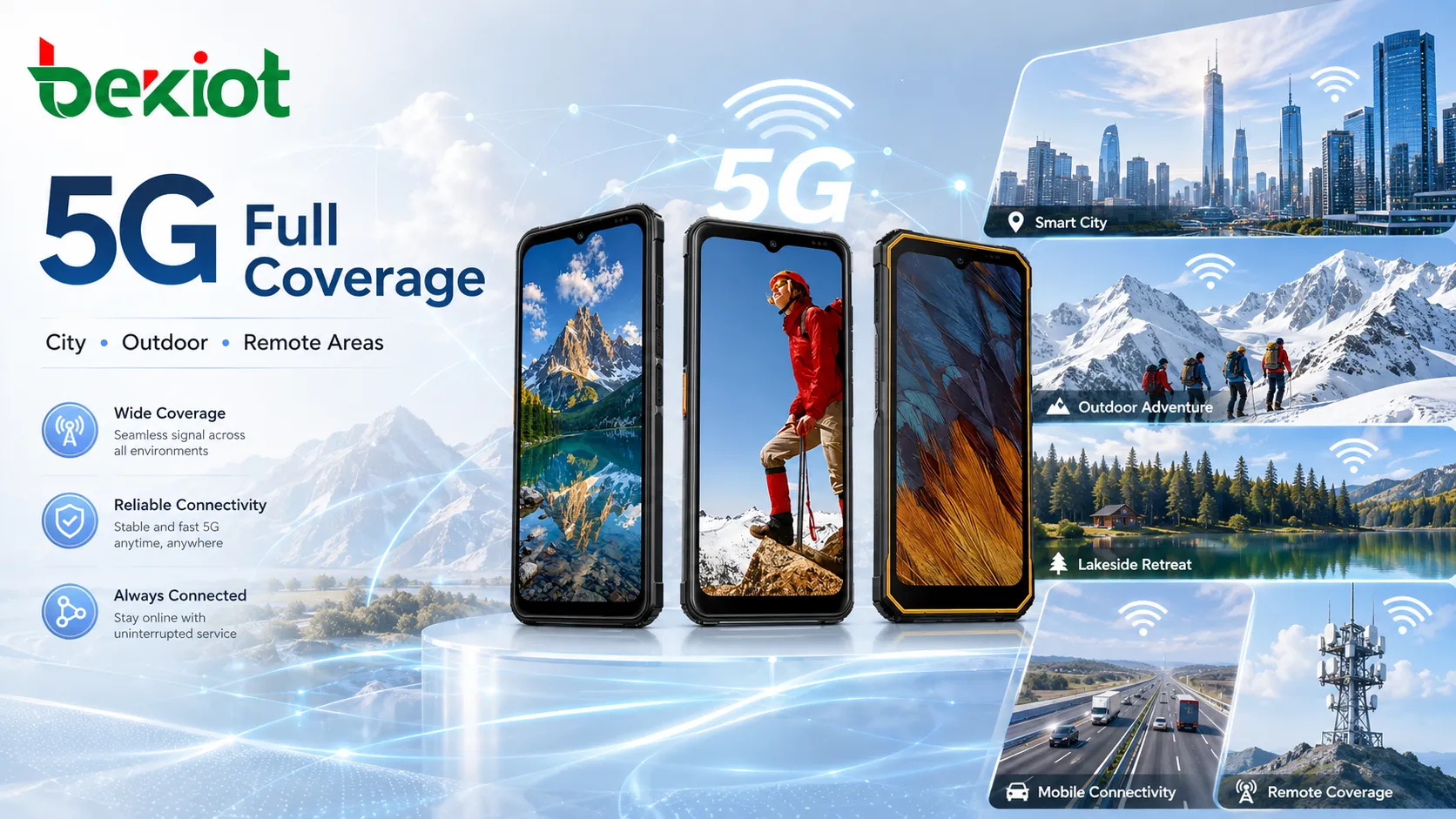
A modern mobile network connects people, machines, sensors, vehicles, and digital services through a more flexible wireless architecture.
Why the new generation matters
Earlier mobile networks were mainly designed around voice, messaging, and mobile broadband. 4G LTE made mobile internet much faster and more practical, but many advanced use cases now require more than broadband access. Factories need predictable wireless performance. Transport sites need mobility and wide-area coverage. Cities need to connect large numbers of sensors. Enterprises may need private networks with controlled access and local data handling.
This is where 5G becomes important. It is designed as a broader service platform, not only as a faster phone network. It can serve consumer devices, industrial terminals, routers, vehicles, cameras, robots, meters, and field gateways on the same standards-based technology family, while allowing different service requirements to be handled more flexibly.
The result is a network generation that can support both public mobile service and private enterprise deployment. For users, the most visible improvement may be faster access. For engineers and businesses, the deeper value often lies in capacity, service control, mobility, automation support, and the ability to connect many types of devices under one architecture.
Basic structure in practical terms
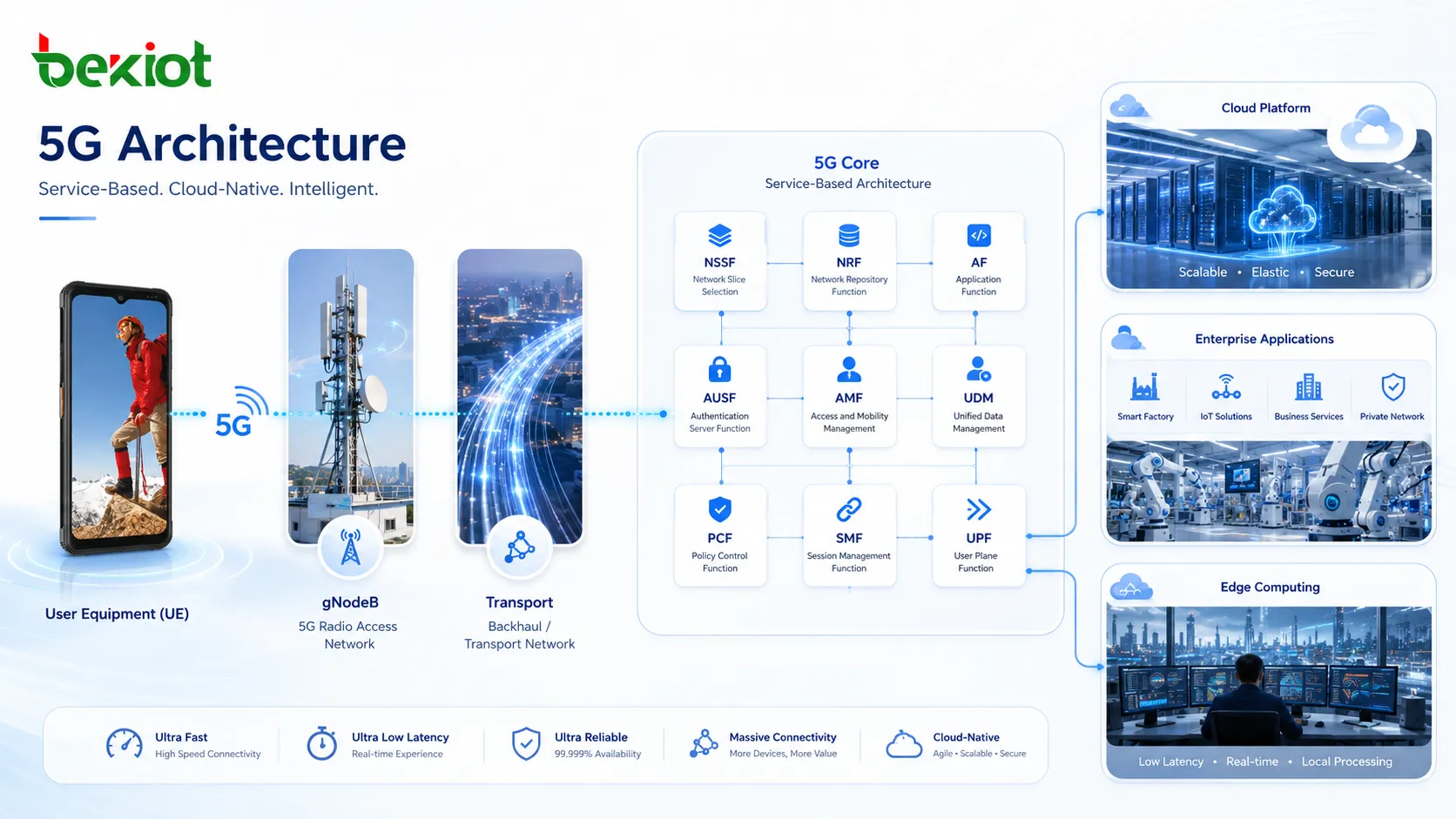
A complete 5G system can be understood through four main parts: user equipment, radio access, transport connectivity, and the core network. These parts work together to authenticate devices, manage mobility, create data sessions, apply service policies, route traffic, and connect users or machines to applications.
User equipment may be a smartphone, router, vehicle terminal, industrial gateway, camera, handheld device, robot controller, sensor concentrator, or private network terminal. The radio access network connects these devices to base stations. The transport network carries traffic between radio sites, edge locations, and core functions. The core network manages sessions, mobility, security, policy, and access to external data networks.
This layered structure explains why performance can differ widely between deployments. Two networks may both show a 5G icon, but the real capability depends on whether the deployment is standalone or non-standalone, which spectrum bands are used, how much backhaul capacity exists, where the core network is located, and whether applications run locally or in a remote cloud.
Service directions behind the technology
The technology is usually described through three service directions: enhanced mobile broadband, ultra-reliable low-latency communications, and massive machine-type communications. These categories help explain why the same network generation can serve streaming video, factory automation, connected meters, industrial cameras, and mobile broadband users.
Enhanced mobile broadband
Enhanced mobile broadband, often shortened to eMBB, focuses on higher-capacity data services. It improves downlink and uplink performance, supports more users in busy areas, and provides a better experience for applications such as ultra-high-definition video, cloud gaming, AR and VR services, remote collaboration, fixed wireless access, and large mobile data use.
This service direction is especially valuable in stadiums, airports, transport hubs, campuses, dense business districts, and city centers. Wider channels, improved spectrum efficiency, beamforming, and advanced scheduling help the network handle more traffic in crowded locations.
Ultra-reliable low-latency communications
Ultra-reliable low-latency communications, or URLLC, is designed for applications where delay and reliability matter. Examples include industrial control, machine coordination, remote operation, robotics, autonomous systems, and selected mission-critical services.
Low latency is not automatic just because a network uses 5G radio. Real performance depends on radio coverage, spectrum, device capability, transport design, core placement, edge computing, application architecture, and network loading. For industrial projects, latency should be designed, tested, and verified rather than assumed.
Massive machine-type communications
Massive machine-type communications, or mMTC, supports large numbers of connected devices such as sensors, meters, trackers, environmental monitors, asset tags, and distributed IoT nodes. The goal is not maximum speed for every device, but scalable connection density, efficient signaling, wide coverage, and practical power behavior.
This is useful in smart grids, agriculture, logistics parks, warehouses, ports, pipelines, smart buildings, municipal infrastructure, and other environments where many devices need secure and manageable wireless access.
Architecture from device to core
The network architecture is often the difference between a basic mobile broadband rollout and a more advanced service platform. A 5G deployment normally includes user equipment, NG-RAN, gNB base stations, transport infrastructure, and a service-based core network.
User equipment
User equipment, or UE, is the device that connects to the radio network. It includes the radio capability and subscriber identity functions needed to register, authenticate, and establish data sessions. In consumer networks, this may be a phone or mobile router. In enterprise projects, it may be an industrial gateway, vehicle terminal, camera, sensor hub, handheld terminal, or machine controller.
Radio access and gNB
The radio access network is called NG-RAN. Its main base station node is the gNB, which provides the 5G NR radio connection, manages radio resources, schedules traffic, supports mobility, and connects the radio side to the core network.
In many deployments, the gNB can be split into a Central Unit and one or more Distributed Units. This gives operators and enterprises more flexibility when designing coverage across campuses, factories, ports, transport hubs, mines, and wide-area industrial sites.
Core network functions
The core network is one of the major architectural changes introduced with 5G. It uses a service-based design with modular functions. Common functions include AMF for access and mobility management, SMF for session management, UPF for user-plane traffic forwarding, UDM for subscriber data, AUSF for authentication, PCF for policy control, NRF for service discovery, NSSF for slice selection, and AF for application interaction.
This structure makes the network easier to deploy in cloud or virtualized environments. It also supports more flexible service control, automation, scaling, and closer integration with edge computing or enterprise applications.
The architecture combines user devices, radio access, transport connectivity, and a service-based core network.
Deployment choices: NSA and SA
Two deployment models are commonly discussed: Non-Standalone and Standalone. The difference matters because the architecture affects latency, slicing, service control, enterprise use, and the level of native 5G capability available to users or applications.
Non-Standalone deployment
Non-Standalone, or NSA, uses 5G NR radio together with existing LTE and EPC infrastructure. It became a common early rollout model because operators could add new radio capacity without replacing the entire core network immediately.
NSA is useful for faster deployment and improved mobile broadband capacity. However, it still relies heavily on the 4G core, so it does not provide the same end-to-end service control as a full 5G Core deployment.
Standalone deployment
Standalone, or SA, connects 5G NR directly to the 5G Core. This is the architecture most closely associated with native 5G capability. It supports more advanced policy control, broader slicing options, edge integration, and better alignment with low-latency or enterprise-specific services.
For private wireless networks, industrial sites, campuses, ports, utilities, mines, and advanced operator services, SA is usually the more strategic model because it provides cleaner end-to-end control over network behavior.
Spectrum and coverage trade-offs
5G does not depend on one single frequency band. Different bands are used to balance coverage, capacity, penetration, and deployment cost. Low-band spectrum provides broad coverage and better indoor reach, but capacity is more limited. Mid-band spectrum is widely used because it offers a strong balance between coverage and throughput. High-band or millimeter-wave spectrum can deliver very high local capacity, but it has shorter range and weaker penetration.
This explains why performance varies from one location to another. A national public network may focus on low-band and mid-band coverage. A stadium, airport, factory, port, or transport hub may add higher-capacity local layers. A private industrial network may choose spectrum and site density based on machine coverage, camera uplink demand, mobility routes, or local control requirements.
Good design starts with the service requirement. A remote sensor network, a mobile robot system, a fixed wireless access service, and an industrial video platform do not need the same spectrum strategy. Coverage, uplink capacity, latency, device density, and reliability should be considered before choosing the final architecture.
Capabilities beyond speed
Speed is the easiest feature to market, but it is not the only capability that matters. Many advanced services depend on how traffic is controlled, where applications are placed, how policies are applied, and how the network supports different service types at the same time.
Network slicing
Network slicing allows different logical service environments to operate on shared infrastructure. A slice can be designed around throughput, latency, security, coverage, device type, or business priority. This is useful when one network must support multiple services without treating all traffic the same way.
Virtualization and cloud-native operation
The service-based core is well suited to virtualization and cloud-style deployment. Network functions can be deployed, scaled, and managed more flexibly than traditional fixed-purpose network nodes. This helps operators and enterprise providers introduce new services more efficiently.
Edge computing
Edge computing places application processing closer to users, machines, or cameras. This can improve response time for machine vision, robotics, AR assistance, industrial control, and local video analytics. In many enterprise deployments, predictable local performance is more important than headline peak speed.
Where it is used in real projects
The technology is used in both public mobile networks and private enterprise systems. Its value depends on the application, network design, ownership model, and level of control required by the organization.
Mobile broadband and fixed wireless access
For consumers and business users, 5G improves smartphone broadband, hotspot performance, and fixed wireless access. In areas where fiber or cable deployment is slow, difficult, or expensive, it can provide last-mile broadband for homes, offices, temporary sites, and remote facilities.
Industrial automation and private wireless
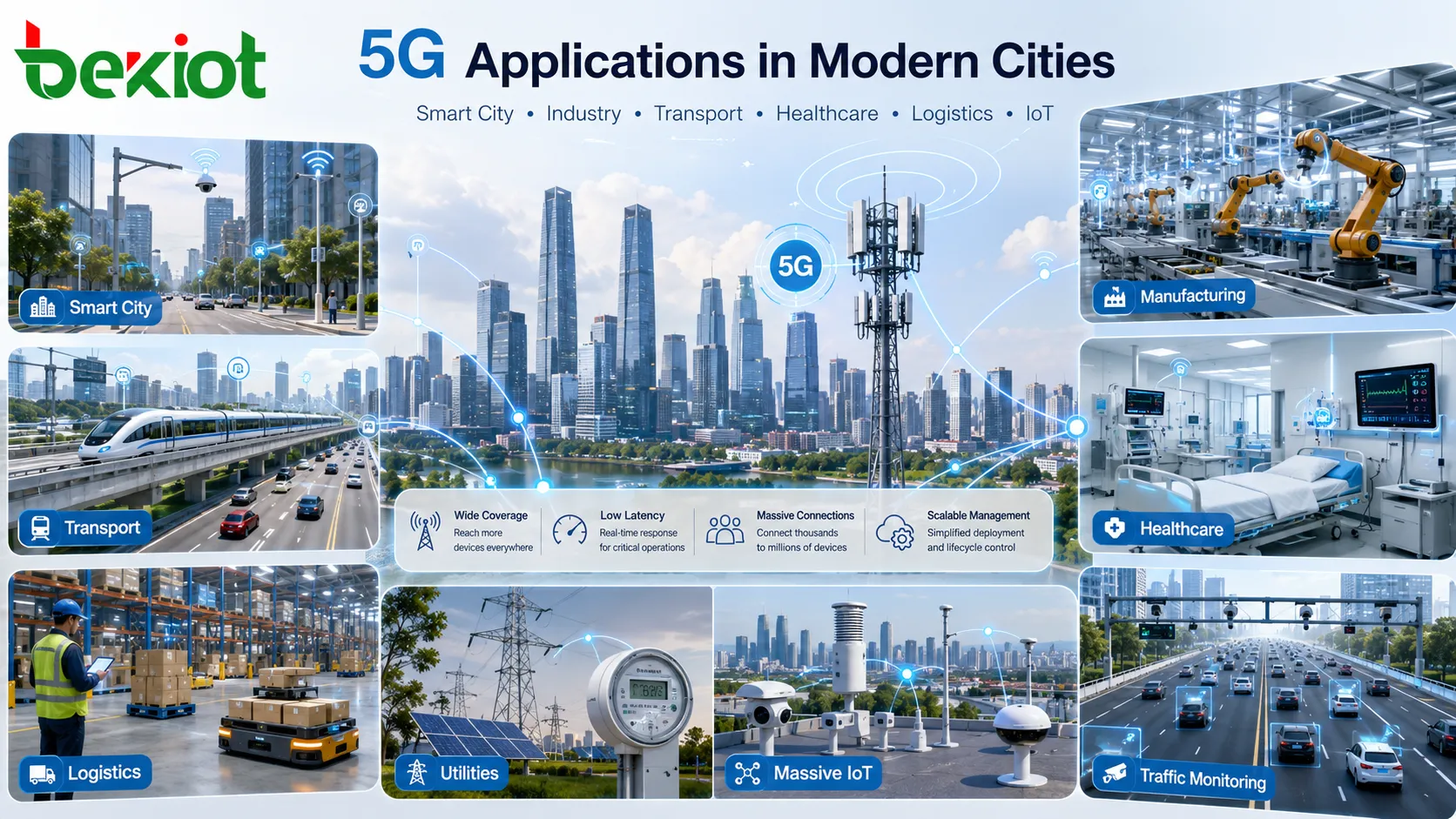
Factories, ports, mines, warehouses, utilities, and energy sites use private wireless systems for connected machinery, automated guided vehicles, industrial video, predictive maintenance, worker terminals, environmental monitoring, and wireless control. The appeal is strongest where mobility, coverage, security, and predictable performance are important.
Transport and logistics
Transport and logistics projects may use the network for fleet tracking, yard coordination, port automation, connected vehicles, rail-related communication, smart intersections, and real-time asset visibility. Large outdoor sites often benefit from using one wireless system to connect moving equipment, cameras, sensors, and handheld terminals.
Healthcare and public services
Hospitals, emergency response teams, public safety agencies, and municipal platforms can use mobile broadband and private network capabilities for field video, connected medical equipment, telepresence, situational awareness, and IoT services. These use cases depend on security and service priority as much as raw speed.
Smart cities and utilities
Smart lighting, metering, environmental sensing, traffic monitoring, infrastructure diagnostics, and grid-related IoT can all use wide-area wireless connectivity. In these cases, the main value is often scalable device management rather than high speed for each individual terminal.
Real deployments include mobile broadband, smart industry, transport, healthcare, utilities, and large-scale IoT environments.
How performance should be judged
Performance should not be judged by peak speed alone. Engineers also review user-experienced data rate, latency, reliability, mobility, area traffic capacity, connection density, uplink capability, coverage consistency, and service availability. These indicators explain why the same technology can support both consumer broadband and industrial applications.
Technical frameworks often reference peak downlink and uplink rates, low-latency targets, high connection density, and large area traffic capacity. These figures are useful for understanding the design direction, but they should not be treated as guaranteed performance in every commercial or private deployment.
Real results depend on spectrum width, frequency band, antenna design, cell loading, device capability, signal quality, backhaul, core placement, deployment model, and application architecture. For enterprise projects, acceptance testing should focus on the actual use case rather than general marketing numbers.
Performance Area
What It Means
Why It Matters
Throughput
Data rate available to users or devices
Important for video, fixed wireless access, cloud services, and large data transfer
Latency
Time required for data to travel through the service path
Important for control, robotics, AR, remote operation, and interactive applications
Reliability
Consistency of successful communication under defined conditions
Critical for industrial, operational, and mission-sensitive services
Device Density
Number of connected devices supported in an area
Important for IoT, smart city, utility, and sensor deployments
Mobility
Ability to maintain service while users or machines move
Useful for vehicles, AGVs, handheld terminals, rail, ports, and logistics yards
Service Control
Policy, priority, slicing, and traffic handling
Helps support different users and applications on one network platform
How it differs from earlier mobile networks
4G LTE was mainly optimized for mobile broadband and IP packet services. The newer generation adds a new radio system, a service-based core network, stronger support for cloud deployment, and better tools for handling different service requirements.
A standalone architecture also gives operators and enterprises more control over policy, slicing, traffic handling, and edge application integration. This is why the technology is often used not only for consumer mobile service, but also for private networks, industrial sites, and large-scale connected operations.
The difference is not only a faster air interface. It is a broader architecture that can be adapted for different business needs. A public operator may focus on coverage and mobile broadband capacity. A factory may focus on low-latency machine communication and local data control. A logistics park may focus on mobility, cameras, and asset tracking.
Common misunderstandings
Misunderstanding
Why It Is Incomplete
Better View
“It is only about speed.”
Speed matters, but capacity, latency, reliability, slicing, policy control, and device density also matter.
Evaluate the full service requirement, not only the peak data rate.
“A network icon means full capability.”
Some deployments still use non-standalone architecture and rely on 4G core infrastructure.
Check whether the network is NSA or SA and what services are actually enabled.
“Low latency is automatic.”
Latency depends on radio quality, transport, core placement, edge design, and application behavior.
Test end-to-end latency under real operating conditions.
“Performance is the same everywhere.”
Spectrum, coverage, device capability, network load, and architecture all affect results.
Assess performance by site, use case, and service level.
“Private and public networks are the same.”
They may use the same standards, but ownership, control, security, and service priority can be different.
Select the deployment model according to business and operational requirements.
Planning considerations for real deployment
A practical deployment should begin with use cases rather than technology slogans. The designer should identify whether the main requirement is mobile broadband, fixed wireless access, industrial automation, video uplink, IoT density, low latency, secure private access, or wide-area coverage.
The next step is to match the architecture to the requirement. NSA may be enough for improved broadband capacity. SA is more suitable when advanced service control, slicing, edge integration, or private network behavior is required. Spectrum choice, radio site planning, transport capacity, core placement, security policy, and device ecosystem should then be reviewed together.
For industrial and enterprise environments, proof-of-concept testing is often useful. Real machines, cameras, handheld terminals, routers, and control applications should be tested under actual site conditions. Wireless performance on a drawing does not always match what happens around metal structures, moving vehicles, high racks, tunnels, outdoor yards, or dense equipment areas.
Final view
5G is a complete mobile network system built from 5G NR, radio access infrastructure, transport connectivity, and a service-based core network. It supports faster broadband, lower-latency services, large-scale device connectivity, and more flexible service control than earlier mobile generations.
For consumers, it improves mobile broadband and wireless access. For enterprises, it can support private networks, edge applications, industrial mobility, connected machines, large-scale IoT, and operational communication. To evaluate it properly, engineers and decision-makers should look beyond the network icon and review the radio layer, core architecture, deployment model, spectrum, edge design, device capability, and real service conditions.
FAQ
What does 5G stand for?
5G stands for fifth generation mobile network technology. It follows earlier generations such as 4G LTE and is designed for higher capacity, lower latency, broader service flexibility, and large-scale device connectivity.
What are the main parts of the system?
The main parts are user equipment, the radio access network, transport connectivity, and the core network. Together, they provide device access, mobility management, data sessions, policy control, security, and service connectivity.
Is it only for smartphones?
No. Smartphones are only one use case. The technology can also connect routers, vehicles, sensors, cameras, gateways, industrial equipment, private enterprise networks, and IoT devices.
What is the difference between NSA and SA?
NSA uses 5G radio together with existing 4G core infrastructure. SA uses 5G radio together with the 5G Core. SA is generally considered the fuller architecture because it supports more native service control and advanced capabilities.
Does it always mean very low latency?
No. Low latency depends on the full network design, including spectrum, radio quality, transport, core placement, edge computing, and application architecture. The standard supports low-latency services, but real-world performance varies.
Can it be used in industrial sites?
Yes. Private and enterprise deployments are used in factories, ports, logistics parks, mines, utilities, and energy sites for automation, monitoring, industrial video, worker terminals, and connected machinery.
Why does standalone architecture matter?
Standalone architecture connects the radio network directly to the 5G Core. This provides better support for native policy control, slicing, edge integration, and enterprise-specific services than a non-standalone deployment.