What Does CE Marking Really Mean for European Product Compliance?
CE marking explained for European product compliance, covering legal scope, directives, conformity assessment, declarations, technical files, notified bodies, IP and ATEX differences, buyer checks and common mistakes.
Becke Telcom
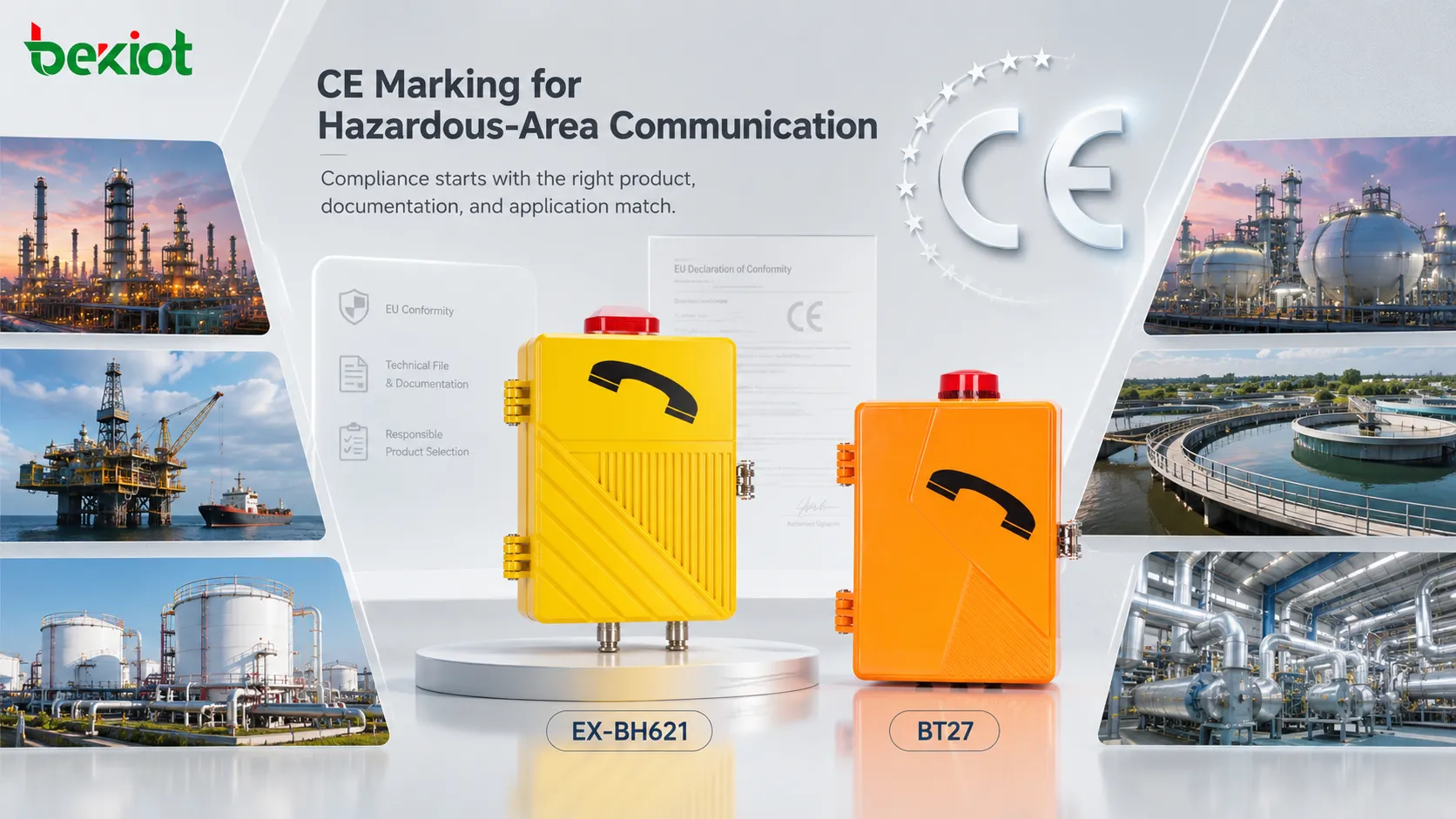
In international trade, many people use the phrase “CE certification.” In formal European product compliance, the more accurate term is CE marking. The CE mark indicates that a product covered by relevant EU legislation has been assessed against the applicable requirements before it is placed on the European Economic Area market.
This does not mean the product is automatically high-end, waterproof, explosion-proof, marine-grade, or approved by a government laboratory. It means the responsible manufacturer or economic operator has followed the required conformity route for the product category and takes responsibility for compliance.
For buyers, engineers, importers, and system integrators, the CE mark should be treated as a compliance starting point. It still needs to be checked together with the EU Declaration of Conformity, applicable standards, technical file, test reports, ratings, user instructions, and real installation conditions.
The CE mark indicates that a regulated product has followed the applicable EU conformity route before being placed on the EEA market.
Why the term is often misunderstood
The misunderstanding usually starts with the word “certification.” In everyday business language, it sounds as if every CE-marked product has been tested and approved by a third-party authority. That is not always the case. For many product categories, the manufacturer can complete the conformity assessment through internal production control if the applicable legislation allows it.
For higher-risk products or specific regulated categories, a notified body may need to be involved. The required route depends on the product type, risk level, directive or regulation, and conformity assessment module. This is why two products carrying the same CE mark may have very different compliance paths behind them.
A wireless industrial terminal, a power supply, a machine, a medical device, a construction product, and an ATEX-rated telephone may all carry CE marking, but they do not follow the same technical assessment process. The mark is common, while the legal and engineering basis behind it is product-specific.
Legal scope and market access
CE marking applies only to products covered by EU harmonisation legislation that requires it. If a product falls outside that scope, the CE mark should not be used. If a product is covered, the manufacturer must identify all applicable rules before placing it on the market.
Depending on the product, the relevant framework may include requirements for electrical safety, electromagnetic compatibility, radio equipment, machinery, pressure equipment, personal protective equipment, medical devices, construction products, ATEX equipment, or other regulated categories.
The mark helps qualifying products move more freely within the European Economic Area, but it does not remove the need for technical review. A product may be legally CE-marked and still be unsuitable for a specific industrial, outdoor, high-vibration, corrosive, hazardous-area, or washdown environment if its ratings and instructions do not match the project.
Rules, standards, and technical evidence
There is no single universal “CE standard.” The process begins by identifying the EU directive or regulation that applies to the product. Once the legal scope is clear, manufacturers normally select relevant harmonised European standards or another valid technical route to show conformity with the essential requirements.
Harmonised standards are developed by recognised European standardisation organisations such as CEN, CENELEC, and ETSI. Using them is generally voluntary, but it is one of the most practical and widely accepted ways to demonstrate conformity.
The manufacturer must also prepare technical documentation. This file may include product descriptions, drawings, risk assessments, test reports, calculations, bills of materials, software or firmware information, labeling details, user instructions, quality records, and evidence of compliance with selected standards.
Common Rule Area
Typical Products
Main Compliance Focus
Low-voltage electrical equipment
Power supplies, control devices, chargers, electrical terminals
Electrical safety, insulation, temperature rise, protection against hazards
Electromagnetic compatibility
Industrial electronics, control cabinets, telecom equipment
Emissions and immunity in the intended environment
Radio equipment
Routers, wireless sensors, gateways, radio terminals
Radio spectrum use, EMC, electrical safety, and radio performance
Machinery
Machines, automated systems, packaging equipment
Risk assessment, guarding, emergency stop, mechanical and electrical safety
Gas or dust zone suitability, Ex marking, temperature class, protection concept
Construction products
Building and infrastructure products under harmonised rules
Declared performance, durability, fire behavior, structural or acoustic properties
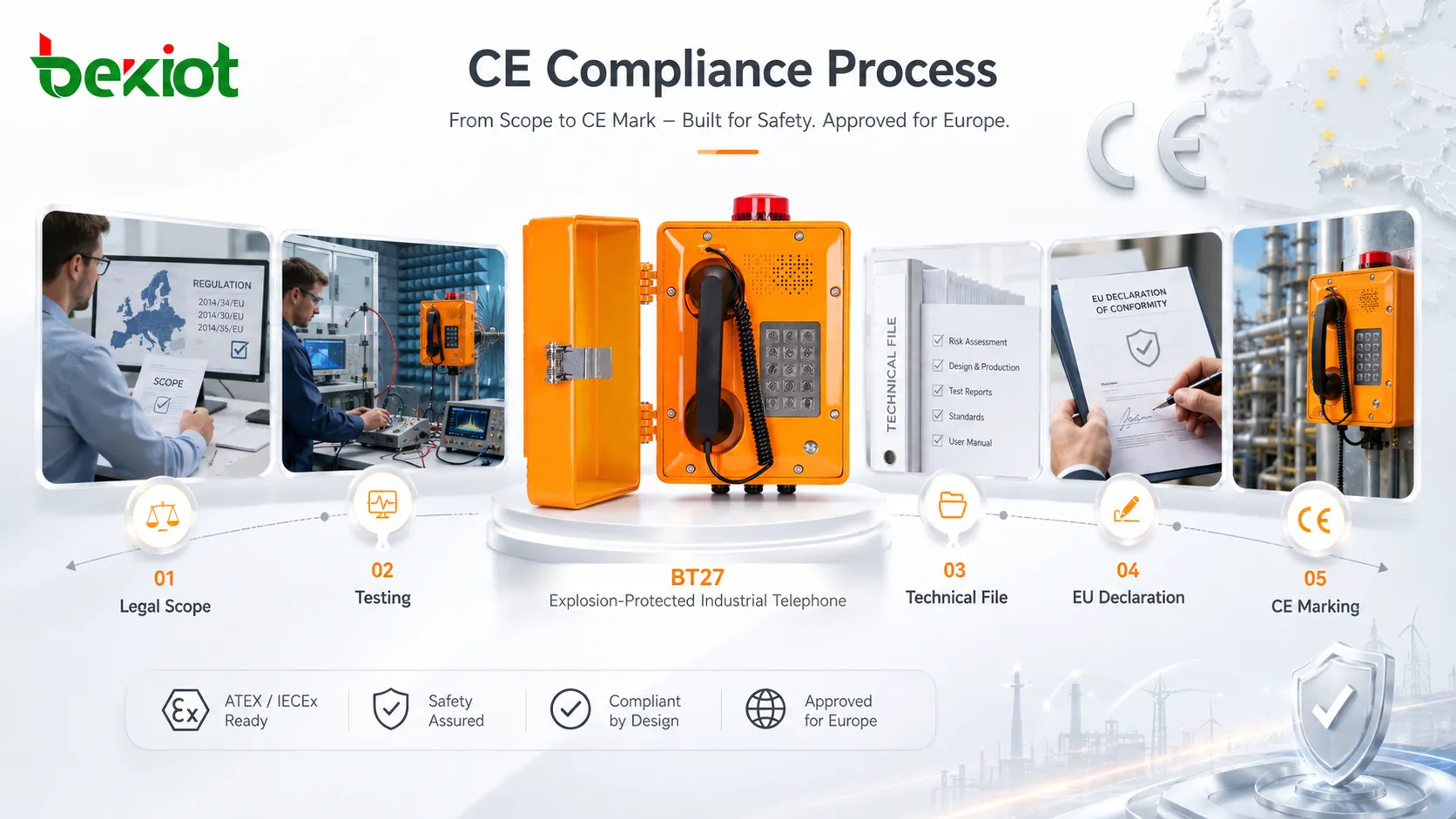
A practical conformity route
A practical CE route starts with one question: is the product legally required to carry the CE mark? If the answer is no, the mark should not be applied. If the answer is yes, the manufacturer must identify every applicable directive or regulation.
The next stage is technical assessment. This may involve electrical safety review, EMC testing, radio testing, mechanical risk assessment, software or firmware evaluation, material checks, thermal review, environmental testing, or hazardous-area assessment. The exact work depends on the product and its intended use.
When the assessment is complete, the manufacturer prepares the technical file and issues the EU Declaration of Conformity. This declaration identifies the product, manufacturer, applicable EU legislation, and the standards or technical specifications used to support conformity.
A practical conformity route moves from legal scope review and standards selection to testing, documentation, declaration, and final product marking.
Confirm whether the product is covered by EU legislation requiring CE marking.
Identify every applicable directive or regulation.
Select harmonised EN standards or another valid technical route.
Carry out risk assessment, design review, and required testing.
Prepare the technical file, user instructions, and labeling information.
Involve a notified body when the applicable legislation requires it.
Draft and sign the EU Declaration of Conformity.
Affix the mark visibly, legibly, and indelibly where required.
When a notified body is involved
A notified body is an organisation designated by an EU member state to carry out conformity assessment tasks under specific legislation. Its involvement is not automatic for every product. It is required only when the applicable law and conformity assessment procedure call for third-party participation.
Depending on the product category, the notified body may review the design, test results, quality system, production process, or product sample. For some higher-risk products, its identification number may appear near the CE mark. For many lower-risk products, no notified body is involved because the manufacturer is allowed to use self-assessment.
Buyers should therefore avoid assuming that a CE mark always means independent certification. A better approach is to request the Declaration of Conformity and supporting documents, then check whether third-party involvement is required for that product type.
What the mark proves and what it does not
The CE mark shows that the responsible economic operator has followed the required conformity route for the applicable EU rules. It also gives market surveillance authorities, distributors, importers, and buyers a common reference point when checking whether a product can be placed on the EEA market.
What it does not prove is equally important. It does not automatically mean the product is premium quality, independently tested, approved by the EU, made in Europe, waterproof, explosion-proof, corrosion-resistant, or suitable for every installation environment.
It Can Indicate
It Does Not Automatically Indicate
The product follows the required EU conformity route for its category.
The product is higher quality than competing products.
The manufacturer or responsible operator takes responsibility for conformity.
The product has always been tested by a notified body.
The product may be placed on the EEA market when all requirements are met.
The product is suitable for every industrial, marine, outdoor, or hazardous location.
A technical file and Declaration of Conformity should support the claim.
The mark alone confirms IP rating, ATEX suitability, EMC level, or impact resistance.
Protection ratings that are often checked together
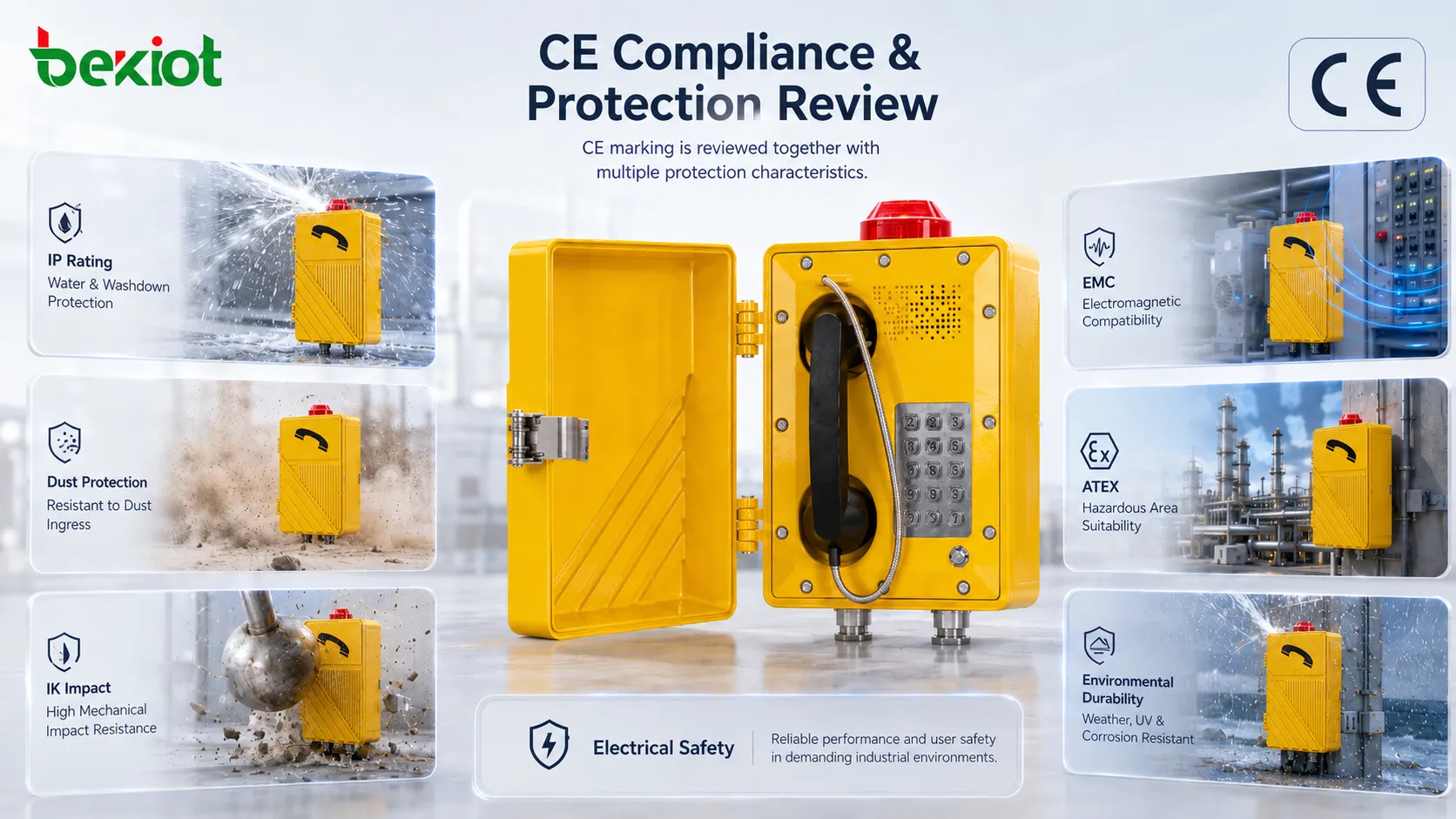
The phrase “CE protection rating” is misleading because CE does not contain one universal protection grade. Real protection characteristics come from the standards and tests that apply to the product. Engineers often need to review CE status together with IP rating, IK rating, EMC performance, ATEX marking, radio compliance, and environmental durability.
For example, an outdoor industrial communication terminal may carry CE marking and also have an IP rating under IEC 60529 for dust and water ingress protection. A rugged enclosure may use an IK rating for impact resistance. A wireless device may need radio equipment compliance. Equipment intended for explosive atmospheres may require ATEX marking and a specific Ex protection concept in addition to CE marking.
IP rating: dust and water ingress protection.
IK rating: mechanical impact resistance.
EMC performance: immunity and emissions behavior.
Electrical safety: insulation, creepage, clearance, and temperature rise.
Radio performance: spectrum use, wireless safety, and antenna-related requirements.
ATEX / Ex marking: suitability for explosive gas, vapour, mist, or dust atmospheres.
Environmental durability: temperature, vibration, humidity, corrosion, UV exposure, or washdown resistance where relevant.
In real procurement, the mark is normally reviewed together with IP, EMC, IK, ATEX, and other product-specific ratings.
Industrial procurement checks
Industrial buyers should not stop at the mark on the label. A product may be CE-marked and still be unsuitable for washdown areas, high-EMI sites, offshore decks, tunnels, ports, railway environments, or hazardous zones if its technical ratings do not cover those conditions.
A practical review should compare the product’s intended use with the project environment. For electrical devices, this may include voltage range, surge protection, insulation, EMC class, grounding, and operating temperature. For wireless devices, it may include frequency band, antenna configuration, radio approval scope, firmware control, and cybersecurity expectations. For hazardous-area products, it may include gas group, dust group, temperature class, equipment category, EPL, cable glands, and certificate conditions.
What to Check
Why It Matters
EU Declaration of Conformity
Identifies the product, manufacturer, legislation, and standards used.
Applicable standards
Shows which technical route supports the compliance claim.
Test reports
Help verify safety, EMC, radio, environmental, or performance claims.
Ratings and markings
Confirm IP, IK, ATEX, temperature, voltage, or other project-relevant limits.
User instructions
May define installation limits, warnings, maintenance rules, and safe use conditions.
Intended use
Prevents a product from being applied outside its assessed design scope.
Where regulated products are commonly used
CE-marked products appear across many industrial, commercial, infrastructure, and consumer sectors in Europe. The actual suitability depends not only on the mark, but also on the product’s design, standards, ratings, and intended use.
Electrical and electronic equipment
Power supplies, industrial controllers, operator panels, lighting products, chargers, telecom terminals, and control cabinets commonly require review under electrical safety and EMC rules. Engineers still need to check voltage range, enclosure rating, surge protection, installation method, and operating environment.
Wireless and networked devices
Routers, IoT terminals, industrial gateways, wireless sensors, IP communication devices, and remote-control units may fall under radio equipment requirements. In these projects, compliance is normally reviewed together with antenna configuration, firmware control, EMC performance, cybersecurity expectations, and environmental suitability.
Machinery and automated systems
Machines, motion systems, automated handling equipment, packaging machinery, and some integrated assemblies may need conformity assessment under machinery and safety rules. Real installations may involve guarding, emergency stop functions, electrical safety, manuals, technical files, and risk reduction measures.
Building and infrastructure products
Construction products covered by harmonised rules may use the mark to indicate conformity with declared performance. In building and infrastructure projects, buyers may also need to check fire behavior, weather resistance, structural performance, acoustic performance, and durability requirements.
Special and hazardous environments
Products used in petrochemical plants, tunnels, ports, transport hubs, outdoor industrial sites, or explosive atmospheres may require CE marking together with more specialised approvals such as ATEX. In these environments, the product must match the actual gas or dust group, temperature class, ingress conditions, corrosion exposure, and installation method.
How it differs from other approvals
CE marking is often mentioned together with ATEX, UKCA, UL, FCC, RoHS, ISO, and other approvals, but these terms do not mean the same thing. Some are legal market-access markings, some are technical approval systems, some relate to environmental restrictions, and others refer to management systems.
Marking or Certification
Main Meaning
CE
EU conformity marking for applicable regulated product categories.
ATEX
EU framework for equipment and protective systems used in explosive atmospheres.
UKCA
UK conformity marking for relevant products placed on the Great Britain market.
UL
Third-party safety certification commonly used for North American product acceptance.
FCC
U.S. regulatory framework for radiofrequency and electromagnetic emissions requirements.
RoHS
Restriction of certain hazardous substances in electrical and electronic equipment.
ISO
Often refers to management system standards, such as ISO 9001, rather than product market access by itself.
Manufacturers selling globally often manage several compliance tracks at the same time. A single industrial communication product may need CE marking for the EEA, UKCA for Great Britain, FCC for the United States, RoHS material compliance, and additional customer-driven tests for railway, marine, offshore, hazardous-area, or heavy-industry projects.
Common mistakes and better fixes
Mistake
Why It Is a Problem
Better Fix
Calling it a universal quality certificate
The mark relates to EU conformity, not general product grade.
Review the actual standards, test reports, and product ratings.
Assuming every product needs it
Only products covered by relevant EU legislation should carry the mark.
Confirm the legal scope before marking or purchasing.
Believing third-party testing is always required
Some products can use manufacturer self-assessment.
Check whether a notified body is required for that product category.
Treating it as waterproof or explosion-proof proof
Those properties require separate ratings or approvals.
Check IP, IK, ATEX, Ex marking, or other relevant technical evidence.
Ignoring the Declaration of Conformity
The label alone does not show which rules and standards were used.
Request the declaration and compare it with the product and application.
Applying a product outside its intended use
The conformity assessment may not cover the real installation condition.
Review the manual, ratings, environment, and project-specific risks.
How to judge whether a product is suitable
A suitable product review begins with scope. The buyer or engineer should confirm whether the product is required to carry the mark and which EU rules apply. If the product is not within a CE-marking category, the mark should not be used as a marketing decoration.
The second check is documentation. The EU Declaration of Conformity should identify the product clearly, name the applicable legislation, and list the standards or specifications used. Test reports, manuals, labeling, and technical ratings should support the same compliance story.
The third check is application fit. A product for an office environment may not be suitable for an outdoor industrial site. A CE-marked device may not be suitable for a hazardous area unless it also has the required ATEX or Ex marking. A wireless product may not be acceptable if its radio configuration or market variant does not match the destination country requirements.
Final view
CE marking is best understood as a legal conformity mark for regulated products in the European market. It helps show that the required EU compliance route has been followed, but it does not replace technical review.
For real projects, the mark should always be checked together with the EU Declaration of Conformity, applicable legislation, harmonised standards, test reports, protection ratings, installation environment, and any industry-specific approvals. This is the difference between seeing a symbol on a label and making a reliable compliance decision.
FAQ
Is CE certification the same as CE marking?
Not exactly. “CE certification” is a common business phrase, but the formal term is CE marking. Depending on the product and legislation, the conformity route may be based on manufacturer self-assessment, notified-body involvement, or a combination of both.
Does every product sold in Europe need CE marking?
No. CE marking only applies to products covered by specific EU harmonisation rules that require it. Products outside that scope should not carry the CE mark, although they may still need to meet other legal requirements.
Does the mark mean a product is waterproof or explosion-proof?
No. Waterproofing, dust protection, impact resistance, and explosion protection must be confirmed through product-specific ratings and approvals such as IP rating, IK rating, ATEX marking, Ex classification, or other relevant standards.
Who is responsible for compliance?
The manufacturer is primarily responsible for identifying applicable rules, completing conformity assessment, preparing technical documentation, issuing the EU Declaration of Conformity, and affixing the mark. Importers and distributors also have responsibilities when placing products on the market.
When is a notified body required?
A notified body is required only when the applicable legislation and conformity assessment procedure call for third-party involvement. This depends on the product category, risk level, and legal route used.
Can one product be covered by more than one rule?
Yes. Many products fall under several EU requirements at the same time. A wireless industrial terminal, for example, may need radio equipment compliance, EMC compliance, electrical safety review, and additional environmental or hazardous-area assessment depending on its intended use.